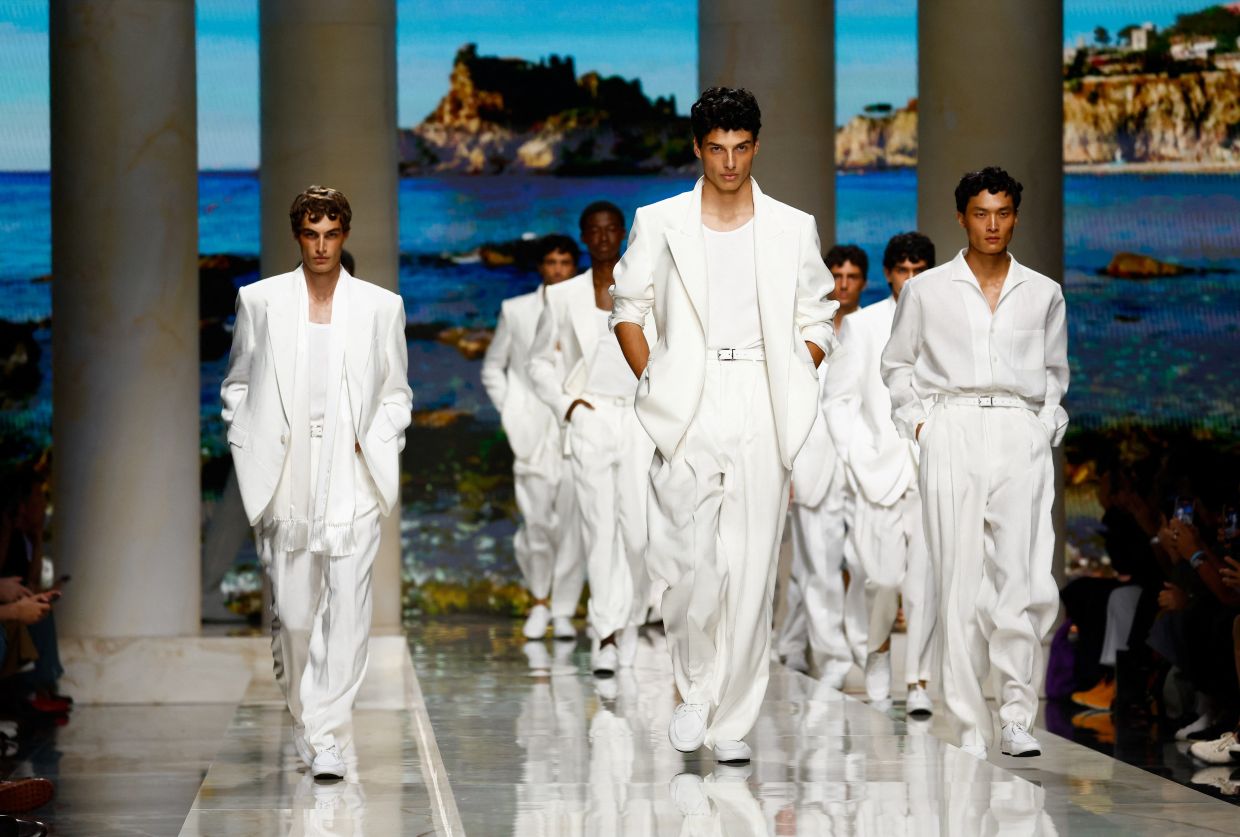
Milan's menswear designers have responded to an increasingly uncertain world by stripping collections back to basics, prioritising clean silhouettes and refined proportions over excess. Against the backdrop of economic instability, geopolitical tensions and the intense heat of Milan Fashion Week, the industry's leading creative minds converged on a shared philosophy: that modern menswear could communicate sophistication through subtraction rather than addition. The message resonated across the runway as the Spring/Summer 2027 menswear presentations closed on Monday, June 22, signalling a notable departure from the oversized, voluminous silhouettes that have dominated high fashion for several years.
Prada's co-creative direction from Miuccia Prada and Raf Simons epitomised this broader movement toward simplicity. Rather than introducing radical new forms, the Milanese house focused on reimagining familiar garments through innovative proportions and unexpected fabrication choices. This approach—championing the idea that incremental refinement can yield profound results—became a template that many peers would follow throughout the week. The philosophy represented a quiet but deliberate assertion that fashion's role in turbulent times was not to distract through spectacle, but to offer wearers a sense of grounded elegance and control. For Southeast Asian readers accustomed to tropical climates where heavy fabrics are already impractical, this shift toward rationality holds particular resonance.
Yet achieving summer dressing without sacrificing luxury presented designers with a genuine paradox. The runways became a study in contradiction: collections abounded with leather, knits and other traditionally warm materials, prompting observers to wonder whether Milan's elite were envisioning wardrobes for air-conditioned interiors, mountain retreats or cooler latitudes rather than authentic warm-weather living. This tension between aspiration and wearability underscored a fundamental truth about high fashion—that aesthetics sometimes triumph over comfort, and that luxury often demands certain compromises from its devotees. Nevertheless, designers deployed technical innovation to resolve the contradiction where possible, incorporating perforated and woven techniques that allowed leather to breathe whilst retaining its prestige associations.
Among the season's most significant trends was menswear's decisive pivot away from oversized proportions toward clothing that acknowledges and embraces the male body. After years when generous volume and exaggerated proportions represented the cutting edge, designers broadly agreed that tailored construction and a closer relationship between fabric and form would define the coming season. This represents not merely a cyclical return to fitted silhouettes, but a fundamental reassertion that the suit—properly constructed and thoughtfully proportioned—remains central to a man's wardrobe. The challenge, which dominated creative conversation throughout the week, concerned how to maintain formal standards whilst enabling movement and comfort in elevated temperatures.
Designers responded to this challenge through strategic ventilation. Dress shirts appeared unbuttoned, sometimes rendered in transparent fabrics, or were dispensed with entirely in favour of exposing the body beneath structured jackets. Long trousers persisted as a non-negotiable element of formal dressing, though with increasingly relaxed fits and closer silhouettes compared to recent seasons. Dolce & Gabbana pushed the boundaries of this new body-consciousness most aggressively, introducing microshorts that exposed muscular legs in ways previously uncommon on Milan runways, whilst other houses experimented with strategic torso exposure. The overall effect suggested a menswear landscape reassessing the relationship between formality and exposure, between traditional dress codes and contemporary attitudes toward the body.
Tailoring itself underwent significant evolution, with construction techniques lightening considerably without abandoning menswear's foundational commitment to structure and shape. Designers softened internal supports, opened necklines to enable greater airflow, and experimented with lighter-weight suiting fabrics and novel construction methods. The result was a new vocabulary of tailoring—one that maintained formality and visual coherence whilst genuinely addressing the physical demands of warm weather. Thom Browne, the American designer now operating under Zegna ownership, made a significant return to Milan for the first time since 2008, bringing collections that layered seersucker and pleated constructions traditionally associated with summer dressing. His presentation reinforced the broader message: formal menswear is evolving to meet contemporary needs, not disappearing into irrelevance.
This dominant aesthetic of restraint and reduction did not go unchallenged. Alongside the minimalist proposition championed by Prada and others, a secondary faction of designers defiantly embraced maximalism and conspicuous embellishment. Philipp Plein presented crystal-encrusted denim ensembles demanding days of meticulous handwork, whilst Dolce & Gabbana layered beaded accents evoking coral formations. These collections argued that luxury menswear could equally communicate status through ornament, craftsmanship and deliberate excess. The existence of these competing visions—restraint versus embellishment, reduction versus augmentation—reflected menswear's current cultural moment, where different aesthetic philosophies coexist without clear hierarchy, offering consumers genuine choice in how they wish to present themselves.
Milan's lighter official calendar this season created space for emerging creative voices to gain visibility alongside industry titans. Martin Quad made his Milan debut with tailoring innovations that had attracted attention in Copenhagen, bringing fresh perspectives on proportion and construction. Domenico Orefice showcased leather and richly textured weaves in collections designed for co-ed dressing, suggesting that gender distinctions in menswear may continue to soften. Japanese designer Shinya Kozuka, presenting his Shinyakozuka label in Milan for the first time, delivered what many observers identified as the season's most poetic summer vision: a bare-chested model beneath a billowing teal coat rendered entirely transparent, paired with voluminous white trousers. His collection suggested that summer menswear need not sacrifice poetry or visual drama even as it embraced proportion and restraint.
For Malaysian and broader Southeast Asian fashion consumers, Milan's Spring/Summer 2027 collections offer valuable validation that formal menswear can adapt to tropical realities without abandoning quality or sophistication. The emphasis on proportion over volume, the experimentation with breathable construction, and the growing acceptance of body exposure in formal contexts all align with the practical necessities of dressing well in consistently warm climates. Moreover, the season's intellectual focus on refinement through subtraction resonates with contemporary sensibilities about responsible consumption and meaningful design. As global uncertainty persists, Milan's designers have essentially argued that menswear's future lies not in spectacular reinvention but in thoughtful adaptation—making clothes that genuinely work for the lives people actually live.