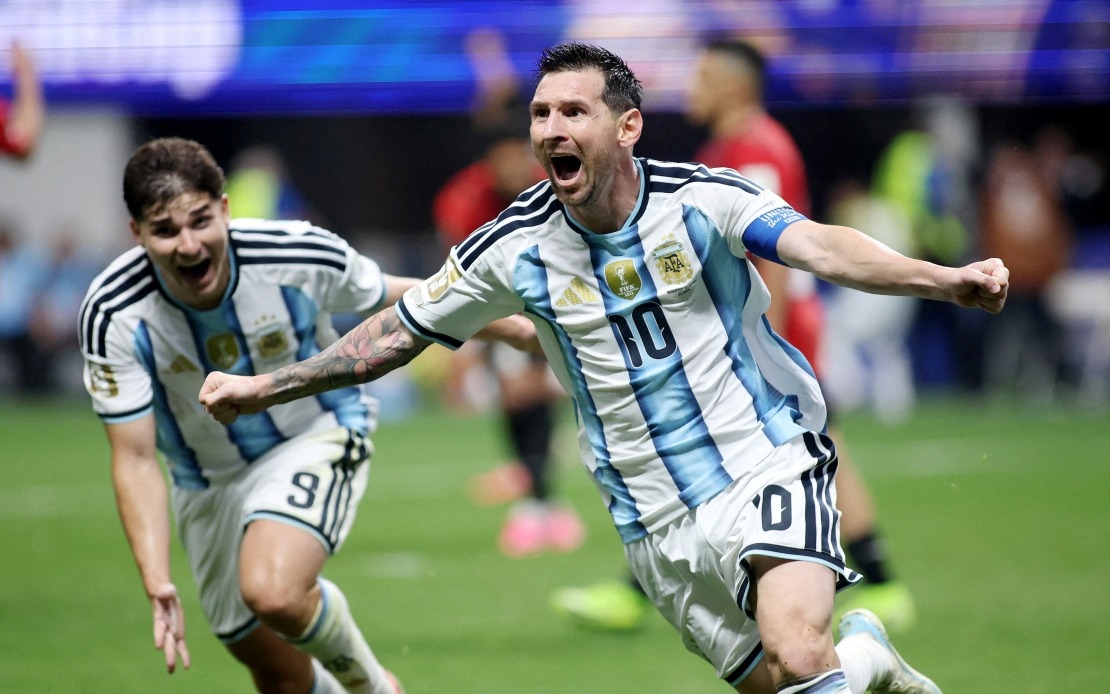
Lionel Messi arrives at another World Cup chapter at the age of 39 with his hunger for glory apparently undiminished, preparing Argentina for a crucial encounter against England in Atlanta on Wednesday. The Argentine maestro's continued presence on the world's biggest football stage defies expectations of retirement that seemed to settle after his triumphant 2022 campaign in Qatar, where he guided his nation to the coveted title while scoring seven goals, two of which came in the decisive final victory against France.
The 2022 World Cup victory in Qatar held profound significance beyond mere sporting achievement. That tournament represented what many observers believed would be Messi's final opportunity to secure the one major prize that had eluded him throughout his extraordinary career, and the squad's palpable determination to deliver the trophy before their talismanic leader's retirement underscored the emotional weight of that campaign. Yet the narrative has shifted dramatically. Rather than stepping aside, Messi has returned to World Cup competition and, remarkably, finds himself once again at the centre of Argentina's ambitions.
His current tournament form matches his status as one of football's greatest competitors. With eight goals already recorded in this summer's World Cup, Messi stands level with France's Kylian Mbappé atop the scoring charts. The competition for the Golden Boot has become a fascinating subplot within the larger tournament drama, with Mbappé holding a technical advantage through superior assist numbers and lower minutes-per-goal ratios. The intensity of their rivalry has captivated observers, particularly given that Mbappé denied Messi the Golden Boot award in Qatar despite scoring a tournament-defining hat-trick in the final on the losing side.
The supporting cast of elite scorers underscores the quality of finishing on display this summer. England's Harry Kane and Jude Bellingham both occupy the secondary tier with six goals apiece, while Erling Haaland's early elimination from contention has narrowed the field. The historical trajectory of Messi's World Cup scoring, however, demonstrates the exceptional difficulty of accumulating goals across multiple tournaments. His record of 21 World Cup goals places him in rarified territory, though Mbappé's current momentum suggests the French forward will inevitably surpass this benchmark and establish himself as the all-time leading scorer in World Cup history.
The context of Messi's scoring evolution across six World Cup campaigns reveals a competitor who adapts and intensifies rather than declines with age. His 2022 campaign proved particularly remarkable when measured against his previous participations. At 35 years old, he scored more goals in Qatar than he had accumulated across the preceding four World Cups combined, demonstrating that peak performance remains achievable even in later career stages. The 2014 tournament in Brazil, hosted by fierce rivals, yielded four goals, establishing that he could perform at the highest level on South American soil despite playing for a rival nation.
Messi's expanded World Cup appearance record places him alongside Cristiano Ronaldo as the first male players to contest six World Cup tournaments, a distinction that carries immense historical weight. Both have now surpassed Lothar Matthaus' previous record of 25 appearances, with Messi set to make his 33rd World Cup appearance against England, extending his lead over Ronaldo to six additional matches. This longevity at the elite level distinguishes both players from virtually every previous generation of footballers, whose careers rarely extended to such repeated tournament participation.
The trajectory of his goal-scoring across World Cup campaigns tells a story of evolving contribution rather than consistent output. His debut in 2006 yielded a single goal, while 2010 saw him return without finding the net. The 2014 tournament in Brazil represented a turning point where he demonstrated tournament-level impact, and 2018 showed measured contribution. However, the 2022 campaign fundamentally altered perceptions of his potential. The role of set-piece conversion featured prominently in that record-breaking campaign, with four of his seven goals arriving from penalties, though he also missed a spot-kick during that run.
The penalty-taking dimension of Messi's game has emerged as a more complex narrative than his general play might suggest. While he has demonstrated exceptional composure in World Cup penalty shootouts, succeeding in all three instances, his conversion rate from open-play penalties tells a different story. In this current tournament, he has already encountered setbacks, sending a penalty wide during Argentina's group-stage victory over Austria and seeing another saved by Egypt's Mostafa Shobeir in the knockout stage. These misses place his overall World Cup penalty record at four successful conversions from eight attempts, excluding shootout situations—a rate that contrasts with the perception of infallibility.
The broader context of Messi's 2006 World Cup participation adds another layer to his ongoing journey. As a 19-year-old substitute unused in Argentina's penalty shootout loss to Germany, he observed that defeat from the sidelines. The intervening years have witnessed a transformation from promising youth to tournament-defining force, with the 2022 victory finally delivering the championship that had defined his entire career narrative. His return this summer, therefore, represents not merely a continuation but a potential rewriting of the closing chapters of his football legacy.
For Malaysian and Southeast Asian observers, Messi's extended World Cup presence offers a compelling study in athletic longevity and mental resilience. The broader tournament dynamics reveal how elite players adapt across different eras of the game, with tactical evolution and physical demands varying substantially across the two decades spanning his World Cup participations. Argentina's campaign trajectory and Messi's individual performance metrics will ultimately determine whether he can secure that elusive second World Cup triumph and finally claim the Golden Boot award that remains conspicuously absent from his trophy collection.

