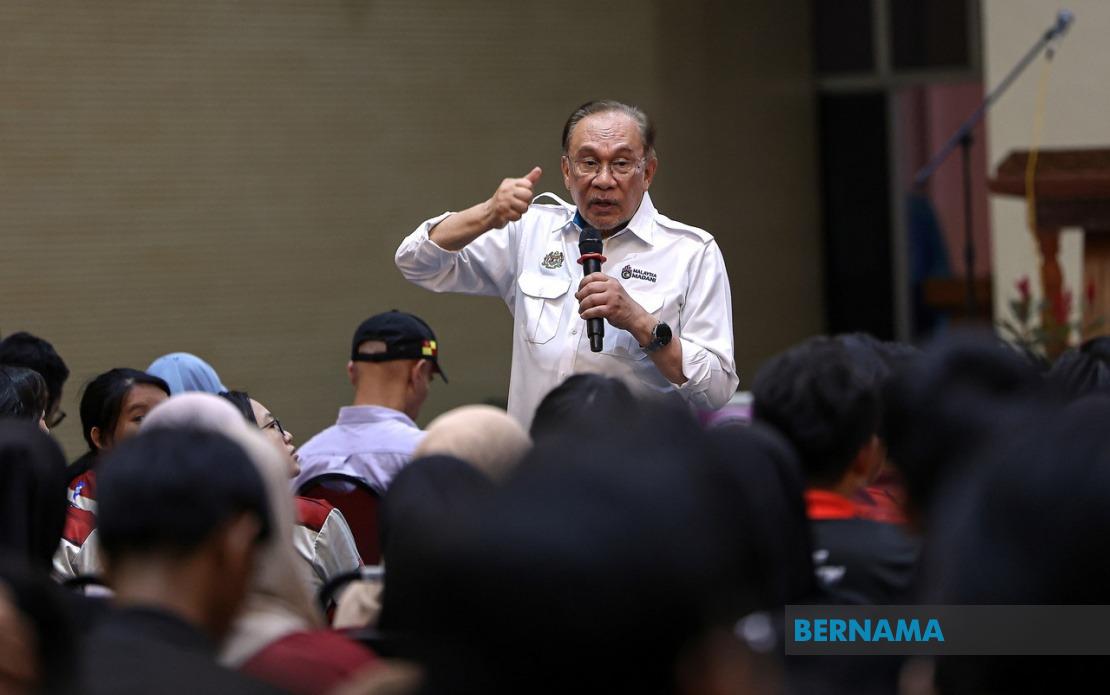
Prime Minister Datuk Seri Anwar Ibrahim has clarified the government's approach to matriculation admissions, emphasizing that educational access decisions reflect both academic performance and the need to support students from less privileged backgrounds. Speaking at a youth engagement programme in Seremban on July 22, the Premier outlined a system designed to uphold standards while addressing long-standing equity concerns across Malaysia's diverse student population.
Under the revised framework, students achieving the highest academic distinction at the secondary level face no barriers based on ethnicity. Those securing 10As in the Sijil Pelajaran Malaysia examination will receive automatic pathway offers into matriculation programmes, irrespective of their racial or ethnic background. This mechanism directly addresses concerns that merit-based advancement had been constrained by other considerations, signalling a shift towards recognising individual achievement as a primary gateway to tertiary preparation.
Simultaneously, the administration maintains the Bumiputera quota system, a foundational element of Malaysia's affirmative action architecture since independence. Anwar stressed that this provision accounts for demographic realities and geographical disparities that continue to characterise the nation. Students from rural and interior regions—including remote communities in Sabah and Sarawak—often face compounded disadvantages in accessing quality pre-university education, making targeted support mechanisms essential for genuine equity rather than mere formal equality.
The dual-track approach reflects broader tensions within Malaysia's education debate. Critics of quota systems argue they can suppress meritocratic advancement, while defenders contend that merit itself is shaped by prior opportunity. By guaranteeing pathways for top performers regardless of background whilst preserving provisions for structurally disadvantaged groups, the government attempts to navigate this divide. The policy suggests an implicit acknowledgment that both excellence and need are legitimate criteria for educational access.
For peninsular Malaysian students, the distinction between merit-based and quota-driven admission may appear more theoretical than practical, given that top academic achievers typically emerge from better-resourced schools concentrated in urban areas. However, for students in East Malaysia and rural regions, quota protections remain materially significant. The infrastructural gaps in educational provision mean that similarly talented students in disadvantaged areas may score lower simply due to teaching quality and resource disparities rather than innate ability—a reality the Bumiputera framework seeks to address.
The matriculation system itself occupies a crucial position within Malaysia's education hierarchy. As the primary public pathway to university entry, it shapes access to higher qualifications and thus career prospects across socioeconomic strata. Competition for matriculation places remains intense, with overall acceptance rates substantially below demand. Any adjustment to admission criteria therefore carries considerable weight for hundreds of thousands of families annually.
Anwar's comments were delivered during the "Jelajah Rakan Muda" initiative at the Youth and Sports Complex in Paroi, an engagement effort aimed at younger citizens. Youth and Sports Minister Dr Mohammed Taufiq Johari's presence underscored the government's positioning of education access as a youth policy priority. Such public statements signal intent to stakeholders while inviting feedback on implementation challenges as the system evolves.
The emphasis on balancing merit with need aligns with broader middle-ground positioning the administration has pursued on sensitive communal issues. Rather than dismantling affirmative action frameworks or embracing pure meritocracy, the approach seeks legitimacy by demonstrating responsiveness to multiple constituencies. Top-performing students gain confidence that excellence will be rewarded regardless of background, whilst members of disadvantaged communities receive assurance that structural barriers remain addressed.
Implementation will prove crucial, however. Clearly defining academic thresholds for automatic entry, ensuring transparent communication to prospective students, and monitoring whether the system actually expands opportunity for rural and lower-income cohorts will determine whether this framework delivers on its stated objectives. Malaysian educational institutions have historically struggled with bridging resource gaps that create disparate starting points for different student populations.
The matriculation pathway competes alongside other university entry routes, including the Unified Examination Certificate and direct entry through tertiary institutions. How these schemes interact under the revised approach remains to be clarified, particularly regarding whether merit and need considerations are calibrated consistently across different entry mechanisms. Such consistency will be essential if the policy is to achieve transparent, defensible outcomes.
For Southeast Asian observers, Malaysia's ongoing recalibration of education access reflects challenges common across the region. Balancing aspiration for inclusive growth with recognition that talent emerges unevenly due to prior inequality remains unresolved. The matriculation policy adjustment, therefore, offers a case study in how one major economy attempts to square this circle—and potentially informs similar debates in neighbouring countries grappling with analogous pressures.

