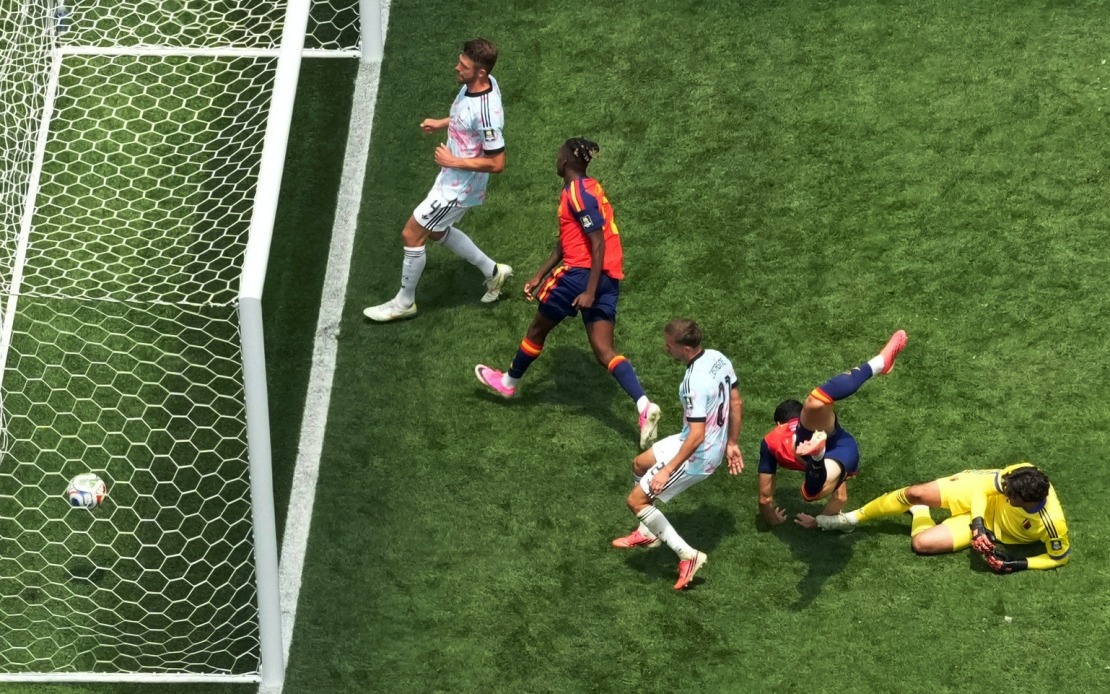
Mikel Merino delivered Spain's knockout punch in the dying moments of their quarter-final encounter with Belgium on Friday, securing a 2-1 victory at Los Angeles Stadium that propels the 2010 champions into the FIFA World Cup 2026 semi-finals. The midfielder's timely intervention echoes his impact in Spain's previous round, where he similarly netted the winning goal against Portugal, cementing his reputation as Luis de la Fuente's reliable finisher when matches hang in the balance. This latest achievement represents a watershed moment for Spanish football, marking their first appearance in the tournament's final four since their triumphant 2010 campaign—a 16-year absence that underscores the significance of Friday's result in Los Angeles.
Spain's path to this victory began promisingly, with the European side controlling possession and dictating the rhythm of play from the opening exchanges. Their attacking ambitions took tangible form when 18-year-old sensation Lamine Yamal threaded a curling attempt toward Belgium's goal in the 21st minute, only to see his effort drift agonisingly wide of the left post. The teenager's early involvement signalled Spain's intent to exploit their positional superiority, and their pressure soon translated into concrete advantage when midfielder Fabian Ruiz capitalised on a loose ball in the 30th minute. Belgian goalkeeper Thibaut Courtois had produced a crucial save moments earlier, denying winger Dani Olmo's shot, but the rebound fell perfectly for Ruiz to restore order in Spain's favour.
Courtois, the 34-year-old veteran between the sticks, subsequently emerged as Belgium's defensive bulwark, frustrating Spanish ambitions with a succession of important interventions. Within five minutes of Ruiz's opener, the experienced custodian stretched low to his right to keep out Yamal's free-kick, which had been targeted at the bottom corner with precision. His acrobatic saves maintained parity at a critical juncture, preventing Spain from extending their advantage. Yet despite Courtois's heroics, Belgium capitalised on a momentary lapse in Spanish concentration to level the contest in the 41st minute. Full-back Timothy Castagne's incisive cross from the right flank found forward Charles De Ketelaere unmarked, and the Belgian attacker's downward header sailed past Unai Simon, leaving the score level at half-time.
The second half unfolded with Belgium posing fresh attacking threats, most notably when full-back Maxim De Cuyper's effort whistled past the post ten minutes after the interval. However, Spain reasserted their dominance thereafter, with Courtois once again proving instrumental in denying further Spanish advancement. The Belgian goalkeeper produced consecutive saves within a minute—thwarting both Yamal and striker Mikel Oyarzabal—that appeared destined to preserve parity. Courtois's afternoon, however, would be curtailed by injury in the 71st minute, forcing his replacement by Manchester United goalkeeper Senne Lammens. This substitution proved consequential in determining the match's outcome.
Lammens's introduction coincided with Spain's intensifying assault on the Belgian goal, and the substitute goalkeeper was immediately tested. When centre-back Pau Cubarsi unleashed a long-range effort in the 88th minute, Lammens misjudged his positioning and spilled the ball directly into danger. Merino, demonstrating the predatory instincts that have defined his tournament contribution, reacted with admirable composure to pounce on the loose sphere and slam a poacher's finish past the goalkeeper. The goal arrived in the tournament's closing stages, leaving Belgium insufficient time to manufacture an equaliser and confirming Spain's progression to the semi-finals with dramatic flair.
Spain's advancement positions them for a mouth-watering semi-final encounter against France in Dallas on July 15, following the two-time world champions' methodical 2-0 elimination of Morocco on Thursday. This pairing represents one of international football's most compelling fixtures, pitting two nations with contrasting tournament trajectories and distinct playing philosophies against one another. France's passage through the knockout rounds has confirmed their status as formidable contenders, whilst Spain's resurgence under de la Fuente suggests a fresh generation capable of challenging the established European hierarchy.
The FIFA World Cup 2026 itself represents a transformative moment for global football administration. Jointly hosted by Canada, Mexico, and the United States, this edition shatters historical records by expanding to 48 participating nations—a significant increase from the traditional 32-team format that characterised World Cups since 1998. This expansion reflects football's exponential growth and the International Federation's commitment to broadening participation, though it simultaneously introduces logistical complexity and altered tournament dynamics compared to previous iterations. The expanded format necessitates modified group structures and knockout configurations, creating unprecedented scenarios that challenge teams' adaptability.
For Malaysian football enthusiasts observing from Southeast Asia, Spain's advancement carries broader implications for the tournament's competitive landscape. The presence of established European powers, emerging footballing nations, and unconventional contenders creates an unpredictable environment where traditional hierarchies face disruption. Spain's 2-1 victory exemplifies how matches between continental heavyweights remain delicately balanced affairs, decided by momentary lapses and individual brilliance rather than predetermined outcomes. Merino's decisive contribution reminds observers that tournament success frequently hinges upon squad depth, effective tactical substitutions, and the mentality to deliver under pressure—factors increasingly relevant as Southeast Asian nations develop their competitive frameworks.
The tournament's schedule indicates the semi-final stage approaches swiftly, with matches concluding by July 19. This condensed timeline reflects the expanded format's accommodation of additional participants whilst maintaining competitive momentum. Spain's remaining opponents, particularly France, represent formidable obstacles requiring sustained excellence and tactical discipline. De la Fuente's squad demonstrated sufficient resilience against Belgium to suggest genuine semi-final credentials, though the step up against France will present significantly heightened challenges requiring tactical sophistication and clinical finishing.

