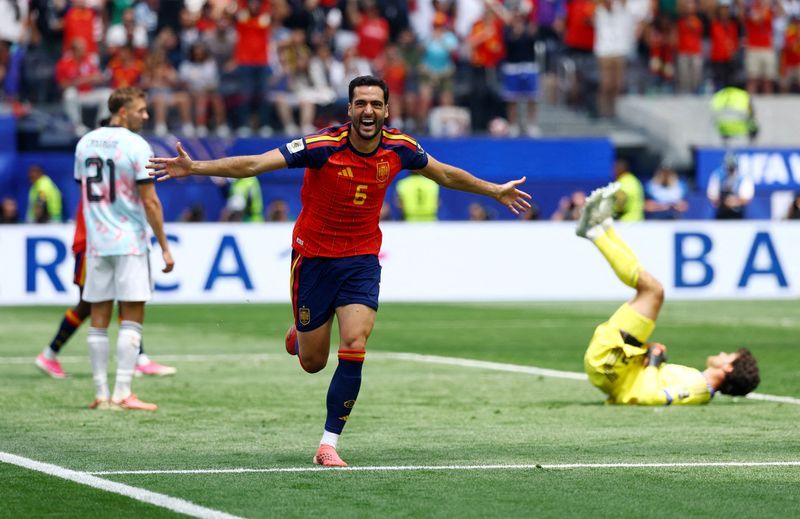
Spain has booked a spot in the World Cup semi-finals following a 2-1 victory over Belgium on Friday at Los Angeles Stadium, with the dramatic finish coming courtesy of substitute Mikel Merino's 86th-minute strike. The result sets up a tantalizing clash between the European champions and tournament favourites France in Dallas on Tuesday, with a berth in the final at stake. Spain's progression marks only their second appearance in the semi-finals since their triumphant 2010 campaign, reflecting the competitive nature of modern World Cup football and the difficulty of sustaining success at the sport's highest level.
Merino's finishing prowess in knockout matches has become a defining narrative of Spain's tournament run. The Athletic Bilbao midfielder has now become the first player in World Cup history to score the winning goal in two different knockout stage matches while coming off the bench, having previously netted the sole goal in Spain's last-16 victory over Portugal. His composed finish after Belgian goalkeeper Senne Lammens spilled a low drive from Pau Cubarsi exemplified the clinical finishing that separates elite teams from their challengers in tournament football. Reflecting on his crucial contribution, Merino observed that preparation and mindset play decisive roles in determining outcomes, suggesting that Spain's systematic approach to squad management and tactical flexibility have created opportunities for impact substitutes to influence results.
Belgium's evening was marred by injuries and goalkeeper misfortune that ultimately proved decisive. Thibaut Courtois, Belgium's primary keeper, suffered an injury during the warm-up period and was replaced by Senne Lammens for the match. The substitution left Belgium vulnerable in a critical fixture, as Lammens struggled with the pressure and composure required at this level of competition. Beyond the goalkeeping situation, Belgium's defensive resources were stretched by the absence of midfielder Amadou Onana, who sustained an anterior cruciate ligament injury during the round-of-16 victory against the United States. Captain Youri Tielemans compounded these problems when he picked up a warm-up injury shortly before kickoff, forcing Hans Vanaken into the starting lineup and further disrupting Belgium's planned approach.
The opening half saw Spain assert dominance through aggressive positioning and purposeful attacking play. Fabian Ruiz gave Spain the lead in the 30th minute, capitalizing on a loose rebound after Courtois produced an outstanding diving save. Ruiz's positioned effort threaded between defender Timothy Castagne's legs, rewarding Spain coach Luis de la Fuente's selection gamble to start the Paris Saint-Germain midfielder ahead of Pedri. The tactical decision demonstrated de la Fuente's willingness to experiment with his lineup based on specific matchup advantages. Belgium responded 11 minutes later through Charles De Ketelaere, whose perfectly timed run connected with Timothy Castagne's cross to equalize past Spain goalkeeper Unai Simon—marking the first goal Spain had conceded throughout the tournament.
The halftime stalemate reflected both teams' competitive intensity despite the sweltering conditions at Los Angeles Stadium. Spain emerged from the interval with renewed vigor and territorial control, progressively suffocating Belgium's attacking options through superior possession and movement. The introduction of 18-year-old sensation Lamine Yamal added an unpredictable attacking dimension that consistently troubled Belgium's defensive structure. Yamal's youthful exuberance and technical proficiency created consistent problems for the Belgian backline, forcing defenders into reactive positions rather than maintaining organizational discipline. Spain's control grew increasingly pronounced as the second half progressed, and the momentum clearly favored the continental champions.
Merino's introduction in the 86th minute proved transformative, though his breakthrough came through Belgium's technical failure rather than Spanish brilliance alone. When Lammens fumbled Cubarsi's straightforward ground-level strike, the ball presented itself invitingly in front of the Belgian goal area. Merino's positioning and reflexiveness allowed him to capitalize immediately, firing the ball past the exposed goalkeeper to secure Spain's advancement. The moment encapsulated how tournament football often rewards not only tactical superiority and technical excellence but also the capacity to punish opponents' errors when they materialize in critical situations.
Belgium's veteran leadership, spearheaded by Manchester City's Kevin De Bruyne and striker Romelu Lukaku, mounted efforts to restore parity following Merino's goal. Despite possessing players of substantial pedigree and experience, Belgium's injury-depleted squad lacked the cohesion and defensive solidity required to fashion clear scoring opportunities. The absence of key midfield reinforcements and a compromised goalkeeping position fundamentally undermined Belgium's ability to contest Spain's territorial dominance. While promising moments materialized, Belgium ultimately could not penetrate Spain's defensive organization or create the decisive final pass needed to unlock a well-organized defense.
Spain's progression carries significant implications for the tournament's trajectory and regional representation in the semi-finals. The European champions' advancement reflects the depth of quality within continental football and confirms expectations that established World Cup contenders would populate the latter stages. For Malaysian and Southeast Asian observers, Spain's success demonstrates how organizational coherence, tactical discipline, and squad depth determine outcomes in high-pressure environments—lessons applicable to regional development ambitions and the structural requirements for competing at elite levels. Merino's performance specifically highlights how impact substitutes, when properly trained and mentally prepared, can alter match trajectories through clinical execution.
Luis de la Fuente's tactical management throughout the Belgium encounter justified the confidence placed in him by the Spanish Football Federation. His willingness to deploy unconventional selections, maintain attacking intent despite defensive vulnerabilities, and manage the balance between established players and emerging talents created a framework for success. The coach's post-match remarks, acknowledging that France represented a worthy challenge while expressing confidence in Spain's preparation, reflected the realistic assessment of a team simultaneously confident and respectful of opposition quality. Spain's stated objective of capturing a second World Cup title within 14 years underscores the ambition driving their campaign and the belief that the squad possesses sufficient quality to navigate the demanding path to final victory.
The upcoming semi-final against France will test Spain's capacity to maintain coherence against a tournament favourite possessing exceptional attacking talent and tournament experience. The Dallas venue will provide a neutral environment where both teams can showcase their capabilities without home advantage influencing proceedings. Spain's route to this juncture has demonstrated an ability to grind out results, adapt tactically to opponent strengths, and capitalize upon moments of opposition vulnerability. Whether these qualities prove sufficient against France's combination of world-class individual talent and proven tournament pedigree will determine whether Spain's semi-final appearance becomes the foundation for another title triumph.

