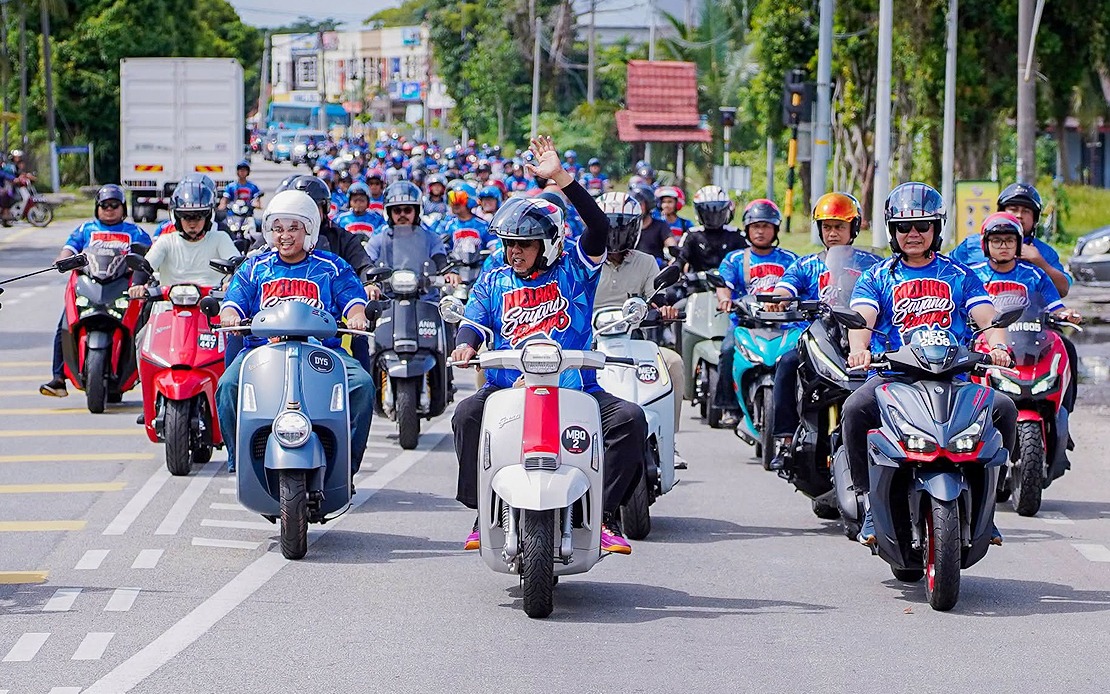
Melaka's Chief Minister Datuk Seri Ab Rauf Yusoh unveiled an expanded iteration of the Tangga Batu parliamentary WRUR programme this week, signalling the state government's commitment to sustained engagement with voters through community-based problem resolution rather than episodic political outreach. The two-phase initiative will extend across the Pantai Kundor and Paya Rumput state constituencies, representing a deliberate strategy to institutionalise grassroots responsiveness as a core governance function rather than a temporary campaign mechanism.
The scope of the expanded programme is ambitious, encompassing more than 200 distinct initiatives spanning welfare assistance, community development projects, educational support, youth engagement, and entrepreneurship promotion. This breadth reflects a recognition that electoral sustainability depends on addressing the multifaceted concerns affecting residents across different age groups and economic circumstances. By bundling diverse programme categories under a single umbrella framework, the state administration presents a cohesive narrative of comprehensive governance attention to local priorities.
Crucially, the Chief Minister framed WRUR not as a novel initiative or a time-limited promotional exercise, but rather as an evolution of continuous ground engagement conducted over the preceding two years. This positioning attempts to establish institutional legitimacy and demonstrate consistency in governance approach, suggesting that community complaint management and resolution mechanisms have become permanent features of how Melaka's state administration operates. The rhetorical emphasis on continuity carries political significance, as it counters any perception of episodic or purely electoral attention to constituent concerns.
The track record presented by the Chief Minister provides quantifiable evidence of the programme's effectiveness. Through 23 previous implementation series, the initiative had accumulated more than 4,000 registered complaints, with nearly 70 per cent successfully resolved. This resolution rate—while respectable—also indicates that approximately 30 per cent of complaints remain unresolved, a figure that warrants scrutiny regarding whether underlying infrastructure deficiencies or bureaucratic bottlenecks impede complete problem resolution. For Tangga Batu specifically, previous phases across the Sungai Udang and Kelebang constituencies had generated 359 complaints, of which 328 were resolved whilst 31 remained under follow-up.
The financial dimension of the programme reveals the state government's willingness to deploy immediate material assistance to affected populations. During the sixth phase, more than RM150,000 in direct aid was distributed across various beneficiary groups. The itemised breakdown demonstrates targeting specificity: fishermen received RM22,000 across 220 individuals, whilst boat owners affected by recent sinking incidents were provided RM1,500, and small and medium enterprise operators received RM14,000 in business equipment support for ten entrepreneurs. Beyond these economic assistance categories, resources extended to religious education institutions, places of worship, students requiring financial support, and homeowners facing economic hardship.
The recent flooding in Pantai Kundor, which damaged 73 residential properties, illustrated how the programme can respond to environmental emergencies and infrastructural vulnerabilities. The Department of Irrigation and Drainage allocated RM50,000 for cleaning and maintenance work at Sungai Seberang Gajah, with completion scheduled within days of the announcement. This rapid response mechanism suggests that WRUR programmes incorporate disaster mitigation and environmental management as core competencies rather than peripheral concerns.
Infrastructural enhancement constitutes another critical dimension of the expanded initiative. Beyond immediate flood remediation work, the Department of Irrigation and Drainage had initiated procurement procedures for comprehensive improvement works at Sungai Lereh valued at RM100,000. More significantly, the Public Works Department had submitted federal approval applications for a RM16 million project to upgrade the crossing culvert structure on Jalan Tangga Batu-Tanjung Minyak, indicating that the programme generates diagnostic assessments of local infrastructure deficiencies and translates them into major capital projects requiring higher-level government endorsement.
For Malaysian readers across other states, the Melaka model presents both replicable institutional approaches and cautionary lessons regarding programme sustainability and effectiveness. The emphasis on complaint documentation and resolution metrics introduces accountability mechanisms that enhance transparency, yet the 30 per cent unresolved complaint rate suggests systemic constraints that merit investigation. The integration of immediate relief assistance with longer-term infrastructure projects reflects a layered intervention strategy addressing both symptom relief and structural remediation.
The programme's sophistication lies in its deliberate construction of multiple engagement touchpoints—complaint channels, aid distribution, skills development, and infrastructure project development—that collectively create institutional structures for sustained community-government interaction beyond electoral cycles. Whether such mechanisms generate genuine institutional change or represent sophisticated political management techniques will become apparent through monitoring of complaint resolution patterns, infrastructure project completion timelines, and the extent to which programme beneficiaries experience tangible improvements in local service delivery and community conditions.

