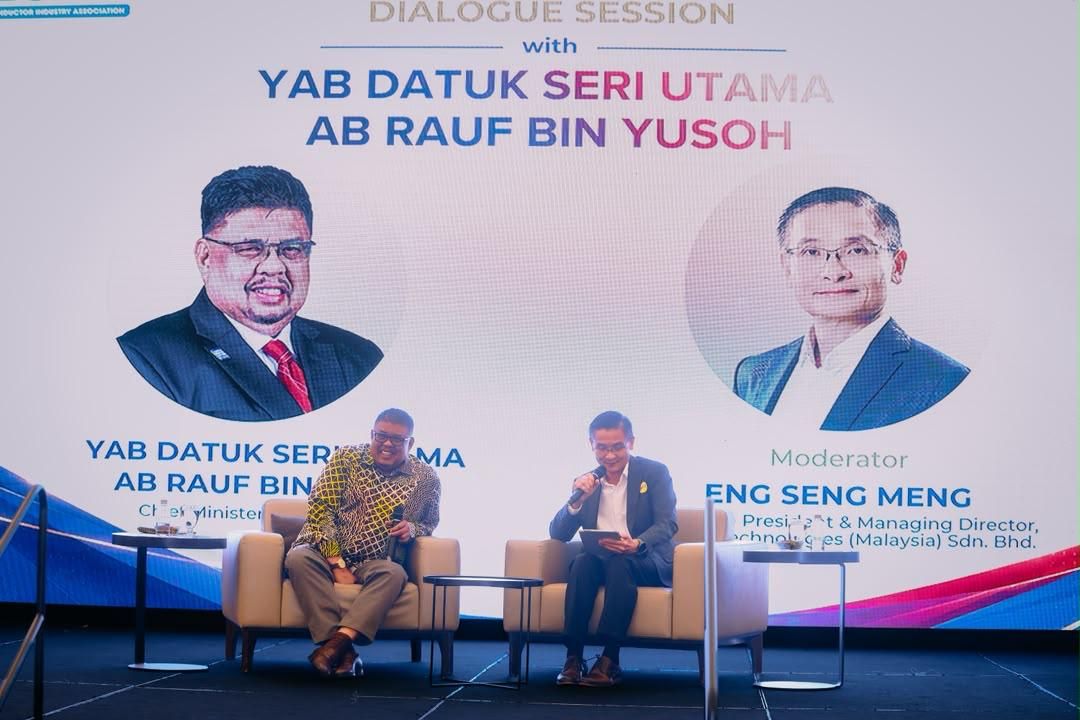
Melaka's semiconductor sector has matured into a RM17.6 billion economic powerhouse, according to Chief Minister Datuk Seri Ab Rauf Yusoh, representing one of Malaysia's most significant industrial transformation stories. What originated as a tentative venture by an international manufacturer during the early 1970s has evolved into a globally competitive cluster, employing generations of workers and underpinning the state's prosperity.
The industry's genesis traces to a pivotal investment decision made when Melaka possessed neither advanced industrial infrastructure nor established electronics manufacturing expertise. A foreign company initially operated from an Umno building on Jalan Hang Tuah before relocating to Batu Berendam after the state established its first Free Industrial Zone in 1976. This relocation marked a turning point, enabling the company to expand operations and attract complementary investments that would eventually transform the region into a sophisticated manufacturing hub.
Today, the semiconductor sector underpins Melaka's broader industrial economy, which now contributes 36.1 percent of state gross domestic product. Beyond semiconductor manufacturing specifically, the state hosts more than 400 manufacturing enterprises spanning 18 distinct industrial sectors. This diversification reflects how initial success in semiconductors catalysed broader industrialisation, creating ecosystems where local suppliers, engineering firms, and service providers established themselves to serve multinational anchors and each other.
The human dimension of this industrial achievement extends far beyond aggregate statistics. Over five decades, the semiconductor cluster has supported not only the multinational corporations that pioneered operations here, but also generated livelihoods for thousands of skilled workers, technicians, and their families. The industry created what Ab Rauf characterised as "high-value employment opportunities," establishing a professional class that has contributed to Melaka's rising living standards and prosperity relative to earlier decades.
Melaka's enduring appeal to global semiconductor manufacturers reflects three distinct competitive advantages. First, its geographical position between Kuala Lumpur, Johor, and Singapore provides unparalleled logistical connectivity to major markets, ports, and airports while offering proximity to Singapore's upstream design and research ecosystem. Second, the state maintains competitive operational costs including land, labour, and utilities, preserving affordability advantages that newer industrial locations struggle to match. Third, Melaka has cultivated institutional capacity through 61 technical and vocational institutions producing industry-ready graduates whose skills align with evolving manufacturer requirements.
The continued confidence of multinational enterprises headquartered in the United States, Germany, China, Japan, and elsewhere underscores the stability and reliability investors perceive in Melaka's business environment. Many corporations have maintained and expanded operations throughout their entire presence in the state, suggesting satisfaction with regulatory predictability, infrastructure quality, and workforce productivity. This longevity contrasts with more volatile investment climates elsewhere, positioning Melaka as a destination for manufacturers seeking long-term operational certainty.
Recent investment momentum validates this positioning. Melaka recorded RM14.68 billion in total investments across 312 projects during 2025, the highest annual investment value in 22 years. This surge suggests that manufacturers, despite global supply chain uncertainties, remain convinced of the state's capacity to support expansion and deliver returns on capital investment. The acceleration may also reflect competitive positioning ahead of anticipated regional trade and technology shifts that could reshape semiconductor manufacturing geography across Southeast Asia.
However, Ab Rauf articulated a cautionary narrative regarding complacency. The semiconductor industry, characterised by rapid technological change and intense international competition, forces manufacturers to make investment decisions today that will determine technology location and supply chain architecture for decades. If Melaka responds sluggishly to evolving industry requirements—such as advanced packaging capabilities, sustainability standards, or digital manufacturing integration—multinational enterprises may redirect investments toward jurisdictions offering faster approvals, superior technical capabilities, or greater operational certainty. Such diversification, while reducing concentration risk for global manufacturers, would constrain Melaka's growth prospects.
The risks of underperformance extend beyond direct manufacturing investment. Supporting industries including logistics, engineering services, materials supply, and technical training would face contraction if anchor manufacturers relocated operations or reduced expansion plans. Local small and medium enterprises that have integrated into semiconductor supply chains over decades would lose market access and struggle to redeploy assets. Thousands of skilled workers would face employment uncertainty, particularly those with specialised technical training limited in applicability beyond semiconductor contexts.
To sustain momentum, Melaka has articulated the Semiconductor Strategy 2035, positioning the state for the next industrial phase. Rather than relying solely on infrastructure and fiscal incentives—conventional tools that competitors can replicate—the strategy emphasises cultivating distinctive capabilities that are difficult to replicate elsewhere. This includes deepening technical talent pipelines, modernising production facilities toward advanced processes, and potentially establishing centres of excellence in specialised semiconductor functions where Melaka can claim genuine differentiation.
Government commitment to facilitating investment constitutes another element of the competitive proposition. Beyond establishing regulatory frameworks, Ab Rauf indicated that state administration would expedite approvals, resolve operational obstacles, and provide sustained support throughout project lifecycles. This proactive facilitation model contrasts with purely permissive regulatory approaches, positioning government as an active partner in investment success rather than merely a licensing authority. Such engagement can prove decisive when manufacturers evaluate competing jurisdictions with comparable fundamental advantages.
Melaka's semiconductor trajectory offers instructive lessons for other Malaysian regions pursuing industrial transformation. Initial success requires accepting modest beginnings, tolerating patient capital, and understanding that industrial clusters emerge through incremental investment accumulation rather than sudden establishment. Once foundational advantages coalesce—infrastructure, talent, investor confidence, and supply ecosystem density—competitive positions become self-reinforcing, attracting complementary investments and creating virtuous cycles. Yet this advantage persists only through continuous adaptation to evolving industry requirements and competitive pressures from emerging alternatives throughout Southeast Asia and globally.

