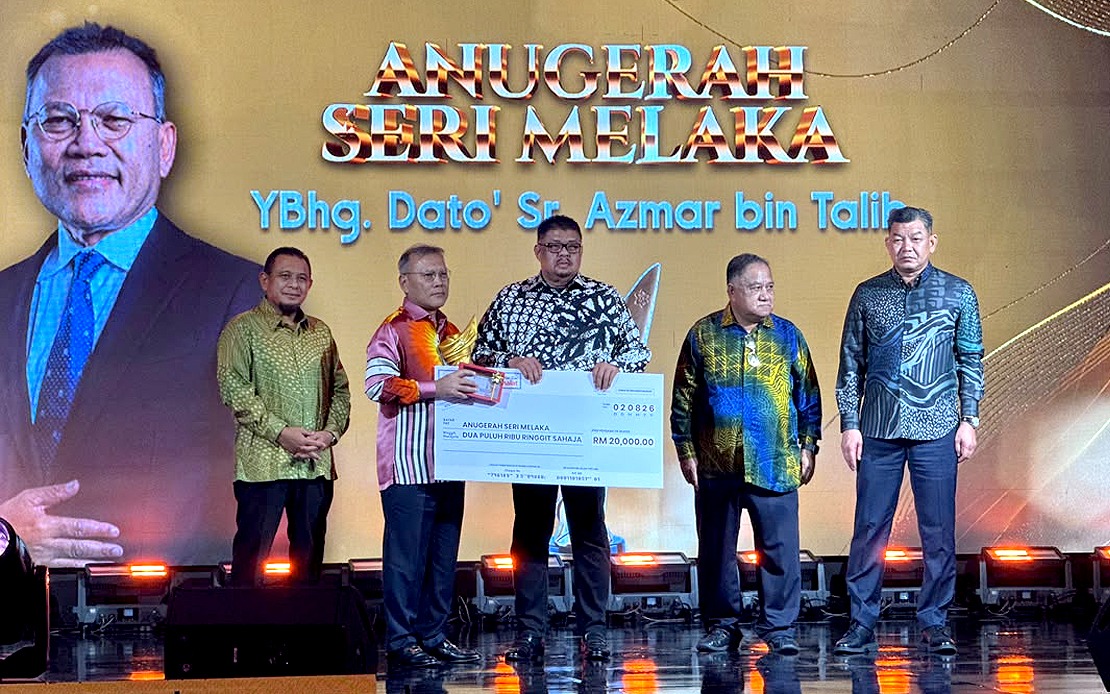
Melaka's Chief Minister Datuk Seri Ab Rauf Yusoh has called on the state's accomplished professionals and entrepreneurs to become active partners of the state government, channelling their accumulated knowledge and influence toward nurturing the next wave of talented individuals. Speaking at the Anugerah Seri Melaka (ASM) Gala Night held at the Melaka International Trade Centre in Ayer Keroh, Ab Rauf emphasised that personal success among Melaka natives should transcend individual achievement and instead become a catalyst for broader state development.
Central to this vision is the Melaka Sayang Rakyat (MeSRa) initiative, a state-backed programme designed to document and publicise the accomplishments of successful Melakans across multiple sectors. Rather than allowing their achievements to remain confined to personal records, the state government intends to convert these narratives into motivational blueprints that inspire younger citizens to pursue ambitious careers and contribute meaningfully to the state's economic and social fabric. This approach reflects a growing recognition that established figures carry considerable influence in shaping aspirations among emerging talent.
The Chief Minister articulated a compelling long-term vision centred on creating a cycle of success that benefits successive generations. He suggested that when one Melakan's triumph opens doors for others, it strengthens the collective resilience of the state and builds institutional memory of excellence. This generational approach to talent development marks a shift from treating success as individual attainment to viewing it as a responsibility to lift others within the same geographic and cultural community.
The ASM awards programme itself operates across four distinct categories designed to recognise excellence in diverse fields. The Public Service category honours those who have served through government roles, while the Corporate category celebrates business leaders and entrepreneurs. The Sports and Arts and Culture categories round out the framework, ensuring that achievement is celebrated across both economic and social dimensions. This breadth reflects an understanding that state advancement depends on talent flowering across multiple domains rather than concentrating in a single sector.
The response to the inaugural awards exceeded expectations, with the state government receiving more than 200 nominations. Each submission carries weight, according to Ab Rauf, as nominations typically encapsulate the personal journey of candidates—stories built on discipline, personal sacrifice, and long-term commitment. The scale of nominations itself suggests that Melaka harbours considerable untapped talent, and that many individuals have indeed established themselves across various professional landscapes.
The winners announced at the ceremony represent the breadth of achievement the state seeks to highlight and leverage. Datuk Azmar Talib, chief executive officer of TRX City Sdn Bhd, claimed the Corporate category award, recognising his leadership in a major commercial venture. Aaron Chia, a national badminton player, received the Sports category honour, embodying athletic excellence at the highest levels. Performing arts director Lokman Abd Ghani earned recognition in Arts and Culture, reflecting the value placed on creative sectors, while Datuk Zamri Misman, director-general of the Legal Affairs Division at the Prime Minister's Department, won the Public Service category, demonstrating Melaka's contribution to federal governance.
The Special Category award went to Dr Saiful Anuar Singar, an international medical science researcher, indicating the government's recognition that breakthrough achievements in knowledge creation and scientific advancement deserve particular acknowledgement. This inclusion suggests that Melaka-based professionals working at global standards in fields such as medical research are emerging as ambassadors for the state's intellectual capacity.
Financial incentives accompanying the awards underscore the state government's seriousness in recognising and motivating excellence. The overall ASM award recipient receives RM20,000 in cash alongside a trophy, while category winners each receive RM10,000 and a trophy. While modest in absolute terms, these prizes serve primarily as symbols of state validation rather than substantial financial rewards, reflecting their true purpose as recognition mechanisms.
For Malaysian readers and policymakers across Southeast Asia, the Melaka model offers an intriguing governance experiment. Rather than attempting to directly manufacture success through industrial policy or tax incentives alone, the state is adopting a softer power approach—using recognition, platform access, and official validation to encourage high performers to invest their social capital in state development. This strategy acknowledges that mentorship and network access often matter as much as formal credentials in enabling younger talent to advance.
The initiative also addresses a persistent challenge in Malaysia's smaller states: brain drain. When accomplished individuals are publicly honoured and given platforms to contribute back to their home state, the psychological barriers to return or reinvestment may diminish. For professionals working in Kuala Lumpur or abroad, designation as an ASM recipient could provide compelling reason to direct resources, attention, or networks back toward Melaka-based ventures and mentoring relationships.
The emphasis on documentation and knowledge-sharing through MeSRa distinguishes this from mere awards ceremonies. By systematically capturing how successful individuals built their achievements, the state creates reference materials for younger people navigating similar career paths. This approach transforms individual success stories into educational resources—a practical toolkit showing what works in contexts familiar to Melaka's younger cohorts.
Looking forward, the programme's success will depend on translating recognition into sustained mentoring relationships and tangible opportunities. If awarded individuals genuinely become engaged in guiding younger professionals, facilitating introductions, or investing in new ventures, the initiative could catalyse measurable improvements in youth employment and entrepreneurship across the state. Conversely, if the awards remain ceremonial, their motivational impact will diminish after the initial announcement period.

