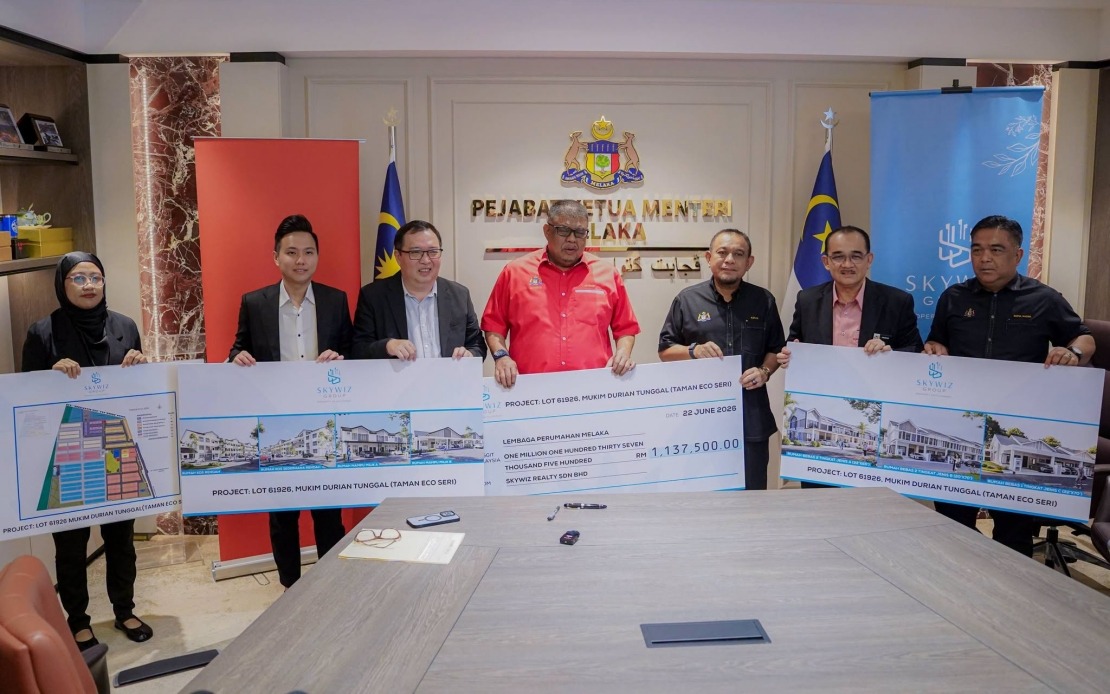
Melaka's Chief Minister Datuk Seri Ab Rauf Yusoh has signalled a significant shift in the state's property development standards, urging private developers to prioritise lift installations in multi-storey shoplots and residential buildings as a means of broadening market appeal and ensuring equitable access for all residents. Speaking following the execution of an affordable housing agreement in the state capital, Ab Rauf reframed lift facilities as a fundamental necessity rather than a premium amenity, reflecting growing recognition among policymakers that accessibility directly influences purchasing decisions and long-term property values.
The timing of this intervention addresses a tangible problem that has plagued Melaka's property sector. Across established precincts such as Kota Laksamana, Banda Hilir, and Melaka Raya, numerous multi-storey developments remain stalled on the market, with inadequate vertical transportation emerging as a critical barrier to sales. For elderly buyers, families with young children, and individuals with mobility challenges, the absence of lifts in buildings exceeding two storeys presents not merely an inconvenience but a practical impediment to occupancy. Ab Rauf's observations underscore how infrastructure gaps can suppress real estate demand, even in otherwise desirable locations, and how remedying such deficiencies could unlock value for both developers and prospective homeowners.
The Chief Minister indicated that policymakers are moving toward formative regulation, proposing the introduction of mandatory lift requirements for all proposed shoplots and three-storey residential developments. This represents a departure from the current voluntary approach and would establish minimum accessibility standards across new projects. The regulatory framework would apply prospectively to newly approved developments, establishing a baseline that developers must meet during the design and construction phases. Such a policy would align Melaka with international building standards that increasingly recognise accessibility as integral to modern housing rather than an optional upgrade, potentially positioning the state as a progressive jurisdiction within Malaysia's property development landscape.
The accessibility imperative resonates particularly strongly given Malaysia's ageing demographic profile. As the population ages, the proportion of residents requiring barrier-free environments will expand substantially over the coming decades. Properties designed without lift access inevitably lose appeal as occupants age in place, creating a mismatch between housing stock and resident needs. By embedding lifts into new developments now, Melaka can construct housing stock that serves residents across their entire lifespan, reducing the likelihood of premature obsolescence and supporting ageing-in-place strategies that benefit both individuals and community infrastructure.
Beyond accessibility considerations, the policy initiative reflects broader economic objectives within Melaka's development agenda. The state government is committed to delivering over 38,440 affordable housing units as part of its long-term housing strategy, with 23,514 units already completed. This ambitious expansion forms a cornerstone of the Melaka Sayang Rakyat (MeSRa) initiative, which frames homeownership as foundational to family stability, community cohesion, and inclusive economic development. By improving the marketability of multi-storey affordable housing through enhanced accessibility, policymakers aim to accelerate absorption rates and maximise the social impact of public investment in housing programmes.
The Melaka Housing Board's (LPM) recent development agreement with Skywiz Reality Sdn Bhd exemplifies the scale of housing expansion underway. The developer will construct 903 units across a 26.56-hectare site in Mukim Durian Tunggal, Alor Gajah, over a three-year period, with 453 designated as affordable units spanning low-cost, low-medium cost, and Type A and B affordable categories. The remaining 450 units will be offered at open-market rates, enabling the developer to cross-subsidise affordable housing while generating returns of RM2.38 million for LPM. This mixed-tenure model balances affordability objectives with financial sustainability, a template increasingly adopted across Malaysian jurisdictions seeking to deliver housing across income bands.
The contractual framework governing Skywiz Reality's obligations incorporates strict timelines and accountability mechanisms designed to ensure project delivery. The developer must commence construction within 90 days of receiving Form B approval from the Hang Tuah Jaya Municipal Council, establishing clear deadlines that prevent indefinite delays. The state government, through LPM, has committed to ongoing monitoring of project implementation, with explicit focus on schedule adherence, specification compliance, and quality assurance. Such governance structures reflect lessons learned from previous housing projects and represent an effort to institutionalise accountability throughout the development lifecycle.
The mandatory lift policy also carries implications for construction costs and project economics. Developers will need to incorporate lift systems into their budgeting and design processes, potentially increasing per-unit construction expenditure. However, this cost may be offset through accelerated sales timelines and premium pricing enabled by enhanced accessibility and marketability. For affordable housing projects in particular, transparent communication about the rationale for cost increases will be essential to maintain political and public support for programmes aimed at expanding homeownership among lower-income households.
The broader context of Malaysia's housing shortage lends urgency to Melaka's accessibility initiative. Across the country, housing affordability remains a persistent challenge, with particular acute shortages in intermediate income segments. Properties that sit unsold due to accessibility barriers represent wasted productive capacity and opportunity cost. By removing such impediments through regulation, Melaka can enhance the efficiency of its housing delivery systems and serve as a proving ground for accessibility standards that other states might emulate. The policy therefore carries demonstration value beyond Melaka's borders, potentially influencing national housing standards and developer practices.
Implementing the new policy will require coordination across multiple stakeholders, including municipal councils responsible for approvals, developers navigating revised requirements, and professional bodies providing technical guidance. Training and awareness campaigns will need to educate developers about accessibility standards, lift specifications, and cost-effective implementation approaches. Building on existing regulatory frameworks rather than creating entirely new structures will likely facilitate smoother adoption and reduce bureaucratic friction. As the policy takes shape, close monitoring of its effects on project economics, construction timelines, and market outcomes will provide evidence to inform refinements and potential expansion to other jurisdictions facing similar challenges with unsold multi-storey properties.

