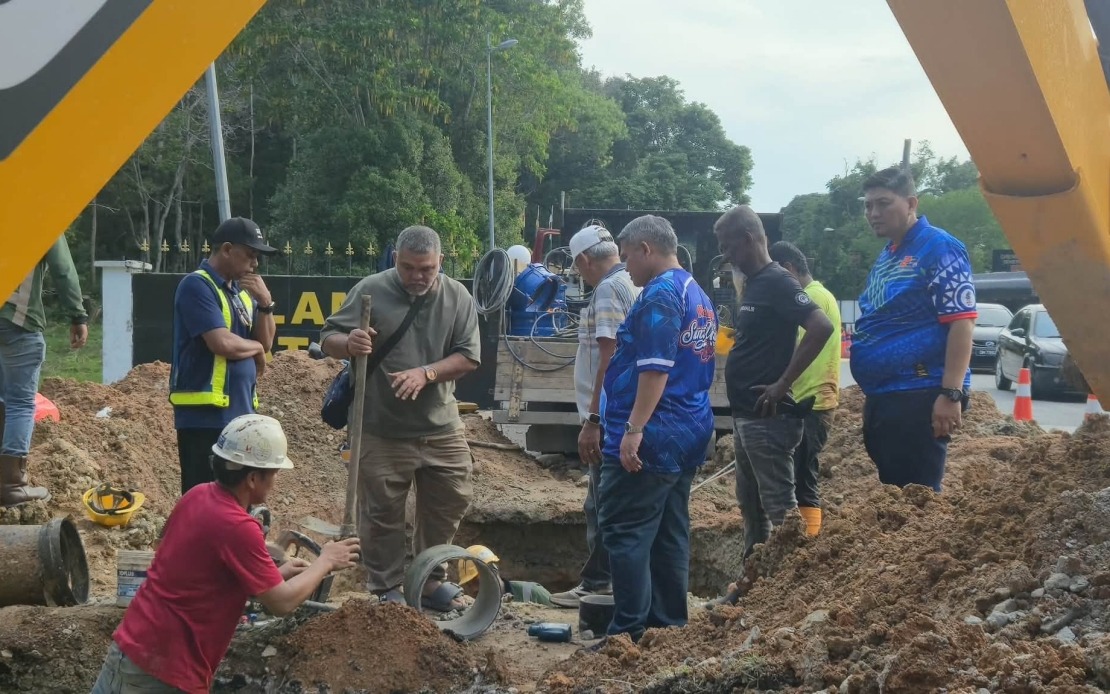
The Melaka state government is moving to address persistent water shortages at Kem Terendak in Sungai Udang by proposing the installation of a temporary water storage facility, marking an interim response to a problem that has plagued the military installation and its residents for several years. Operating through Syarikat Air Melaka Berhad (SAMB), the state authorities believe the tank will provide crucial relief while longer-term infrastructure projects progress toward completion.
The proposal emerges as the state grapples with immediate challenges stemming from a significant pipe fracture along Jalan Kampung Payasum in Sungai Udang. The rupture has left approximately 2,000 military personnel, their families, and educational institutions within the camp without reliable water access over a five-day period. The situation extends beyond simple inconvenience—five schools, including a MARA Junior Science College, have faced disruption to their daily operations, underscoring the broader impact of water infrastructure failures in densely populated military establishments.
Datuk Rais Yasin, the senior executive councillor responsible for housing, local government, drainage, climate change and disaster management, acknowledged that implementation of the temporary tank hinges on clearance from the Ministry of Defence. As the Sungai Udang assemblyman, Rais recognises the jurisdictional complexity inherent in military installations, where defence ministry oversight typically supersedes civilian authority. His pragmatic stance reflects an understanding that state-level intervention, however well-intentioned, requires federal coordination when defence facilities are involved.
The temporary tank concept represents a holding measure until the Development and Upgrade of the Water Reticulation System project reaches completion, currently scheduled for April 2028. This extended timeline—nearly four years away—illustrates the challenging reality facing Malaysian infrastructure development, where ambitious capital projects often encounter delays and resource constraints. Residents and military personnel cannot reasonably be expected to endure repeated crises for such an extended period, making interim solutions essential for maintaining basic service standards.
Beyond the temporary storage facility, SAMB has deployed an emergency distribution network utilising mobile water tankers to mitigate immediate shortages. The authority has committed 25,000 gallons of daily supply delivered by 25 tanker lorries, though even this substantial mobilisation remains insufficient given the scale of disruption across the camp. The logistics of sustaining such a distribution system over months underscores both the commitment and the strain placed on state water authorities when mains infrastructure fails.
The rupture itself, while serious, appears manageable in repair terms, with authorities estimating completion of initial patching by the evening of the announcement. However, full operational restoration requires an additional one to two days as water pressure is gradually restored throughout the network and air pockets are purged from repaired sections. This phased restoration process reflects standard utility management practices but extends the period during which alternative supplies prove necessary.
Schools and educational institutions have received portable water containers to sustain their operations, a targeted intervention acknowledging that educational continuity carries social importance beyond the immediate convenience of residents. The MARA Junior Science College specifically serves a national function, making its water security a matter of broader concern than a single camp facility. This selective resource prioritisation demonstrates pragmatic crisis management, allocating scarce tanker capacity where disruptions pose the greatest systemic impact.
The military dimension of this infrastructure crisis carries implications often overlooked in civilian water supply discussions. Defence force personnel represent a captive population unable to simply relocate or access alternative supply sources, while their families, who constitute a significant portion of the affected population, bear particular hardship from extended service disruptions. Military efficiency and morale depend substantially on reliable provision of essential services, making repeated water crises a governance failure with operational consequences.
Melaka's infrastructure challenges reflect broader Malaysian patterns wherein rapid urban expansion and population density growth have outpaced water system expansion and maintenance. The Kem Terendak situation, while presenting unique military dimensions, exemplifies water security vulnerabilities affecting major population concentrations nationwide. The vulnerability of a single major pipe demonstrates how fragile centralised water distribution systems become when critical infrastructure ages without simultaneous capacity enhancement.
The state government's commitment to supporting affected residents and military families carries symbolic weight beyond immediate water delivery. Public acknowledgement of service failures and transparent communication of remedial measures helps maintain institutional trust, particularly within military communities where institutional confidence carries operational significance. Rais Yasin's public apologies and detailed progress reporting reflect understanding that crisis communication matters as much as physical infrastructure response.
Looking ahead, the temporary tank proposal requires federal approval but should progress relatively straightforwardly given its limited scope and duration. The device would address immediate pressurisation and buffering challenges that pipe failures create, allowing water distribution networks to maintain minimum pressure thresholds even when supply experiences temporary interruptions. Such intermediate storage becomes increasingly important as networks age and peak-demand management becomes more complex.
The April 2028 completion date for the comprehensive water reticulation upgrade project represents SAMB's commitment to permanent resolution, though such timelines warrant cautious assessment given typical construction delays. Stakeholders would be prudent to anticipate potential schedule slippage and plan accordingly, particularly given the military's operational requirements and the affected schools' educational responsibilities. Interim measures, however temporary, must therefore prove sufficiently robust to sustain service quality regardless of major project delays.

