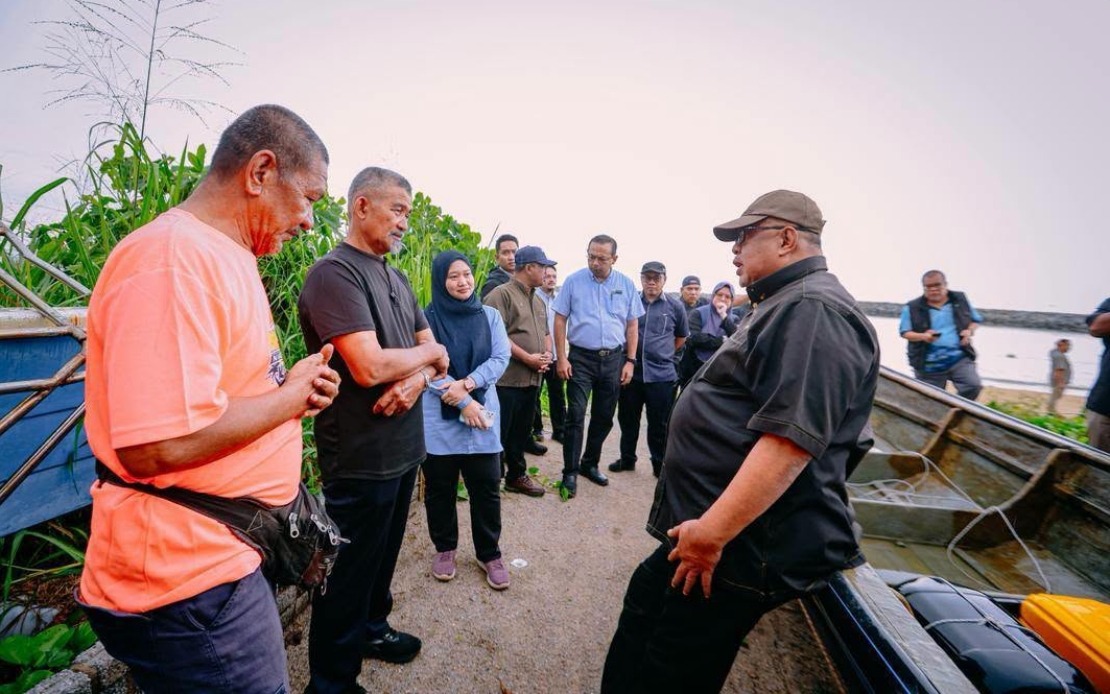
Melaka Chief Minister Datuk Seri Ab Rauf Yusoh has directed the Public Works Department and Drainage and Irrigation Department to immediately tackle difficulties confronting the fishing community at Pasir Gembur in Tanjung Bidara, signalling renewed state focus on coastal livelihoods ahead of the monsoon season. The directive follows an on-site inspection where Ab Rauf assessed progress on a new fishermen's complex and consulted directly with residents about their pressing concerns regarding infrastructure and environmental threats to their operations.
The intervention underscores growing recognition among Malaysia's state administrations that fishing communities require targeted support as climate variability, coastal development pressures, and infrastructure gaps increasingly squeeze traditional maritime livelihoods. Tanjung Bidara's fishing population faces acute challenges from tidal flooding and saltwater incursion, issues common across Southeast Asia's low-lying fishing ports but particularly acute during monsoon transitions. The Melaka government's response reflects the broader regional pattern where states must balance economic development with preserving space for artisanal fishing sectors that remain economically and culturally significant despite modernisation.
During the chief minister's visit, officials identified several priority actions requiring coordinated agency response. The Drainage and Irrigation Department will undertake a comprehensive feasibility assessment for deepening the fishing channel linking Pasir Gembur and Batu Tenggek, addressing accessibility problems that restrict boat operations during low-water periods. This technical evaluation will determine whether dredging or alternative solutions can improve year-round passage for commercial fishing vessels, a concern affecting catch transportation and market access. Such channel improvements have ripple effects throughout the regional fish supply chain, as Tanjung Bidara serves wider markets beyond Melaka's borders.
The Public Works Department has simultaneously received instructions to identify and prepare an alternative site for the new fishermen's complex, relocating it to terrain less vulnerable to seasonal flooding and high-tide seawater intrusion. Current site constraints have reportedly complicated construction timelines and created operational hazards, motivating a comprehensive site reassessment. Proper siting remains fundamental to fishery infrastructure resilience, particularly as climate-driven sea-level changes and intensified weather patterns create new exposure profiles for coastal facilities. A more defensible location would reduce operational disruptions and extend asset lifespan, considerations that often escape attention in initial development planning.
Crucially, the state administration has imposed a regulatory freeze on additional private construction within the coastal wave-breaker zone, recognising that uncontrolled development degrades both environmental integrity and fishing community access to natural resources. This constraint reflects governance maturation around balancing competing coastal claims. Future structures in the coastal reserve area must now obtain Temporary Occupation Licences from the Land Administrator and secure technical approvals, creating accountability mechanisms previously absent. Such licensing frameworks, when effectively administered, prevent ad-hoc encroachment while maintaining state oversight over coastal land use compatible with fishing operations.
Ab Rauf characterised the site visit as substantively different from perfunctory political engagement, framing it as evidence of state commitment to translating electoral mandates into tangible community improvements. His emphasis on direct consultation with residents rather than reliance on bureaucratic briefings signals an attempt to ground decision-making in lived experience of coastal challenges. This approach acknowledges that fishing communities possess detailed environmental knowledge and operational expertise that centralised planning often overlooks, a principle gaining traction among Southeast Asian administrations seeking to improve development outcomes through community participation.
The government's invocation of "Melaka Sayang Rakyat" as governing philosophy reflects the state's positioning of itself as people-centred, converting the slogan into concrete mechanisms for addressing grievances. For Malaysian fishing communities watching state responsiveness to sectoral needs, such commitments carry material significance when translated into budget allocations, agency coordination, and regulatory enforcement. However, the sustainability of these initiatives depends on sustained political will beyond election cycles and consistent funding for implementation, variables that have historically challenged similar state-level initiatives.
Regionally, Melaka's approach to coordinating multiple agencies around fishing community needs offers lessons for neighbouring states managing similar coastal pressures. Indonesia, Thailand, and the Philippines all grapple with comparable tensions between development ambitions and fishing sector viability, with outcomes often determined by the quality of interagency coordination and commitment to sectoral equity. Melaka's model of centralised direction through the chief minister's office, while not uniquely sophisticated, demonstrates the importance of executive leadership in overcoming bureaucratic silos that typically impede rapid, holistic responses to community challenges.
The feasibility studies and site assessments mandated by the chief minister will require several months to complete, with outcomes dependent on technical analysis and budget availability. Implementation timelines remain uncertain, a reality that tempers immediate optimism among Pasir Gembur residents awaiting tangible improvements. Previous infrastructure projects affecting Malaysian fishing communities have experienced delays from tender complications, environmental assessments, or shifting political priorities, patterns worth monitoring as the Melaka initiatives progress toward execution phases.
For the broader Malaysian fishing sector, the Melaka intervention signals that state administrations remain attentive to coastal community welfare despite modernisation pressures and urbanisation trends that have historically marginalised fishing interests in policy hierarchies. Whether this attention translates into durable improvements or represents cyclical political engagement will become apparent as implementation proceeds through 2024 and beyond. The ultimate test lies in whether coordinated state action successfully mitigates the environmental and infrastructure vulnerabilities currently constraining Pasir Gembur's fishing operations and livelihood security.

