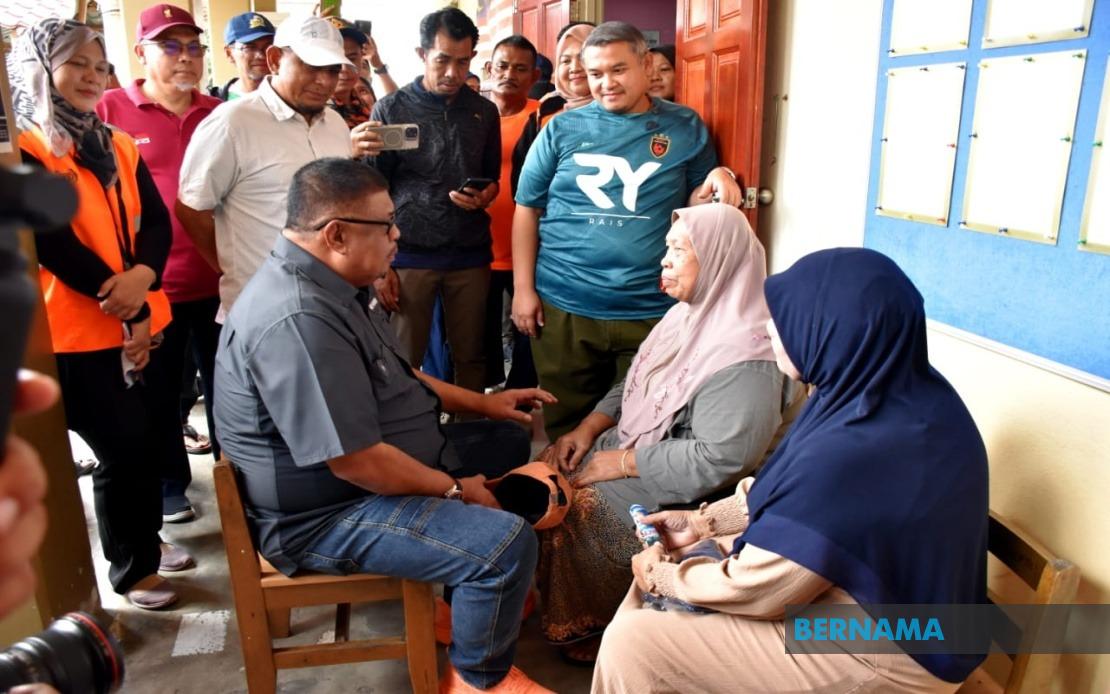
Melaka Chief Minister Datuk Seri Ab Rauf Yusoh has declared his administration's determination to finally break a cycle of recurrent flooding that has defined daily life in Tanjung Minyak for the past thirty years. The commitment came during a visit to temporary relief shelters accommodating residents displaced by the latest deluge, signalling that the state government is placing resolution of this chronic problem at the centre of its policy agenda. The timing of the announcement, made directly to media representatives and stakeholders, underscores the political salience of the issue and the urgency with which state leadership is treating what has become an entrenched infrastructure and public safety challenge.
The scale of the current flooding event has thrown the inadequacy of existing systems into sharp relief. More than 900 evacuees representing approximately 300 families are currently housed across multiple relief centres throughout the state, with the Sekolah Kebangsaan Tanjung Minyak 2 facility serving as one of the primary shelters. This displacement represents not merely an inconvenience but a significant disruption to the lives of ordinary Malaysians, many of whom have experienced similar upheaval repeatedly over decades. The sustained nature of their predicament highlights how previous interventions and drainage solutions have fundamentally failed to address the underlying structural vulnerabilities that render the area susceptible to inundation.
According to meteorological data released by officials, the rainfall recorded during the recent flooding episode surpassed conditions observed over the preceding twenty years, establishing a new benchmark for precipitation intensity in the region. The Melaka Irrigation and Drainage Department director, Mohd Adnan Ahmad Fauzi, noted that cumulative rainfall measurements exceeded 100 millimetres in both Melaka Tengah and Alor Gajah districts, measured at approximately 2:30 pm. These figures carry particular significance when contextualised against Tropical Storm Senyar, which struck the region late last year; the recent rainfall exceeded even those storm conditions, indicating an escalation in weather extremes that existing infrastructure was never designed to manage.
The immediate cause of the flooding stemmed from the incapacity of the state's water retention infrastructure to manage the volume of precipitation. When rainfall of this magnitude overwhelmed the drainage systems, water flowed directly into residential neighbourhoods, transforming streets and homes into temporary waterways. This mechanism of failure—the simple inability of engineered systems to process the volume of water—represents a core vulnerability that technical experts must address through comprehensive redesign rather than incremental patching. The Chief Minister acknowledged this reality, committing to a thorough reassessment of all technical proposals and recommendations from relevant agencies tasked with drainage and water management.
Datuk Seri Ab Rauf's public statement reflected an understanding that solving Tanjung Minyak's flooding requires moving beyond reactive emergency response to establish proactive, long-term infrastructure solutions. He articulated the necessity of identifying approaches that would definitively resolve a problem that has persisted across three decades of governance by multiple administrations, suggesting that previous attempts have remained inadequate to the challenge. The commitment to evaluate multiple proposals from diverse technical agencies indicates a willingness to consider comprehensive solutions rather than limiting interventions to modest upgrades of existing systems that have demonstrably proven insufficient.
The administrative response to the current crisis has been coordinated through established channels, with the District Office taking the lead role in immediate aid distribution and welfare coordination by the state government. Supporting this effort were state Senior Housing, Local Government, Drainage, Climate Change and Disaster Management Committee chairman Datuk Rais Yasin and Melaka Social Welfare Department director Halyjah Muhamad, both of whom were present during the Chief Minister's relief centre visit. This multi-agency coordination structure ensures that evacuation support, emergency sheltering, food provision, and other immediate humanitarian needs are addressed systematically rather than through ad hoc arrangements.
The inclusion of climate change and disaster management within the portfolio of the housing and local government committee signals an institutional acknowledgment that Melaka's vulnerability to flooding is intensifying within the context of broader climatic shifts. The reference to rainfall patterns surpassing those recorded over twenty years, combined with conditions exceeding Tropical Storm Senyar, suggests that weather extremes are becoming more pronounced. For Malaysian policymakers and residents across the region, Tanjung Minyak's experience serves as a cautionary case study demonstrating how infrastructure designed for historical weather patterns may prove inadequate when climate conditions shift toward more intense precipitation events.
The Chief Minister's assurance that all relevant agencies have been placed on heightened alert aims to ensure the most expeditious possible response to future flood emergencies. However, this emphasis on rapid response capacity, while necessary for immediate humanitarian protection, does not resolve the underlying infrastructure deficiency. True resolution requires capital investment in upgraded drainage infrastructure, potentially including expanded detention basins, improved pumping systems, or comprehensive redesign of stormwater management across the affected area. The stated commitment to reviewing all technical proposals suggests that state leadership recognises this distinction and is prepared to move beyond emergency management toward permanent infrastructure solutions.
For the residents of Tanjung Minyak, the Chief Minister's pledge represents both a promise of relief and a test of governmental commitment and capability. Three decades of repeated flooding has likely generated considerable scepticism regarding official assurances of resolution. The practical validation of this commitment will depend on the pace and scale of infrastructure investment, the technical soundness of implemented solutions, and the follow-through by government agencies in executing approved plans. The success or failure of this initiative will bear implications extending beyond Melaka, serving as a benchmark for how state governments across Malaysia address chronic infrastructure failures affecting vulnerable residential populations.
The flooding event and the government's response also underscore the importance of regular review and upgrade of critical infrastructure across Malaysia's states. Tanjung Minyak's experience—where a single rainfall episode displaces hundreds of families from an area that has suffered repeated inundation over decades—reveals how deferred maintenance and inadequate infrastructure investment can accumulate into major public safety and welfare challenges. As Malaysia's climate conditions continue to evolve and precipitation patterns potentially intensify, state and federal authorities must prioritise systematic assessment and upgrading of drainage systems, water retention facilities, and stormwater management infrastructure across vulnerable regions.

