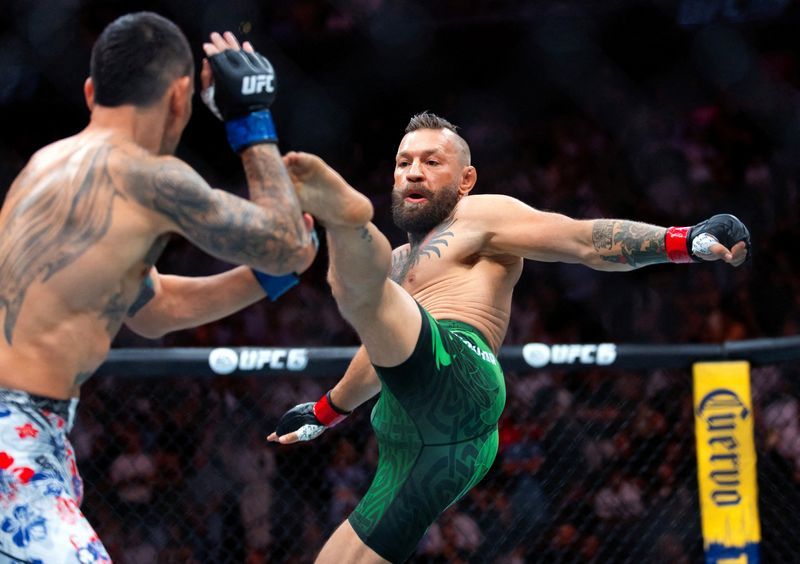
Conor McGregor's long-awaited return to mixed martial arts competition lasted barely more than a minute. The Irish fighter suffered a severe knee injury during the opening moments of his contest with Max Holloway on Saturday night in Las Vegas, forcing him to signal to the referee that he could not continue. What was intended as a triumphant comeback for the former two-weight champion instead became another chapter in a career increasingly marked by injury and misfortune.
The injury occurred in the most unfortunate circumstances—McGregor landed awkwardly while executing a jump kick, causing immediate damage that left him unable to proceed. Despite his competitive instincts and willingness to push through pain, the nature of the injury was clearly too severe to overcome within the fighting arena. The incident has reignited questions about McGregor's physical durability and his ability to maintain the explosive athleticism that once defined his career.
In a statement posted on Instagram on Monday, McGregor expressed defiance and determination, suggesting he remains committed to a return despite the setback. His message indicated an intention to undergo surgery, followed by rehabilitation and a gradual return to training before attempting to fulfill what he described as the final fight on his contract. The tone of his post suggested unwavering confidence, though observers will note this represents yet another detour in a career that has seen multiple false starts in recent years.
The 37-year-old fighter has endured a troubling period outside the octagon that has compounded his injury difficulties. A jury in an Irish civil court determined earlier that McGregor was liable for rape allegations involving Nikita Hand dating to 2018, a verdict that carries significant implications for his reputation and marketability. This legal judgment represents one of the most serious reputational challenges of his career and adds complexity to his attempts at a competitive comeback.
McGregor's injury history itself tells a cautionary tale about the toll of professional fighting. Five years prior, he suffered a broken leg while facing Dustin Poirier, an incident that began an extended absence from competition. More recently, a planned June 2024 matchup against Michael Chandler was cancelled after McGregor broke his toe during training—an injury that exemplifies how even preparation for competition has become fraught with setbacks.
Beyond physical injuries, McGregor's career has been disrupted by regulatory matters. In late 2024, he accepted an 18-month ban related to whereabouts failures, stemming from his inability to be located for three separate anti-doping sample collection attempts conducted by Combat Sports Anti-Doping in 2024. Though the ban was backdated and officially expired in March, the incident reflected broader compliance issues that have plagued his recent career trajectory.
For Malaysian and Southeast Asian fight fans, McGregor's situation raises important questions about athlete longevity in combat sports and the intersection of personal conduct, legal accountability, and professional performance. The fighter who once dominated the UFC with charisma and precision now faces an uncertain pathway forward, complicated by factors entirely separate from his technical abilities in the ring.
McGregor's commitment to another comeback, should it materialize, will depend not only on successful surgical repair and rehabilitation but also on resolving the cloud of legal and regulatory complications that have accumulated around his career. The fan base that once celebrated his meteoric rise now watches with considerably more skepticism, aware that numerous injuries and controversies have fundamentally altered the trajectory of what was once considered a transcendent athletic career.
The broader narrative surrounding McGregor reflects how professional athletes in contact sports face unique vulnerabilities—not merely the risks of physical injury inherent to their discipline, but also the challenges of maintaining focus on competitive excellence amid personal and legal complications. For a fighter approaching the twilight of his career, the question is whether surgery and rehabilitation can adequately address either the physical damage or the reputational harm that now define his legacy.

