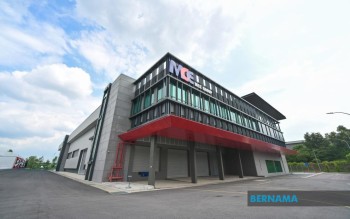
MCE Holdings Bhd has formally inaugurated the MCE Auto Hub, a RM50 million state-of-the-art manufacturing complex located within the UMW High Value Manufacturing Park in Serendah, Hulu Selangor. The facility represents a pivotal expansion for the Kuala Lumpur-listed automotive electronics supplier and signals renewed confidence in Malaysia's advanced manufacturing sector despite global headwinds affecting the industry.
The 5.52-hectare facility constitutes the opening salvo of MCE's ambitious RM200 million capital expenditure programme, which the company expects will substantially augment its existing manufacturing footprint. Investment, Trade and Industry Minister Datuk Seri Johari Abdul Ghani presided over the official ceremony, underscoring the government's backing for the venture and its strategic importance to Malaysia's automotive ecosystem. The project aligns with broader national aspirations to elevate the country's standing in high-value manufacturing and position it as a regional electronics and advanced automotive technology centre.
MCE's trajectory over the past three decades illustrates the evolution of Malaysian automotive suppliers from simple component manufacturers into sophisticated technology firms. The company commenced operations in 1990 by supplying remote alarm systems and central locking mechanisms to domestic vehicle makers. Through methodical expansion and reinvestment, MCE has progressively deepened its engineering capabilities and broadened its product portfolio into advanced automotive electronics and mechatronic systems. This progression reflects broader trends within Malaysia's automotive supply chain, where local firms increasingly compete for contracts requiring cutting-edge design and manufacturing expertise rather than relying purely on low-cost labour advantages.
The MCE Auto Hub has been engineered as an Industry 4.0-compliant manufacturing facility, incorporating controlled clean room environments and precision production zones essential for contemporary automotive electronics destined for both internal combustion engine vehicles and electric vehicles. This dual capability is particularly significant as global automakers accelerate electrification programmes and demand localised EV component supply chains. By establishing production capacity for both ICE and EV electronics, MCE positions itself to capture demand across the industry's transitional phase, when vehicle fleets will comprise mixed powertrains for several years.
With the new facility operational, MCE now commands a workforce of 680 employees distributed across its operations in Johor Bahru, Port Klang, and Serendah. The company has assigned 90 engineers to these locations, substantially elevating its technical capacity for developing bespoke solutions and managing complex customer programmes simultaneously. This concentration of engineering talent within Malaysia creates a potential nucleus for innovation in automotive electronics and provides multinational customers with assurance that design and development activities can occur locally, reducing lead times and fostering closer collaboration between suppliers and manufacturers.
MCE Group Managing Director Dr Goh Kar Chun articulated the company's strategic vision during the launch, emphasising that the Auto Hub represents a watershed moment for Malaysian automotive manufacturing. He highlighted that MCE now serves customers across Malaysia, other ASEAN member states, and the United States, a geographic diversification that insulates the company from dependence on any single market. The expansion into sophisticated mechatronic solutions and automotive electronics reflects global industry trends, where traditional mechanical components are increasingly superseded by electronic systems managing engine control, autonomous driving features, vehicle connectivity and energy management.
The facility's emphasis on localisation carries implications extending beyond MCE itself. By demonstrating that Malaysia can efficiently manufacture and engineer advanced automotive components, the project potentially catalyses investment by other technology firms and semiconductor companies seeking to establish regional production bases. Malaysia's relative proximity to major ASEAN automotive markets, coupled with established industrial infrastructure and skilled workforce availability, positions the country competitively against other regional manufacturing destinations. The Auto Hub thus functions not merely as an isolated corporate facility but as a proof point for Malaysia's broader manufacturing aspirations.
Minister Johari underscored in his remarks that MCE's investment reflects confidence in Malaysia's industrial future and the necessity for local suppliers to pursue manufacturing excellence through innovation and engineering expertise. His comments implicitly acknowledge that Malaysia faces intensifying competition from Vietnam, Thailand, and Indonesia in automotive supply chains, particularly as these nations court manufacturing investment with aggressive incentive packages. MCE's decision to expand domestically rather than relocate production signifies faith in Malaysia's value proposition, though it also reflects the company's roots and established customer relationships within the country.
The strategic importance of this investment extends to Malaysia's broader automotive policy objectives. The government has prioritised upgrading the sector's technological capabilities and attracting higher-value manufacturing activities as domestic vehicle production faces consolidation. Tier-1 suppliers like MCE represent crucial intermediaries between multinational carmakers and Malaysia's fragmented supplier base. By strengthening MCE's engineering and design functions, the Auto Hub indirectly elevates capabilities throughout the upstream supply chain, as smaller component manufacturers can access technical support and collaborate on projects of increasing complexity.
Dr Goh articulated a vision of Malaysia's automotive future predicated on strengthened collaboration among carmakers, tier-1 suppliers, semiconductor firms, and electronics companies. This ecosystem perspective contrasts with siloed approaches where suppliers operate independently of one another. Cross-supplier collaboration in advanced manufacturing and technology development could generate intellectual property and proprietary solutions distinctly Malaysian in origin, reducing dependence on imported technology and creating higher-margin opportunities for domestic firms.
The MCE Auto Hub's emphasis on serving regional ASEAN markets alongside domestic customers reflects the reality that Malaysia's automotive sector increasingly functions as a regional manufacturing and innovation node. ASEAN's combined vehicle production exceeds eight million units annually, and as localisation requirements tighten across the region, suppliers positioned to serve multiple markets simultaneously gain competitive advantage. MCE's geographic expansion of sales to ASEAN territory positions the company to capture growth driven by rising vehicle sales in neighbouring economies and the corresponding demand for advanced electronics.
Looking forward, the completion of this first investment phase sets the stage for potential further expansion within the RM200 million envelope, contingent upon demand trajectories and capital availability. Should EV adoption accelerate across Malaysia and ASEAN—driven by stricter emissions regulations and charging infrastructure development—demand for automotive electronics and battery management systems will intensify accordingly. MCE's forward-positioned manufacturing capacity and engineering resources position the company to capture a meaningful share of this anticipated growth.
The Auto Hub's inauguration ultimately signals that despite headwinds buffeting the global automotive industry, selective manufacturing investments continue in Malaysia among firms confident in long-term regional demand and committed to continuous technological upgrading. For policymakers, MCE's expansion validates strategies prioritising sector modernisation and investment in engineering talent development. For MCE shareholders and employees, the facility represents tangible validation of management's strategic direction and enhancement of the company's competitive positioning across increasingly sophisticated markets.

