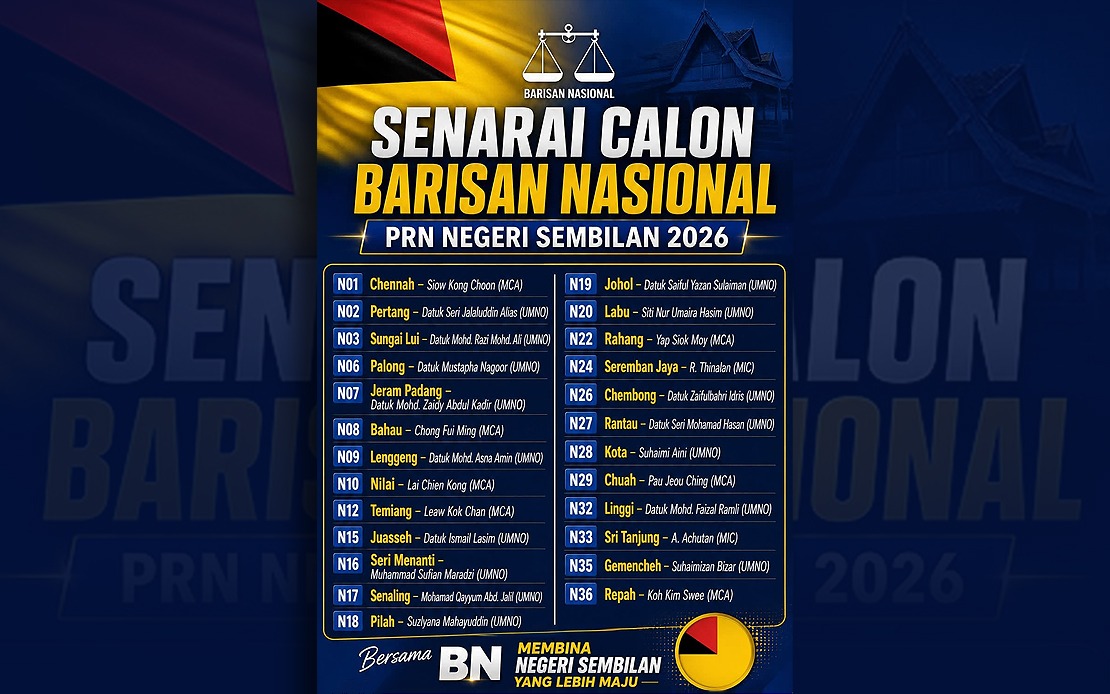
Barisan Nasional's allocation of seats to its component parties for the Negeri Sembilan state election reflects a strategic approach to maximising the coalition's electoral prospects. Deputy Prime Minister and BN chairman Datuk Seri Dr Ahmad Zahid Hamidi announced that MCA would contest seven seats while MIC would field candidates in four constituencies, a division that underscores the coalition's confidence in these parties' capacity to secure victories in their assigned areas.
The methodology employed by BN in distributing the 11 seats between MCA and MIC centred on a careful evaluation of each candidate's electoral viability within their respective constituencies. This assessment-based approach differs from formulaic seat-sharing that relies solely on party representation or historical performance, instead prioritising ground-level analysis of where individual candidates could mount the most competitive campaigns. Ahmad Zahid's emphasis on this pragmatic calculation suggests BN is attempting to optimise its seat count in a state where the political landscape has shifted considerably since the previous election.
The scale of this allocation reflects the relative standing of these component parties within the broader coalition framework. MCA, as the largest Chinese-majority component of BN, traditionally receives a larger slate of constituencies, while MIC's allocation represents the Indian-majority party's participation in a coalition that seeks representation across Malaysia's diverse demographic groups. The combined 11 seats assigned to these two parties must be understood within the context of BN's overall performance trajectory in Negeri Sembilan, where the coalition's dominance has eroded significantly.
The formal process Ahmad Zahid described involved direct engagement with prospective candidates at Wisma UMNO Negeri Sembilan, where individuals confirmed their commitment to the party and pledged allegiance to him as coalition chairman. This ritualistic aspect of candidate vetting, while standard across Malaysian elections, underscores the hierarchical nature of BN's decision-making and the personal authority vested in the coalition's leadership. The requirement for candidates to sign undertakings serves both as a loyalty mechanism and a formal acknowledgement of party discipline.
Context from the previous election cycle reveals the magnitude of BN's challenge heading into this contest. In the 15th state election, BN secured only 14 of the 36 assembly seats, a dramatic decline from its historical dominance. Pakatan Harapan emerged as the dominant force with 17 seats, while Perikatan Nasional captured five seats. This distribution indicates that BN faces an uphill battle in reclaiming its position as Negeri Sembilan's leading political force, making the strategic allocation of seats to viable candidates all the more critical.
For Malaysian readers monitoring coalition dynamics, the seat distribution carries implications beyond Negeri Sembilan's borders. The manner in which BN manages internal negotiations with component parties like MCA and MIC signals whether the coalition can maintain cohesion during a period of electoral vulnerability. Any perception of unfair seat allocation or inadequate recognition of a component party's electoral capacity could trigger internal friction, particularly given MCA's ongoing efforts to reinvigorate its electoral performance after significant losses in recent national elections.
The election timetable established by the Election Commission provides a compressed but standard campaign period. With nomination day set for July 18 and polling day on August 1, candidates and parties have approximately two weeks between the official announcement of nominees and early voting on July 28. This schedule mirrors previous state elections and reflects EC's standardised approach to election administration across Malaysia.
Ahmad Zahid's scheduled announcement of the full BN candidate list at Stadium Tuanku Abdul Rahman Paroi represented a formal occasion designed to generate public attention and demonstrate coalition unity at a critical juncture. Such announcements typically feature remarks from senior party leaders and attempts to project confidence in the coalition's electoral prospects, regardless of underlying internal negotiations or strategic recalibrations.
The broader political context matters significantly for understanding this election. Negeri Sembilan, as a relatively prosperous state with a diverse economic base spanning agriculture, manufacturing, and services, holds symbolic importance within Malaysia's political geography. The state's electoral outcome could offer insights into shifting voting patterns among Chinese and Indian-majority communities, whose support for BN has fluctuated considerably in recent election cycles.
For MCA specifically, the allocation of seven seats provides an opportunity to demonstrate renewed electoral competitiveness, particularly given the party's struggles to maintain relevance amid changing demographics and evolving Chinese-Malaysian political preferences. Similarly, MIC's four seats represent an opportunity for the party to demonstrate its continued utility within the coalition framework at a time when Indian-Malaysian voting patterns have become increasingly volatile and unpredictable.
The emphasis Ahmad Zahid placed on candidate viability assessments reflects a recognition that seat quantity matters less than seat conversion in a highly competitive electoral environment. Rather than distributing seats equally across component parties or based on historical entitlements, BN's leadership has opted for a performance-based model designed to maximise total seat gains. This approach assumes that strong candidate placement will translate into vote conversion, an assumption that will be tested on August 1.

