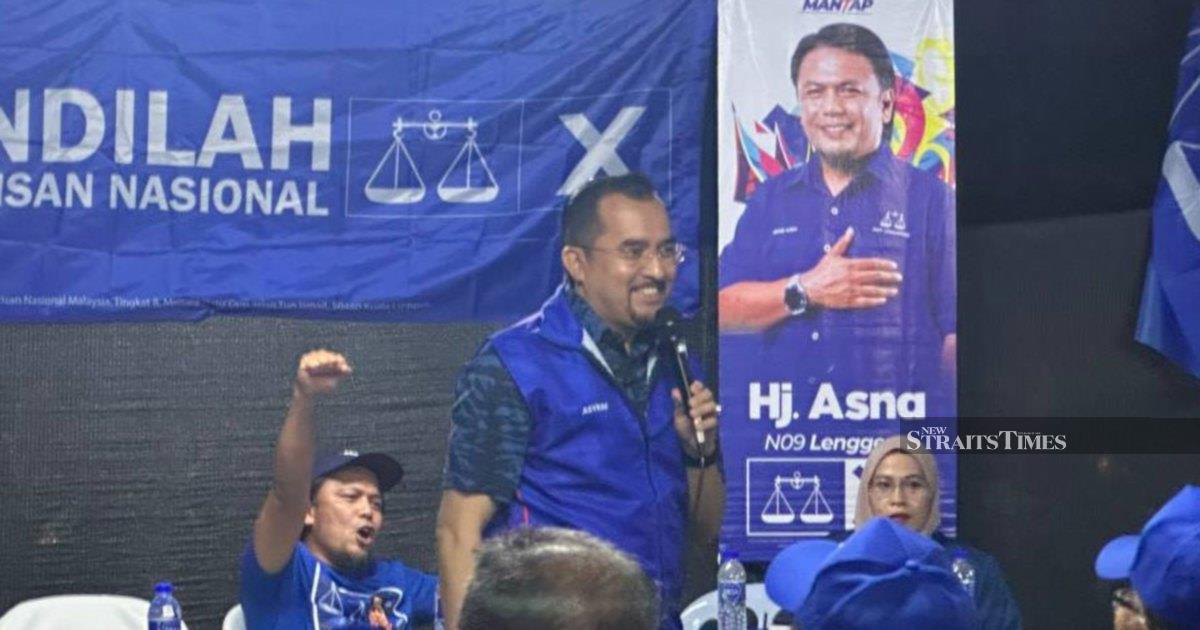
A prominent political voice in Seremban has pushed back firmly against a campaign narrative that paints Chinese voters supporting Barisan Nasional-linked MCA candidates as effectively endorsing PAS, calling such framing racially divisive and inappropriate for the Negeri Sembilan election cycle.
The assertion that voting for the Malaysian Chinese Association amounts to voting for the Islamic Party represents a reductive and inflammatory approach to electoral discourse, according to Asyraf Wajdi's intervention into the campaign debate. His remarks highlight growing concern among Barisan figures about the deployment of identity-based messaging that could fracture voter coalitions along communal lines.
The characterisation of such claims as "racially charged" underscores deeper anxieties within the coalition about voter perception and coalition cohesion. By framing the MCA not as an independent political entity but as a mere conduit for PAS influence, the narrative risks alienating the party's traditional Chinese support base and complicating Barisan's multi-ethnic voting calculus in what remains a competitively balanced state.
Negeri Sembilan has long been a barometer for peninsular electoral sentiment, given its ethnic composition and historical swing-voter patterns. The state encompasses urban centres like Seremban alongside rural constituencies where both demographic diversity and political preferences vary significantly. Any messaging that reduces voter choice to a binary communal calculation potentially undermines the moderate, inclusive positioning that Barisan has attempted to cultivate.
The controversy reflects broader tensions within Malaysia's political landscape as parties jostle for position ahead of electoral contests. Campaign strategists increasingly deploy sophisticated targeting that appeals to specific voter blocs, yet such precision targeting carries risks when it relies on essentialist assumptions about community voting patterns or inter-party relationships.
MCA's political positioning within Barisan has evolved considerably since the coalition's reformation following the 2018 general election. The party has worked to establish its relevance to Chinese voters by emphasising its distinct policy agenda and negotiating positions within coalition structures. Suggestions that MCA candidates function primarily as vehicles for PAS advancement directly challenge this independent identity and could weaken the party's appeal among its core electorate.
Ashraf Wajdi's intervention suggests that coalition partners recognise the risks of allowing such narratives to circulate unchallenged. The competitive intensity of Negeri Sembilan politics, combined with fractious dynamics within both coalitions, creates an environment where damaging accusations can take hold quickly if left uncontested. His statement therefore functions partly as damage control and partly as a broader signal about acceptable campaign conduct.
The intersection of religious politics and communal identity remains sensitive in Malaysia, where electoral campaigns frequently navigate around these fault lines rather than across them. Framing a major Chinese-based party as a proxy for a predominantly Malay-Muslim political entity not only mischaracterises intra-coalition relationships but also risks reducing political choice to crude communal identity matrices that diverge from voter sophistication on policy matters.
Barisan's internal coalition management has been a consistent challenge since its 2018 defeat and subsequent reformation. Different component parties bring distinct voter bases, regional strengths, and policy preferences. The MCA represents a crucial element of this architecture, particularly in states like Negeri Sembilan where Chinese voters remain electorally significant. Allowing doubts about the party's independence to fester could undermine overall coalition performance.
The criticism of such campaign rhetoric also reflects recognition that election outcomes depend partly on voter confidence in the integrity of political institutions and messaging. When campaigns descend into what political analysts characterise as inflammatory identity politics, the broader democratic discourse suffers regardless of which coalition benefits electorally. Asyraf Wajdi's stance thus aligns with a broader moderating impulse within mainstream political circles.
As Negeri Sembilan heads toward its electoral contest, the state will likely remain a proving ground for how effectively different political formations can construct inclusive messaging while maintaining distinct organisational identities. The MCA's capacity to attract its traditional constituencies while contributing meaningfully to Barisan's electoral strategy will substantially influence outcomes. Rejecting reductive narratives about communal voting becomes, in this context, not merely a matter of political correctness but strategic necessity for coalition cohesion and competitive viability.
The episode underscores that electoral politics in Malaysia increasingly demands navigation of complex identity terrain while resisting the gravitational pull toward simplistic communal categorisation. Senior figures like Asyraf Wajdi appear to recognise that sustainable coalition building depends on respecting component parties' distinct roles and voter relationships rather than collapsing them into homogenised bloc assumptions.

