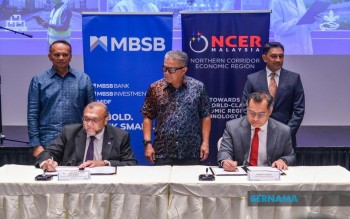
MBSB Bank Bhd has partnered with the Northern Corridor Implementation Authority (NCIA) through a new memorandum of understanding aimed at channelling up to RM1 billion in financing towards small and medium enterprises across the Northern Corridor Economic Region (NCER). The arrangement, formalised at a ceremony in Petaling Jaya on July 17, represents a significant push to catalyse economic expansion and business development across Perlis, Kedah, Penang and Perak, four states that collectively form Malaysia's fastest-growing economic corridor.
According to MBSB Bank chairman Datuk Wan Kamaruzaman Wan Ahmad, the collaboration creates tangible pathways for SMEs to expand their footprint in the northern states. Rather than simply extending credit, the partnership is designed to enable businesses to scale their operations substantially—allowing them to bid for positions within major supply chains and position themselves as reliable suppliers to larger corporations or export markets. This approach recognises that SME growth is not merely about individual company success but about weaving smaller enterprises into the broader economic fabric of the region.
The financing facility will serve as a catalyst for several categories of economic activity that NCER authorities have prioritised for development. The electrical and electronics sector, which has long anchored Malaysia's manufacturing reputation, stands to benefit alongside advanced manufacturing operations that increasingly demand sophisticated local supply chains. Agri-food producers, logistics operators, and companies harnessing digital and green technologies will similarly gain access to capital on terms designed to suit their growth trajectories rather than forcing them into ill-fitting conventional lending structures.
MBSB Bank's group chief executive officer Rafe Haneef articulated an ambition extending beyond domestic borders. The bank has secured a partnership with Europe's Santander Group, creating a platform through which export-oriented SMEs can access international market intelligence and networking opportunities. This dimension of the arrangement suggests that NCER businesses gaining RM1 billion in financing support will simultaneously access global expansion pathways, potentially transforming regional SMEs into multinational operators within a single business generation.
The formal signatories to the agreement—MBSB Bank group chief commercial banking officer Noor Mohamed Amin and NCIA chief operating officer Hasri A Hassan—represent institutions with sharply different mandates converging toward shared economic objectives. MBSB Bank operates as a traditional financial intermediary, assessing risk and allocating capital based on commercial principles. NCIA, by contrast, functions as a statutory planning and development authority tasked with orchestrating long-term regional growth. Their collaboration suggests an evolution in how development institutions and financial sector players work together in Malaysia, moving beyond parallel efforts toward genuine integration.
NCIA chief executive Datuk Mohamad Haris Kader Sultan positioned the arrangement within the broader framework of Malaysia's 13th Malaysia Plan, suggesting that such strategic partnerships have become essential infrastructure for economic policy in the contemporary context. The NCER itself has already demonstrated substantial magnetism for both domestic and foreign investors, establishing itself as a magnet for capital seeking exposure to Southeast Asia's fastest-growing markets. Yet planners recognise that without deliberate financing mechanisms supporting smaller businesses, the benefits of regional growth can concentrate excessively among larger incumbent firms while SMEs remain perpetually undercapitalised.
The four sectors identified as strategic priorities—E&E, advanced manufacturing, agri-food and logistics—encompass both traditional strengths and emerging opportunities. The electrical and electronics sector represents established competitive advantage that Malaysia has cultivated since the 1970s, whereas green technology and the digital economy signal recognition that future growth must be technologically sophisticated and environmentally conscious. This sectoral balance indicates that NCER development strategy is neither purely extractive nor purely innovative, but rather modernising existing industries while incubating new ones.
For Malaysian SMEs operating outside the northern states, this arrangement carries cautionary implications. Capital deployment of this magnitude into a specific region creates competitive dynamics that could either stimulate broader national development through demonstration effects and supply chain expansion, or alternatively concentrate growth in ways that leave other regions relatively disadvantaged. The success or failure of this partnership in generating inclusive growth across NCER will likely influence how policymakers structure subsequent regional development initiatives elsewhere in Malaysia.
The RM1 billion commitment also merits scrutiny regarding absorption capacity and implementation quality. Financing availability means little if SMEs lack the technical capacity, market access, or management capability to deploy capital productively. The arrangement's success will depend substantially on whether MBSB Bank and NCIA can jointly address these deeper constraints on SME performance, rather than simply extending credit to businesses that may struggle to generate returns sufficient to service debt.
International context matters too. Malaysia competes with Thailand, Vietnam and Indonesia for manufacturing investment and regional supply chain integration. Initiatives that strengthen SME competitiveness in northern Malaysia indirectly strengthen Malaysia's position within broader Southeast Asian economic hierarchies. If NCER SMEs successfully capture positions in electronics, advanced manufacturing and logistics networks, they contribute to Malaysia's ability to compete against regional rivals offering similar cost structures and policy incentives.
Looking forward, this partnership may serve as a template for deepening collaboration between development authorities and financial institutions across Malaysia. The NCER's infrastructure, institutional capacity and policy environment have positioned it as a leading regional development project, and deliberately pairing financing availability with strategic planning represents methodologically sound practice. Other corridors and development regions may seek similar arrangements, transforming the relationship between banking and developmental objectives across the country.

