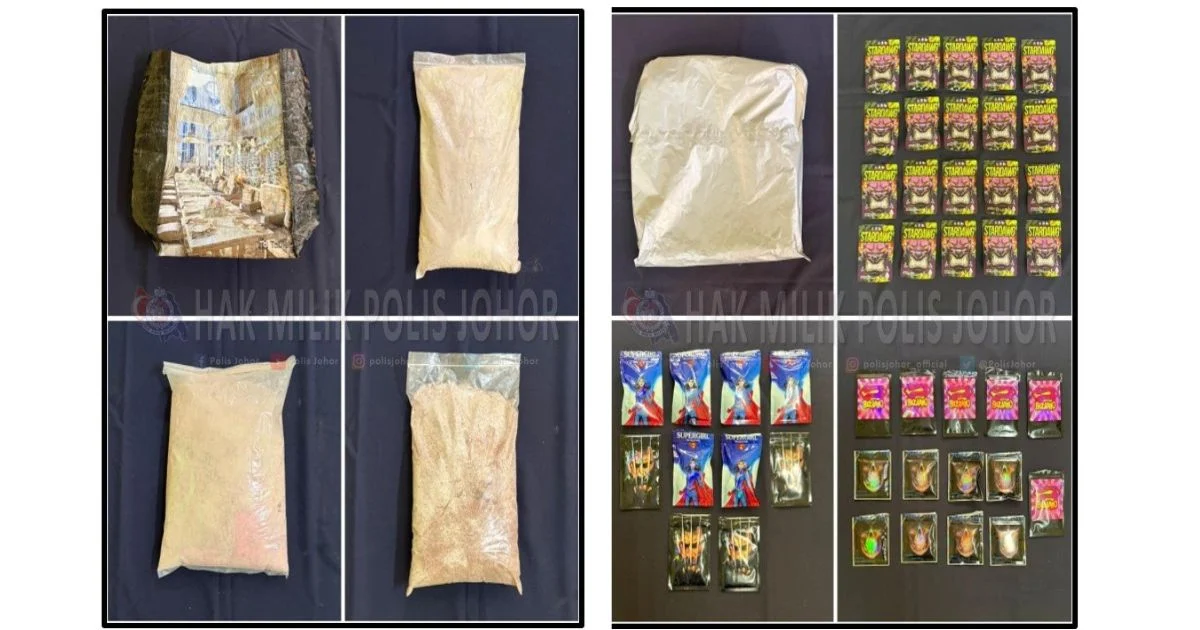
Johor police have successfully dismantled what investigators describe as a sophisticated drug operation by apprehending a married couple in the Kulai district and recovering a substantial cache of illegal narcotics estimated to be worth RM3.59 million. The operation highlights the continuing challenge of narcotics trafficking throughout the state, particularly in residential areas that have become centres for distribution networks serving broader markets across peninsular Malaysia.
The arrest came after a coordinated investigation that saw plainclothes enforcement officers converge on a residential address in Kulai following weeks of surveillance and intelligence gathering. The couple, whose identities have been withheld pending further investigation and court proceedings, were taken into custody without incident. Their detention marks a significant development in law enforcement efforts to disrupt the supply chains feeding the domestic drug market.
The seizure encompasses multiple classes of controlled substances, according to initial police assessments. The composition and specific breakdown of the narcotics cache indicates this operation was not merely a retail-level enterprise but rather functioned as a regional distribution point. The volume and variety of substances recovered suggest the syndicate was systematically supplying smaller dealers across wider geographical areas, amplifying the societal harm that flows from such enterprises.
Kulai, situated between Johor Baru and the Klang Valley, has increasingly become a focal point for law enforcement operations targeting trafficking networks. Its strategic location along major highway corridors and relative proximity to manufacturing hubs in Peninsular Malaysia make it an attractive base for criminal organisations seeking to maintain distribution infrastructure while remaining somewhat removed from the intense policing presence of central Johor Baru. The town's residential character also provides cover for operations that might draw more immediate attention in more densely monitored urban zones.
The RM3.59 million valuation reflects street-level pricing rather than wholesale costs, meaning the actual quantity of controlled substances is substantial. Such valuations underestimate the economic disruption caused by these operations, which generate profits that fuel corruption, violence, and organised crime hierarchies across Malaysia and the wider region. Each dollar of street value represents demand from thousands of users, indicating the scale of addiction affecting communities throughout Johor.
Investigators are now examining the couple's financial records, communications, and supplier networks to determine the broader scope of their operation and identify upstream sources. Such investigations typically reveal connections to larger syndicates operating across state boundaries and sometimes internationally. The intelligence gathered during interrogation will likely feed into ongoing operations targeting major trafficking organisations that supply regional nodes like the Kulai operation.
The timing of this bust coincides with heightened public concern about drug-related crime in Johor. Residents of suburban and semi-urban areas have increasingly reported suspicious activities at residential premises, indicating growing awareness of how traffickers operate within apparently ordinary neighbourhoods. Police have urged the public to remain vigilant and report suspicious behaviour, noting that community cooperation remains essential for effective drug enforcement.
For Malaysian law enforcement agencies, the bust demonstrates the value of patient intelligence work and inter-agency coordination. The quantities involved place this operation well above routine street-level dealing, confirming that major syndicates continue to view Johor as a crucial market for their operations. The state's geographic position, transportation infrastructure, and proximity to major consumption centres in Selangor make it strategically valuable for trafficking organisations.
The arrest also underscores persistent vulnerabilities in how residential areas can be exploited for criminal enterprise. The couple's apparent willingness to operate from what was presumably a family home reflects the normalisation of drug trafficking within certain networks, where risk is calculated against potential earnings and the perceived likelihood of detection. This normalisation makes prevention increasingly challenging for authorities.
Moving forward, the case will likely proceed through the courts under the Dangerous Drugs Act, potentially exposing the couple to substantial custodial sentences given the quantities involved. Successful prosecutions of this magnitude serve both deterrent and incapacitative functions, removing individuals from trafficking networks and signalling to potential operators that large-scale operations face serious legal consequences. However, enforcement experts acknowledge that such individual cases, while important symbolically, address only a fraction of the broader trafficking problem affecting Southeast Asia.
The successful operation will now shift focus to upstream investigations targeting suppliers and downstream inquiries identifying the couple's customer base. Intelligence gathered during interrogation will feed into larger counter-narcotics operations. For residents of Johor and neighbouring states, the bust serves as a reminder that drug trafficking remains a persistent organised crime threat requiring sustained enforcement pressure and community vigilance.

