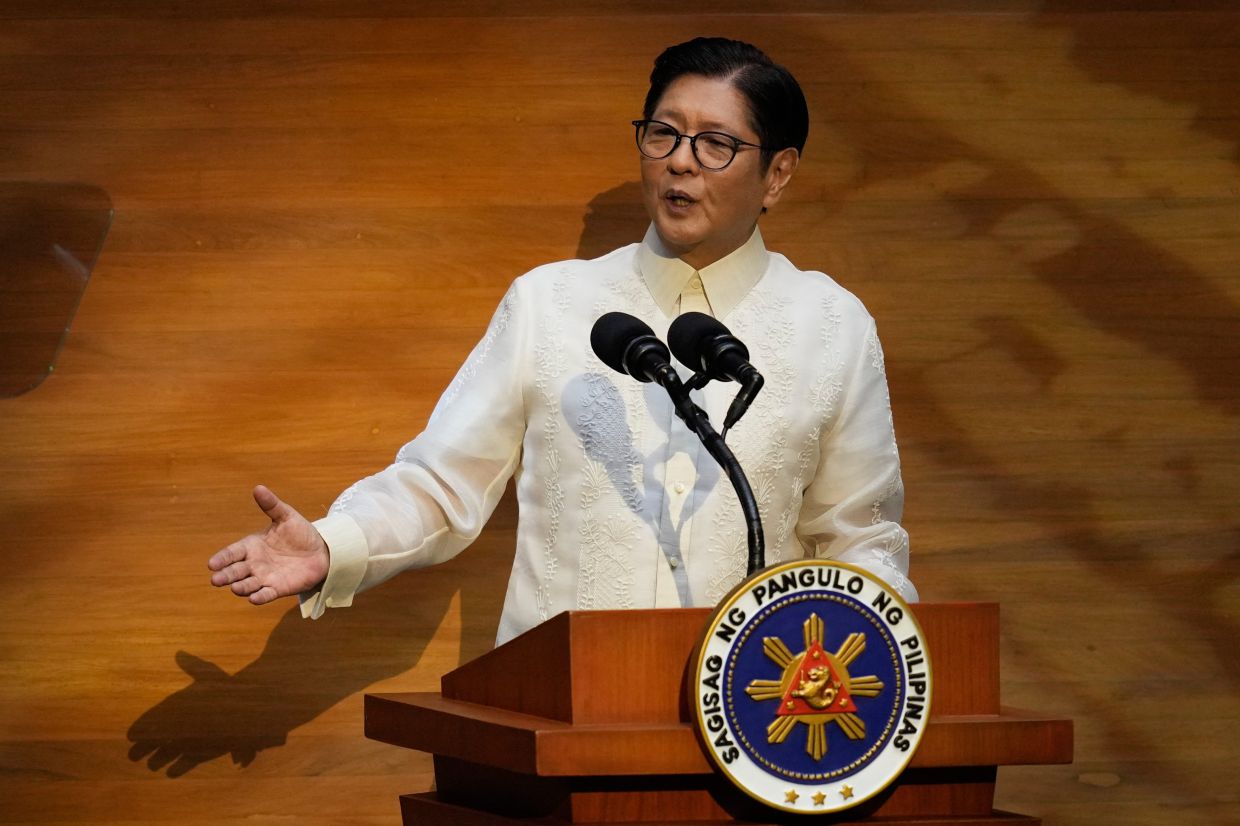
Philippine President Ferdinand Marcos Jr. used his state of the nation address on Monday to deliver a carefully calibrated critique of China, pledging that his administration would steadfastly defend a landmark 2016 arbitration ruling that invalidated Beijing's sweeping claims across the disputed South China Sea. Though he avoided naming China directly, Marcos's remarks were unmistakable in their intent, drawing loud applause from lawmakers as he asserted that Filipinos "do not yield" to foreign pressures and reaffirmed the government's commitment to upholding international law in the contested waters.
The president's comments arrive amid escalating tensions between Manila and Beijing, triggered in part by inflammatory content distributed by China Daily, a state-controlled media outlet that published AI-generated images depicting Filipinos as monkeys. Marcos responded by summoning Chinese Ambassador Jing Quan to his office the previous week, and the Philippine government formally denounced the material as "racist and dehumanizing," demanding its immediate removal. The incident exposed raw sensitivities surrounding the long-running territorial dispute and underscored how disputes over competing claims have begun to spill into the realm of public diplomacy and cultural antagonism.
Marcos framed his defence of the arbitration award in sweeping moral terms, emphasizing Filipino dignity and national character rather than engaging in technical legal arguments. "Of late, our very humanity has been called into question," he told lawmakers, before asserting that "Filipinos are a noble … and a great race. We are not greedy. We are not racists. We are not liars." This rhetorical strategy transformed what might otherwise appear as a narrow legal dispute into a matter touching on national pride and the fundamental respect owed to the Philippine people on the global stage.
The 2016 arbitration ruling, issued by an international tribunal under the framework of the 1982 U.N. Convention on the Law of the Sea, found that China's claims to vast expanses of the South China Sea lacked legal foundation. The Philippines had initiated the arbitration process in 2013 following a tense naval confrontation between Chinese and Philippine vessels near Scarborough Shoal, a contested feature in the waterway. China declined to participate in the proceedings and has since consistently rejected the award as illegitimate, with Foreign Ministry spokesperson Lin Jian reiterating last week that the decision was "a political farce disguised as a legal proceeding" with "no binding force."
Marcos characterized the ruling as "final and binding," positioning it as the definitive benchmark for interpreting maritime rights and obligations under international law. He pledged that the Philippine government would employ "every peaceful and legal means available" to defend this achievement against any attempt—whether from foreign powers or domestic opponents—to undermine it. This commitment carries significant weight given the Philippines' increasing vulnerability to Chinese pressure in the resource-rich waterway, a critical global trade route through which trillions of dollars in commerce passes annually.
The territorial disputes in the South China Sea have intensified markedly in recent years, with Chinese, Philippine, and Vietnamese forces frequently encountering one another as they patrol the waters or assert claims to contested features and exclusive economic zones. The conflict involves multiple claimants, including Malaysia, Brunei, and Taiwan, each with overlapping territorial assertions. These confrontations have become more than mere diplomatic spats; they now involve regular interactions between military and civilian vessels that carry the constant risk of escalation into unintended conflict. For Malaysia and other Southeast Asian nations with interests in these waters, the Philippines' firmness in defending international legal norms holds considerable significance, as it potentially sets precedent for how maritime disputes should be resolved.
Beyond his international posturing, Marcos also addressed domestic corruption concerns that have dogged his administration. Without naming him directly, the president announced that charges would soon be filed against Martin Romualdez, his cousin and former House Speaker, who has been implicated in a sprawling graft scandal centring on flood control projects. Marcos characterized the decision as personally painful, emphasizing that "I'm not a president for my family. I'm not a president for my friend," a statement that appears designed to demonstrate his commitment to the rule of law despite familial ties.
Romualdez, who resigned as House Speaker last year but continues serving as a congressman, has consistently maintained his innocence and indicated his readiness to defend himself in court proceedings. The broader corruption investigation has already ensnared multiple officials and contractors, including a former senator, a former public works secretary who served under Marcos, and several government engineers and construction company executives, all of whom have been formally charged and detained. These prosecutions represent part of a larger reckoning within the Philippine government over misappropriated funds from infrastructure and public works programmes.
The scale of alleged misappropriation uncovered through these investigations is staggering. The Philippine government has recovered or frozen nearly 25 billion pesos, equivalent to approximately 410 million United States dollars, in cash and property assets belonging to various suspects implicated in the corruption schemes. Some of these recovered funds have already been returned to the national treasury, representing an effort to restore stolen public resources. The prosecution of high-profile figures like Romualdez, despite his political prominence and family connections to the president, could signal a broader commitment to accountability—though critics may question whether the investigations have proceeded with equal vigour across all branches of government.
The timing of Marcos's state of the nation address underscores a delicate balancing act the Philippine president must maintain. He must simultaneously project firmness in defending national interests against an assertive China while managing concerns about corruption and institutional credibility at home. The decision to prosecute Romualdez, framed as a matter of principle rather than political calculation, suggests an attempt to burnish his administration's reform credentials. Yet the announcement also reflects the complexities of Philippine politics, where family networks and patronage systems remain deeply embedded in governance structures, even as democratic institutions struggle to hold the powerful accountable.

