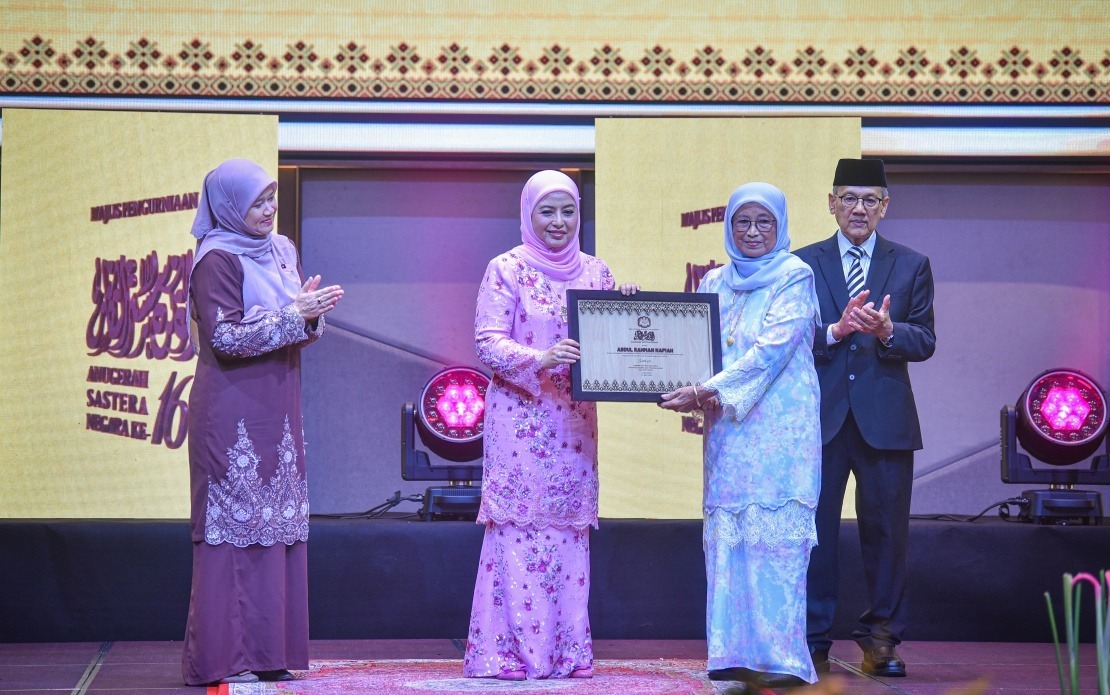
Malaysia's literary landscape has been enriched by the posthumous recognition of Dr Abdul Rahman Napiah, known professionally as Mana Sikana, who was conferred the title of the nation's 16th National Laureate at a ceremony in Kuala Lumpur on August 6. Her Majesty Raja Zarith Sofia, Queen of Malaysia, presented the accolade to Mana Sikana's widow, Salmah Ali, in a solemn recognition of a writer whose career fundamentally shaped contemporary Malaysian literature and critical discourse.
The National Laureate distinction represents the Malaysian government's paramount acknowledgement of literary achievement, extended only to those whose sustained contributions have demonstrably altered the trajectory of national literary culture. For Mana Sikana, who passed away in May 2025 at the age of 80 following heart complications, the honour comes as vindication of a career spanning decades that transformed not merely what Malaysian writers produced, but how they approached their craft. Education Minister Fadhlina Sidek, who chaired the selection committee, emphasised during the ceremony that Mana Sikana's influence extended far beyond the publication of individual works; his theoretical innovations, critical frameworks and pedagogical methods embedded themselves within Malaysian literary institutions.
Born in Bagan Serai, Perak, on October 9, 1946, Mana Sikana traversed multiple professional identities before establishing himself as one of Malaysia's most intellectually consequential writers. He commenced his working life as an educator before transitioning into academic scholarship, subsequently holding positions at prominent institutions including Universiti Kebangsaan Malaysia, Nanyang Technological University in Singapore, and Universiti Pendidikan Sultan Idris. This combination of teaching experience and university-level scholarship equipped him uniquely to influence emerging generations of writers, critics and literary scholars who would carry forward his methodologies and philosophical approaches to their own creative endeavours.
The breadth of Mana Sikana's literary output alone demonstrated exceptional commitment to his craft; during his career, he authored more than 100 works that encompassed novels, criticism, theory and academic discourse. Yet Minister Fadhlina articulated that the deeper significance of his contribution lay in three interconnected dimensions. First, Mana Sikana substantially expanded the technical vocabulary and methodological approaches available to Malaysian creative writers, enabling them to experiment with innovative narrative structures and literary devices previously less utilised within the Malaysian context. Second, his critical writings and theoretical interventions actively encouraged Malaysian writers to engage with ideas, to embed philosophical complexity within their narratives, and to conceive of literature as a vehicle for intellectual exploration rather than mere entertainment or social documentation.
Third, and perhaps most enduringly, Mana Sikana functioned as a mentor and intellectual guide to multiple cohorts of writers, researchers and critics whom he encountered through universities, academic seminars and collaborative publications. His capacity to nurture emerging talent whilst simultaneously advancing the discipline's theoretical foundations created a multiplier effect extending well beyond his individual authored works. For Malaysian readers and literary observers, this mentoring legacy signifies that his influence continues circulating through the writings, methodologies and intellectual frameworks adopted by dozens of subsequent Malaysian authors and scholars who benefited from his guidance.
The substantive recognition accompanying the National Laureate designation reflects governmental commitment to supporting literary culture in practical terms. Alongside the national letter of honour, Mana Sikana's estate receives a cash award of RM60,000 and a publishing allocation permitting the distribution of up to 50,000 copies of his selected works, valued at up to RM500,000. The government's undertaking to systematically purchase and disseminate these books across schools, libraries, government departments and public agencies throughout Malaysia ensures that Mana Sikana's literary legacy will circulate within institutional spaces where new readers, particularly younger Malaysians engaging with literature through educational settings, will encounter his contributions.
Prior to this national recognition, Mana Sikana had accumulated an impressive constellation of literary honours throughout his career, including the Malaysian Literary Prize, the Malaysian Perdana Literary Prize, the Perak Laureate Award, and the Darul Ridzuan Lifetime Literary Achievement Award. These successive accolades testified to consistent peer recognition within Malaysian literary communities, yet the National Laureate designation carries particular institutional weight as it emerges from formal governmental processes and reflects broader national acknowledgement of his cultural significance. For a writer approaching the twilight of his career, receiving such honours represented professional validation; the posthumous timing of this specific recognition, however, serves equally as a cultural statement about which literary figures Malaysia collectively values and wishes to preserve for future generations.
Mana Sikana's elevation to National Laureate status carries implications extending beyond individual recognition. In Southeast Asia's broader literary context, where many nations maintain limited public investment in literary culture and where writers frequently struggle for institutional support, Malaysia's systematic honouring of distinguished literary figures through both pecuniary recognition and publishing initiatives demonstrates a governmental willingness to anchor national identity partially within literary achievement. The decision to publish and distribute his works widely across public institutions signals that Malaysian cultural policymakers regard contemporary literary voices as central to national self-understanding rather than peripheral aesthetic concerns. This positioning influences how subsequent Malaysian writers perceive their potential social role and the likelihood of receiving institutional support for their endeavours.
For Malaysian readers seeking to understand their nation's contemporary literary landscape, Mana Sikana's trajectory offers instructive lessons. His career demonstrates that sustained intellectual engagement, willingness to experiment with literary form, and commitment to advancing the discipline's theoretical foundations can yield recognition and influence. His pedagogical impact underscores that writers' contributions extend beyond their individually published volumes; the frameworks they establish and the succeeding generations they cultivate perpetuate their influence across decades. Furthermore, his institutional career—bridging universities in Malaysia and Singapore—reflects the transnational dimension of Southeast Asian literary culture, suggesting that national literary greatness increasingly emerges through cross-border intellectual exchange and regional scholarly collaboration.
The National Laureate programme itself, through its systematic recognition of accomplished writers, establishes institutional mechanisms acknowledging that literature constitutes a dimension of national life meriting governmental attention comparable to other cultural domains. By conferring the 16th National Laureate honour posthumously to Mana Sikana, Malaysia's government affirms that exceptional literary contribution—whether measured through creative output, critical innovation, or intellectual mentorship—warrants preservation and celebration. This recognition ensures that future Malaysian readers will encounter Mana Sikana's works within educational and public institutional contexts, allowing his literary voice and intellectual legacy to continue shaping Malaysian cultural conversation across generations not yet born when he passed away.

