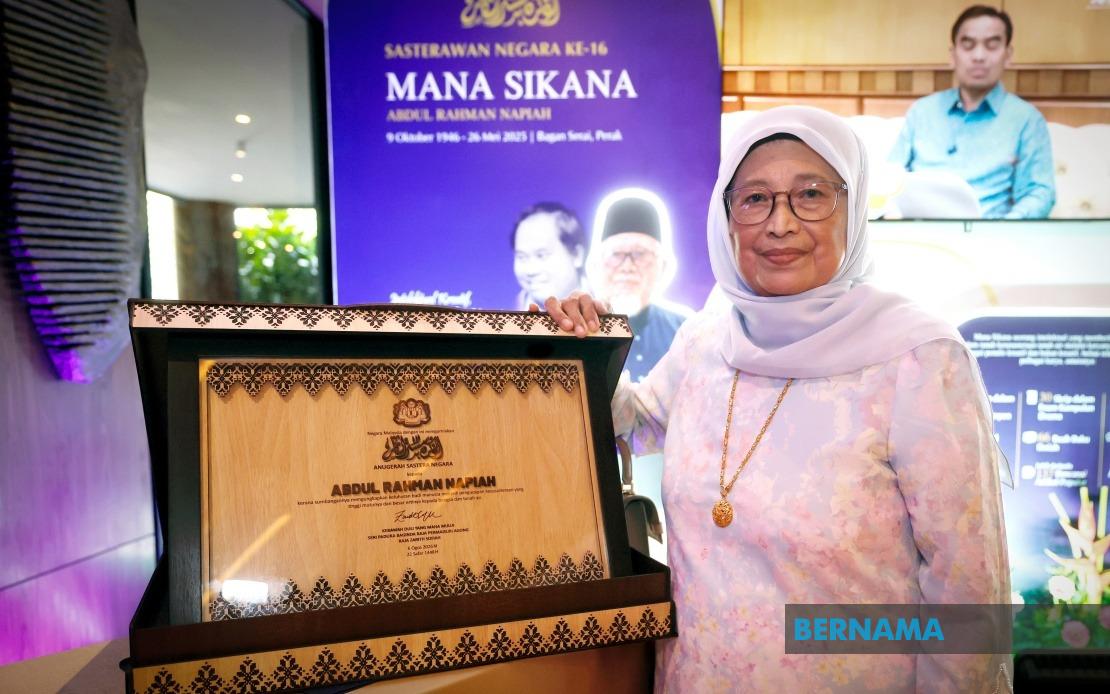
Malaysia's literary establishment paid tribute this week to Dr Abdul Rahman Napiah, the celebrated writer and academic better known by his pen name Mana Sikana, who has been named the 16th National Laureate. The honour was conferred posthumously, with Her Majesty Raja Zarith Sofia, Queen of Malaysia, presenting the award at a ceremony in Kuala Lumpur on August 6. The recognition came as vindication for a man whose influence spanned creative writing, literary theory, and higher education across multiple nations throughout a career spanning six decades.
Salmah Ali, the 82-year-old widow of the literary giant, accepted the accolade on his behalf, describing it as acknowledgment that had eluded him during his lifetime despite his towering contributions to Malaysian letters. Speaking with visible emotion at the presentation, Salmah revealed that her husband had anticipated and hoped for this particular recognition. The timing of the honour carried poignant significance—Mana Sikana had been informed of the possibility of receiving the award before his death in May last year at the age of 80 from heart complications, meaning he understood the recognition was coming but did not live to witness it formally bestowed.
The trajectory of Mana Sikana's literary career began in his schooldays and never wavered in its ambition or output. Born in Bagan Serai, Perak, on October 9, 1946, he initially worked as a teacher before transitioning into academia, a shift that would define the latter and more influential portion of his professional life. His academic appointments took him through several prestigious Malaysian institutions, including Universiti Kebangsaan Malaysia (UKM) and Universiti Pendidikan Sultan Idris (UPSI), where he eventually attained the rank of professor. Beyond Malaysia's borders, his reputation attracted visiting lecturer positions at universities in Indonesia, extending his intellectual footprint across the region and cementing his status as a Southeast Asian literary figure of consequence.
What distinguished Mana Sikana from many of his contemporaries was the breadth of his creative and scholarly engagement. Beyond the written page, he immersed himself in the dramatic arts, producing works for both radio and television during his time in Johor Bahru, with his productions finding airtime on Singaporean broadcasters as well as Malaysian television networks. This multimedia approach to literature reflected a modern understanding of how stories could reach audiences through evolving platforms. Throughout his career, he maintained simultaneous commitments to creative production, critical theory, and academic mentorship, rarely allowing one dimension of his work to overshadow the others.
Education Minister Fadhlina Sidek underscored the National Laureate selection committee's reasoning in her address at the ceremony, emphasising that Mana Sikana's selection reflected recognition of his instrumental role in strengthening the nation's literary foundations. The award was not merely for individual works of fiction or poetry, but for his systemic contributions to how Malaysia's literary culture was theorised, taught, and advanced through both creative and academic channels. His influence extended into the living rooms of Malaysian families through television and radio, into university lecture halls where he shaped emerging writers, and into the homes of his own descendants.
Salmah illustrated the enduring nature of her husband's commitment to literary transmission by noting that he continued sharing his knowledge of writing and literature with their four children and twelve grandchildren until the very end of his life. This intergenerational passing of craft and philosophy was characteristic of how Mana Sikana viewed his vocation—not as a collection of published works to be achieved and then set aside, but as a living practice to be continuously refined and transmitted. The day he suffered the fatal heart attack, he had been engaged in precisely this kind of intellectual labour, presenting a working paper to Dewan Bahasa dan Pustaka before collapsing.
The National Laureate award represents Malaysia's highest formal recognition for literary contribution, a distinction that has been bestowed only fifteen times previously. That Mana Sikana received this honour posthumously rather than in the twilight of his active career speaks to both the changing pace of institutional recognition and the enduring relevance of his body of work. For Malaysian readers and writers, the award validates a figure whose influence may have seemed dispersed across multiple media and institutions rather than concentrated in the monumental single-work achievements that sometimes dominate literary consciousness.
For Southeast Asian literary scholars, the recognition of Mana Sikana carries additional weight, signalling Malaysia's continued investment in honouring intellectuals whose work transcends national boundaries. His visiting lectureships in Indonesia and his involvement with Singaporean media during a formative period in regional broadcasting history positioned him as a figure whose contributions belonged not just to Malaysia but to the broader cultural development of Southeast Asia. The conferment of this award therefore extends recognition beyond one man's individual achievement to acknowledge the regional literary networks and cross-border cultural exchanges that shaped modern Southeast Asian letters.
The absence of Mana Sikana from the ceremony while his widow stood in his place created an poignant tableau that will likely resonate through Malaysian literary circles for years to come. Salmah expressed both pride and profound sadness at receiving the honour without her husband present to experience it, having known how deeply he desired this recognition. Yet the award's posthumous nature does not diminish its significance—if anything, it ensures that future generations of Malaysian writers and scholars will regard Mana Sikana not as a historical figure whose influence has faded, but as a foundational voice whose theoretical contributions and creative output remain vital to understanding how Malaysian literature developed and globalised throughout the latter twentieth century.

