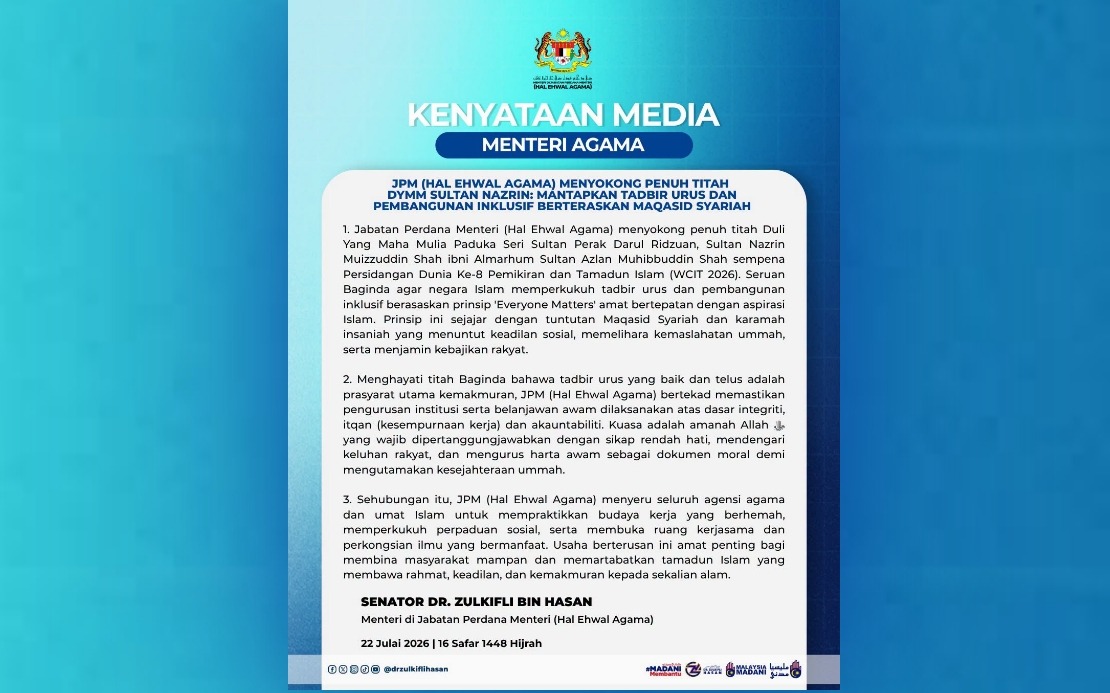
The Prime Minister's Department (Religious Affairs) has committed itself to advancing religious institutional management through frameworks built on integrity, accountability, and genuine public welfare, positioning these principles as central to Malaysia's approach to Islamic governance. This undertaking emerges directly from Sultan Nazrin Shah's recent articulation at the World Conference on Islamic Thought and Civilisation that Muslim nations must embrace good governance rooted in the concept that everyone matters—a philosophy the government now seeks to embed across Malaysia's religious administration.
Dr Zulkifli Hasan, Minister in the Prime Minister's Department (Religious Affairs), framed this commitment as more than administrative reform. In his statement, he emphasised that the sultan's vision aligns fundamentally with Islamic principles themselves, arguing that inclusive governance is not a Western imposition but rather an authentic expression of Islamic values. This positioning is strategically important, as it preempts any suggestion that adopting participatory governance models represents a departure from Islamic doctrine or surrenders Malaysia's Islamic identity to external pressures.
The alignment with Maqasid Syariah—the objectives of Islamic law—and the concept of karamah insaniah (human dignity) forms the theological underpinning of this approach. These are not peripheral concerns but central to how Islamic jurisprudence has traditionally understood governance's purpose: protecting faith, life, intellect, lineage, and property while safeguarding human dignity. By invoking these classical Islamic frameworks, the government signals that strengthening governance standards and expanding citizen participation represent a deepening rather than a dilution of Islamic principles in public administration.
Sultan Nazrin's broader thesis, delivered at the 8th World Conference on Islamic Thought and Civilisation, positioned inclusive governance as inseparable from national unity and effective leadership. The sultan articulated that public services genuinely serving all citizens irrespective of race, religion, or political affiliation demonstrate both national cohesion and the humility required of leaders who listen before legislating. This formulation carries particular resonance in Malaysia's diverse context, where religious administration touches citizens of various faiths and where the legitimacy of religious institutions depends partly on their perceived fairness and responsiveness to broader society.
The department's emphasis on social justice and ummah welfare reflects a recalibration of how religious governance relates to the wider population. Rather than positioning Islamic institutions as separate domains operated according to purely theological logic, this framework insists they must demonstrate tangible benefits to community wellbeing. This shift acknowledges that in modern Malaysia, religious institutions' authority increasingly depends on demonstrating institutional competence, financial propriety, and genuine responsiveness to public concerns—not merely on doctrinal legitimacy.
Dr Zulkifli's invocation of authority as amanah (divine trust) requiring humility and people-centred management introduces an ethical dimension to administrative practice. The language of listening to grievances and exercising financial stewardship as moral responsibility—rather than merely bureaucratic obligation—represents a deliberate appeal to religious motivation among officials. This approach attempts to cultivate what might be termed religious administration as spiritual practice, where adherence to governance standards becomes an expression of faith rather than an externally imposed compliance burden.
The government's call for courteous workplace culture and strengthened social unity across religious agencies suggests recognition that institutional reform requires cultivation at the human level. Merely implementing systems of accountability without fostering collaborative attitudes and knowledge-sharing practices would remain incomplete. This holistic vision acknowledges that good governance emerges from both structural mechanisms and the character of individuals operating within those structures.
For Southeast Asian context, Malaysia's adoption of these governance principles positions it as attempting a distinctive synthesis: maintaining robust Islamic institutional frameworks while embedding them within participatory, accountable governance structures. This model may offer relevant lessons for other Muslim-majority democracies navigating comparable tensions between religious authority and democratic accountability. The articulation that such integration strengthens rather than weakens Islamic governance represents a notable intellectual positioning in regional debates.
The emphasis on development that cannot proceed in isolation, combined with Sultan Nazrin's observation that no nation can isolate itself from global trade and knowledge exchange, suggests the government sees good governance as essential to Malaysia's international competitiveness and prosperity. Religious institutions operating with integrity and public accountability become assets in Malaysia's broader development narrative rather than sectors requiring defensive protection from external scrutiny. This reframing potentially transforms how religious affairs departments approach their roles—not as guardians against modernisation but as contributors to sustainable national development.
Implementation of these principles will determine their significance. The gap between ministerial statements and ground-level institutional practice in Malaysia's religious bureaucracies remains substantial. Whether departmental structures, resource allocation, and personnel evaluation systems genuinely orient toward accountability and public welfare, or whether such commitments remain rhetorical, will reveal the depth of this governance reform commitment.
The government's framework also implicitly acknowledges that Malaysia's religious administration has faced criticism regarding financial transparency, responsiveness to public concerns, and equitable treatment across different communities. By explicitly adopting a governance model emphasising accountability and inclusive well-being, the department positions itself as responsive to these concerns while grounding reform in Islamic rather than secular justifications. This preemptive framing seeks to shape how religious governance reforms are understood domestically and internationally.

