Sudden cardiac arrest remains one of Malaysia's most formidable public health challenges, claiming lives with devastating frequency and minimal warning. The statistics paint a sobering picture: Malaysia's survival rates from cardiac arrest hover between just 0.5 and 8.5 percent, figures that stand starkly below international benchmarks and underscore a critical vulnerability in the nation's emergency response infrastructure. This disparity is not merely a medical statistic—it represents hundreds of preventable deaths annually, each one a tragedy that could potentially have been averted with the right equipment and rapid intervention.
The gap between what is needed and what is currently available stems from two interconnected problems. First, Automated External Defibrillators (AEDs) remain scarce in public spaces where cardiac emergencies are most likely to strike: shopping malls, transport terminals, office buildings and cultural venues. Second, the public remains largely untrained in cardiopulmonary resuscitation and AED use, leaving bystanders paralysed by uncertainty when confronted with a medical crisis. Without CPR initiated within the critical eight to ten-minute window following cardiac arrest, survival odds plummet dramatically. Every moment of delay represents diminished chances of neurological recovery and life itself.
Recognising this urgent need, Sunway Medical Centre Velocity has launched an ambitious initiative to strategically position AEDs throughout Kuala Lumpur's high-traffic zones while simultaneously building public capability through hands-on emergency response training. The project, operating under the hospital's corporate social responsibility framework, represents a departure from reactive healthcare toward proactive community resilience. Rather than waiting for cardiac emergencies to occur and then scrambling to respond, this approach embeds life-saving infrastructure into the fabric of the city's most frequented locations.
The scope of the rollout is substantial and thoughtfully targeted. AED units are being installed at major MRT stations including Tun Razak Exchange, Bukit Bintang, Ampang Park and Muzium Negara, alongside commercial landmarks such as Aquaria KLCC, Menara Public Bank, Menara Public Bank 2, and the upcoming National Heritage Building within the Merdeka 118 Precinct. Each location was selected based on foot traffic patterns and the statistical likelihood of cardiac emergencies occurring in densely populated areas. The distribution across transportation hubs is particularly strategic, as train and bus stations concentrate large numbers of people—including elderly passengers at higher risk—into compact spaces where rapid medical response becomes both more necessary and more feasible.
Beyond mere equipment placement, the initiative incorporates design thinking aimed at ensuring accessibility during moments of high stress and urgency. Each AED unit will feature prominently designed standees that make the device immediately visible and identifiable to untrained members of the public. Quick Response codes linking to the hospital's "Save A Number, Save A Life" campaign webpage will be embedded on these standees, providing smartphone users with instant access to emergency guidance protocols. General practitioner clinics throughout the city will similarly display these QR codes, extending the reach of digital medical guidance into neighbourhood healthcare settings where community members regularly visit.
Dr Wee Tong Ming, Sunway Medical Centre Velocity's Medical Director and Consultant Emergency Physician, articulated the fundamental insight driving this intervention: deaths from cardiac arrest often result not from insufficient medical resources, but from delays in response and absence of accessible tools. He emphasised that survival hinges on the critical principle that every second matters in cardiac emergencies. The window of opportunity is narrow and unforgiving—bystanders who encounter a cardiac arrest victim face a race against cellular deterioration that accelerates exponentially with time. In this context, positioning AEDs within a two-minute walking distance of any public gathering space becomes not a luxury but a medical imperative.
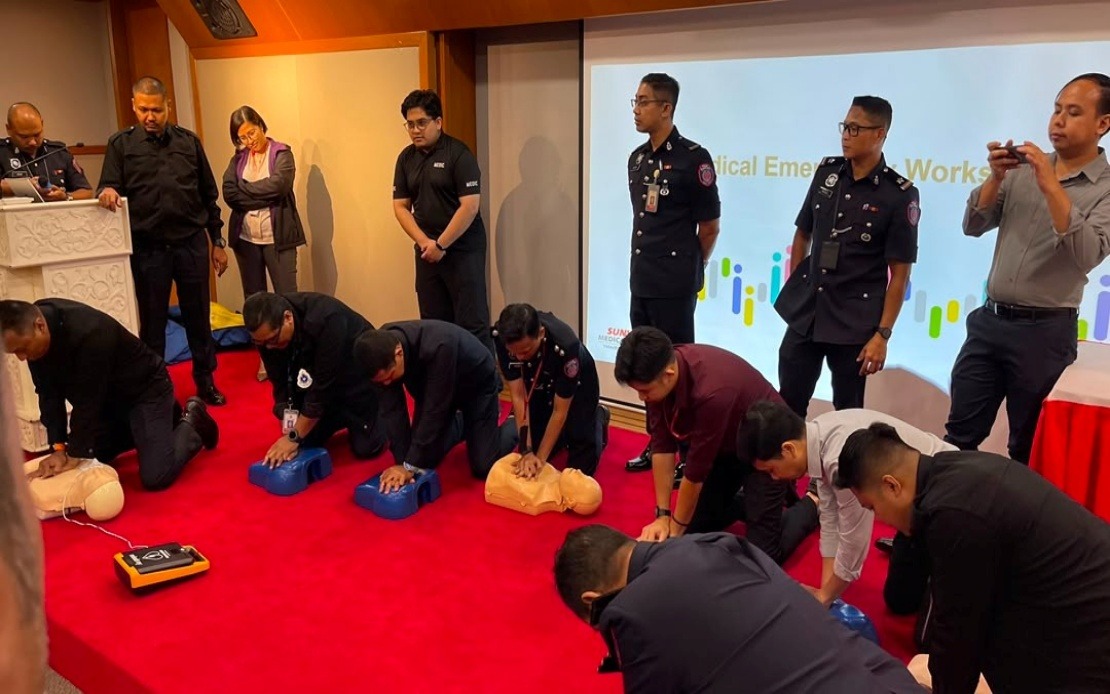
Education forms the second pillar of this comprehensive strategy, acknowledging that equipment without knowledge remains inert. The hospital has been conducting on-site training sessions and Accident and Emergency awareness talks across various venues, teaching members of the public to recognise cardiac arrest symptoms, perform basic life support techniques, and operate AED devices with confidence and proper technique. This educational component directly addresses a psychological barrier that prevents bystanders from intervening—the fear of doing something wrong or causing additional harm. Training dispels this paralysis by building competence and confidence, transforming ordinary citizens into potential lifesavers capable of acting decisively in medical crises.
Susan Cheow, Chief Executive Officer of Sunway Medical Centre Velocity, articulated a broader vision that frames cardiac emergency preparedness as a collective responsibility embedded within urban planning and public consciousness. She argued that no individual should feel helpless when confronted with medical emergency, whether due to lack of knowledge or absence of equipment. This philosophy represents a subtle but significant shift in how society approaches public health—moving from an assumption that emergencies are someone else's responsibility toward recognition that emergency preparedness belongs to everyone. When AED devices appear prominently in public spaces and training becomes routine, they send a cultural message that communities are organised and capable of saving their own members.
The infrastructure and training initiatives work synergistically to address the survival challenge from multiple angles simultaneously. Equipment accessibility eliminates the logistical barrier to intervention, while public training eliminates the knowledge barrier. Together, they create an environment where the probability of effective bystander intervention increases substantially. Research from other countries demonstrates that communities with widespread AED placement and CPR training can achieve cardiac arrest survival rates exceeding 50 percent—a tenfold improvement over Malaysia's current baseline. The gap between current Malaysian outcomes and international best practices is not insurmountable; it requires systematic investment in exactly the kind of infrastructure and education Sunway Medical Centre Velocity is implementing.
The selection of cardiac emergency preparedness as a corporate social responsibility focus reflects evolving understanding of how hospitals can leverage their medical expertise to improve public health outcomes beyond their immediate patient populations. Rather than limiting intervention to those who reach their emergency departments, Sunway Medical Centre Velocity is extending its reach into public spaces, shopping centres, and transport hubs where the majority of cardiac arrests actually occur. This represents healthcare moving upstream to prevent deaths before patients ever reach hospital doors—arguably the most cost-effective and impactful form of medicine.
For Malaysian policymakers and other healthcare institutions, this initiative offers a replicable model that could be scaled across other cities and regions. The components—strategic AED placement in high-traffic zones, visible signage and location design, digital connectivity through QR codes, and systematic public training—are neither technologically sophisticated nor prohibitively expensive. What they require is sustained commitment, coordination among stakeholders, and recognition that emergency preparedness should be designed into urban infrastructure rather than bolted on as an afterthought. If this Kuala Lumpur initiative succeeds in measurably improving cardiac arrest survival rates, it will generate compelling evidence for expansion to Penang, Johor Bahru, Subang Jaya, and other major population centres.
The deeper significance of this initiative lies in its implicit recognition that healthcare systems cannot function effectively in isolation from the communities they serve. Sudden cardiac arrest demonstrates this principle with particular clarity—the outcome depends overwhelmingly on what happens in the first minutes before any ambulance arrives, when only bystanders and nearby equipment matter. By positioning AEDs strategically and building public competence through training, Sunway Medical Centre Velocity is acknowledging that the hospital is only one component of a comprehensive emergency response ecosystem. The true lifesavers in cardiac emergencies are always ordinary people—shoppers, office workers, commuters—who happen to be present at the critical moment and possess the knowledge and tools to act. This initiative invests in empowering those ordinary people, transforming them from helpless witnesses into capable responders capable of literally saving lives.

