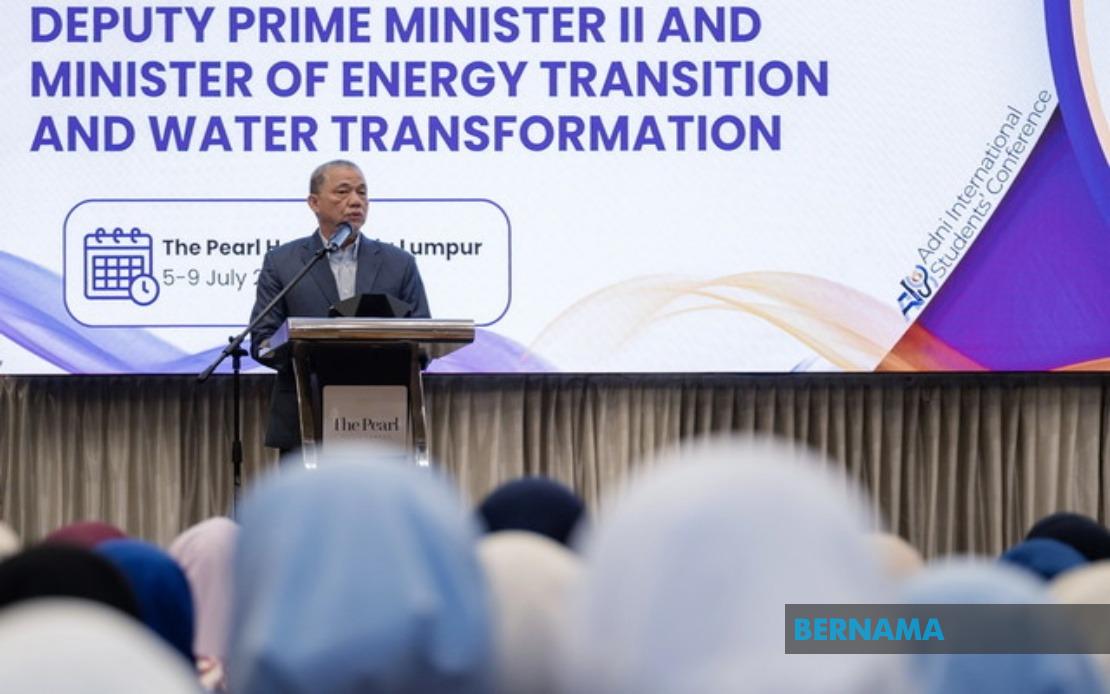
Deputy Prime Minister Datuk Seri Fadillah Yusof has emphasised that Malaysia's trajectory in the coming decades will be determined primarily by the calibre of its workforce and citizenry, rather than by economic indicators or technological prowess alone. Speaking at the opening of the ADNI International Students' Conference (AISC) 2026 in Kuala Lumpur on July 6, Fadillah outlined a holistic vision of national development that places people at the centre of policy-making. This perspective represents a significant pivot from conventional growth narratives that emphasise gross domestic product and infrastructure expansion, signalling instead a recognition that sustainable competitive advantage flows from the skills, values and adaptability of a nation's population.
The Deputy Prime Minister articulated the contemporary skill set necessary for individuals to thrive in an era of rapid globalisation and technological disruption. Citizens must possess critical thinking capabilities that enable them to analyse complex problems, communicate their ideas with precision and clarity, and demonstrate the flexibility to adjust to shifting economic and social conditions. These competencies have become increasingly indispensable as Malaysia competes for talent and investment in a region where neighbouring economies have made comparable strides in economic development. The emphasis on adaptability carries particular weight given the accelerating pace of technological change and the uncertainty surrounding which industries will drive growth a decade hence.
Fadillah identified four interconnected challenges that transcend national boundaries and demand coordinated multilateral responses: the environmental crisis, the fragility of public health systems exposed by recent pandemics, the acceleration of digital transformation that leaves many populations behind, and the persistent widening of inequality within and between countries. These issues cannot be resolved through the efforts of any single government or sector acting independently. Instead, addressing them requires an unprecedented convergence of effort spanning governmental structures, universities and research institutions, commercial enterprises, grassroots organisations and the emerging generation itself. This framing suggests that Malaysia's development strategy must embed collaboration mechanisms and institutional partnerships that facilitate knowledge-sharing and joint problem-solving across traditional silos.
In anchoring his remarks to the MADANI Government's policy agenda, Fadillah drew an explicit line connecting contemporary priorities to Malaysia's earlier history. He invoked the legacy of Tun Hussein Onn, the nation's third Prime Minister, emphasising that a country's resilience ultimately derives from the harmony among its diverse populations and the strength of character they collectively demonstrate. This historical reference grounds the human capital discourse within Malaysia's specific context as a multiethnic, multireligious society where social cohesion remains both an asset and a continuing challenge. The allusion suggests that economic advancement and technological modernisation, while necessary, lack meaning if they occur in an environment fractured by distrust or division.
The Deputy Prime Minister articulated a vision of development that extends beyond the conventional metrics of educational attainment or income generation. True progress, in his formulation, encompasses the cultivation of ethical frameworks, the nurturing of creative potential, the integration of environmental stewardship into decision-making processes, and the reinforcement of bonds among citizens. This expansive conception of development reflects principles embedded in the United Nations Sustainable Development Goals, which the government has adopted as a guiding framework. By tethering national objectives to the SDG agenda, Malaysia positions itself as a contributor to global solutions while addressing localised needs.
Fadillah highlighted the particular value of intellectual engagement and exposure to different cultural perspectives in shaping globally conscious individuals who maintain robust connections to their own identities and values. The AISC 2026 gathering, which drew approximately 150 participants from Malaysia and across Southeast Asia including Thailand, the Philippines and Indonesia, exemplifies this principle in practice. Regional conferences of this nature create spaces where young leaders can exchange perspectives grounded in their distinct national experiences whilst identifying shared concerns and collaborative opportunities. Such platforms become increasingly significant as geopolitical competition intensifies and regional stability depends on relationships forged through mutual understanding rather than state-to-state diplomacy alone.
The Deputy Prime Minister's observation regarding artificial intelligence carries implications that extend beyond rhetorical flourish. As machine learning systems become more sophisticated and capable of performing routine cognitive tasks, the distinctly human qualities of practical wisdom—the ability to exercise sound judgment in novel situations—become more valuable rather than less. Similarly, whilst technology mediates an expanding share of human interaction, the irreducibility of compassion and empathy to algorithmic processes means that these dimensions of human experience will remain central to addressing social challenges. This framing implicitly cautions against the techno-utopianism that sometimes characterises development discourse in the region, suggesting instead that technological tools serve human purposes rather than replacing human agency.
The thematic focus of AISC 2026, centred on 'Thriving Together: Diversity, Education and Wellness in a Digital World', encapsulates these preoccupations with particular relevance to Southeast Asia. The region encompasses some of the world's most ethnically and religiously heterogeneous societies, many of which grapple with the challenges of managing diversity whilst building inclusive institutions. The emphasis on education reflects recognition that quality learning systems serve as vehicles for social mobility whilst simultaneously shaping civic consciousness. The inclusion of wellness in the conference framework acknowledges that individual and collective wellbeing encompasses mental health, physical vitality and psychological resilience—dimensions that preceding development models often overlooked.
For Malaysia specifically, the articulation of human capital development as the paramount strategic priority offers a clarifying lens through which to assess existing policies and resource allocation. Educational institutions at all levels face mounting pressure to balance the production of graduates with specific technical skills demanded by industry with the cultivation of broader capabilities in critical thinking and creative problem-solving. The vocational and technical training sector, which accounts for a significant proportion of enrolments, must evolve to develop learners who can navigate technological change rather than master particular tools destined to become obsolete. Universities confront questions about curriculum relevance, the balance between disciplinary depth and interdisciplinary breadth, and the extent to which their research missions align with pressing national challenges.
The regional context adds further dimensions to these considerations. The Association of Southeast Asian Nations encompasses countries at varying stages of economic development, with disparities in educational quality and access that create unequal opportunities for talented individuals across the region. The circulation of human capital across national borders—through migration, diaspora networks and transnational education—represents both an opportunity and a potential drain on countries that invest heavily in developing their populations only to see significant numbers emigrate in search of superior economic prospects. Fadillah's emphasis on values and identity alongside skills suggests an implicit concern that economic internationalisation should not erode the distinctive character of national societies.
The emphasis on cross-cultural engagement and regional cooperation carries geopolitical significance in an era when the Indo-Pacific region faces intensifying great power competition. The cultivation of networks among young leaders who have developed mutual understanding and shared commitment to addressing transnational challenges potentially strengthens the region's capacity for autonomous action on matters affecting its collective interests. Educational exchanges and intellectual partnerships can reinforce regional cohesion even as individual nations pursue distinct development paths and maintain varied international alignments. In this sense, investment in human capital quality serves not merely economic functions but also contributes to regional stability and the preservation of space for smaller nations to navigate great power pressures.
Moving forward, translating the policy rhetoric around human capital development into concrete institutional change and resource commitments presents substantial challenges. Educational reform requires sustained investment, changes to teacher preparation and compensation, curriculum revision and assessment systems that measure capabilities beyond standardised testing. The private sector must be incentivised to engage with educational institutions in ways that strengthen rather than merely exploit the learning process. Civil society organisations can facilitate the kinds of cross-cultural dialogue that the Deputy Prime Minister emphasised. These actions, individually modest, collectively represent a demanding agenda that will test the government's commitment to prioritising human development over competing fiscal and political demands. The success or failure of this approach will substantially shape Malaysia's competitive position and social stability in the decades ahead.

