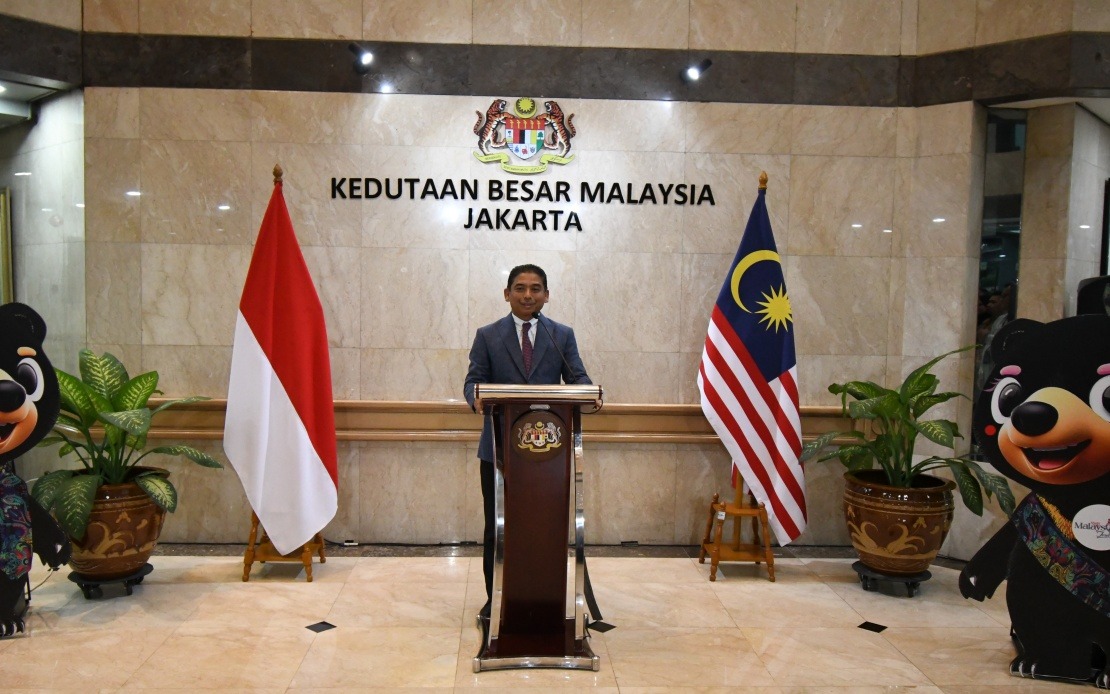
Datuk Muzafar Shah Mustafa has officially commenced his duties as Malaysia's Ambassador to Indonesia following his arrival in Jakarta on August 10, marking a significant transition in Malaysia's diplomatic representation to its largest Southeast Asian neighbour. The appointment represents a strategic move by Kuala Lumpur to strengthen bilateral relations with Indonesia, a nation with which Malaysia shares deep historical, cultural and economic ties spanning centuries.
Muzafar received his letter of credence from Yang di-Pertuan Agong Sultan Ibrahim at Istana Negara on July 14, formally authorizing him to represent Malaysian interests at the embassy in Jakarta. His arrival comes after he completed nearly three years as Malaysia's High Commissioner to India, a major diplomatic post overseeing Malaysian interests across the Indian subcontinent. He departed New Delhi on July 9, allowing a brief transition period before assuming his new responsibilities.
The timing of this ambassadorial change reflects Malaysia's ongoing commitment to maintaining robust diplomatic channels with Jakarta as regional geopolitical dynamics continue to evolve. Indonesia, as the largest economy in Southeast Asia and a key player in ASEAN, holds considerable importance for Malaysian foreign policy objectives. The appointment of an experienced diplomat like Muzafar underscores the significance Kuala Lumpur places on this bilateral relationship.
With a career spanning nearly three decades in Malaysia's Foreign Ministry, Muzafar brings substantial international experience to his new posting. He joined the diplomatic service in 1995 and has accumulated extensive exposure to diverse regions and political systems across three continents. This breadth of experience positions him well to navigate the complexities of Malaysia-Indonesia relations, which encompass trade, security cooperation, maritime boundary matters and cultural exchange.
Prior to his assignment in India, Muzafar served as Malaysia's Ambassador to Mexico from 2018 to 2023, during which period he also held accreditation responsibilities for Belize, Costa Rica, El Salvador, Guatemala and Honduras. This Latin American posting demonstrated his capacity to manage multi-country diplomatic operations simultaneously, a skill increasingly valuable in modern diplomacy where ambassadors often oversee several nations from a single headquarters.
His earlier diplomatic assignments reveal a diplomat who has cut his teeth across multiple challenging environments. Between 2016 and 2018, he represented Malaysia in Venezuela, navigating a period of significant political turbulence in that country. His earlier postings included service as counsellor at the Malaysian Embassy in Berlin from 2007 to 2011, placing him in Europe during consequential years for international relations, and as second secretary at the Malaysian Embassy in Baghdad from 1999 to 2003, during a period when Iraq faced substantial international attention and complex geopolitical circumstances.
The ambassador's personal background includes marriage to Datin Najwa Zainal and four children. This family dimension adds to the human element of diplomatic postings, as ambassador families often serve as important cultural ambassadors themselves through their community engagement and social functions, particularly in major capitals like Jakarta.
Muzafar's appointment to Jakarta assumes added importance given the regional context in which Malaysia and Indonesia operate. Both nations share responsibilities within ASEAN, coordinate on maritime security matters, manage shared maritime boundaries and collaborate on regional economic initiatives. The quality of diplomatic representation between the two countries can influence how effectively they address shared challenges including terrorism, transnational crime and regional stability.
The bilateral relationship between Malaysia and Indonesia has historically been characterized by periodic tensions alongside deep cooperation. Issues ranging from maritime boundary demarcation to labour migration and historical disagreements require careful diplomatic management. Ambassadors serve as crucial conduits for dialogue, helping to resolve misunderstandings and build understanding between governments and peoples.
Muzafar's appointment also reflects Malaysia's broader diplomatic strategy of staffing key posts with career professionals who have demonstrated competence across multiple assignments. Rather than political appointments, Malaysia's Foreign Ministry generally favours career diplomats for ambassador positions, a practice that has contributed to the ministry's professional reputation and effectiveness in advancing national interests abroad.
As Muzafar settles into his role in Jakarta, the embassy will continue managing the full spectrum of bilateral relations including political dialogue, trade and investment facilitation, consular services for Malaysian citizens, and cultural and educational exchanges. The ambassador will also serve as Malaysia's representative to ASEAN, which has its secretariat in Jakarta, adding another important dimension to his responsibilities.
Looking ahead, observers will watch how Muzafar's diplomatic approach shapes Malaysia-Indonesia engagement during his tenure. His experience managing relations across Latin America, Europe and Asia, combined with his previous work in India, equips him with comparative perspectives valuable for understanding Indonesia's regional and global positioning. His appointment signals Malaysia's commitment to maintaining high-level diplomatic engagement with Indonesia and suggests that both countries view their relationship as sufficiently important to assign seasoned professional diplomats to manage it.

