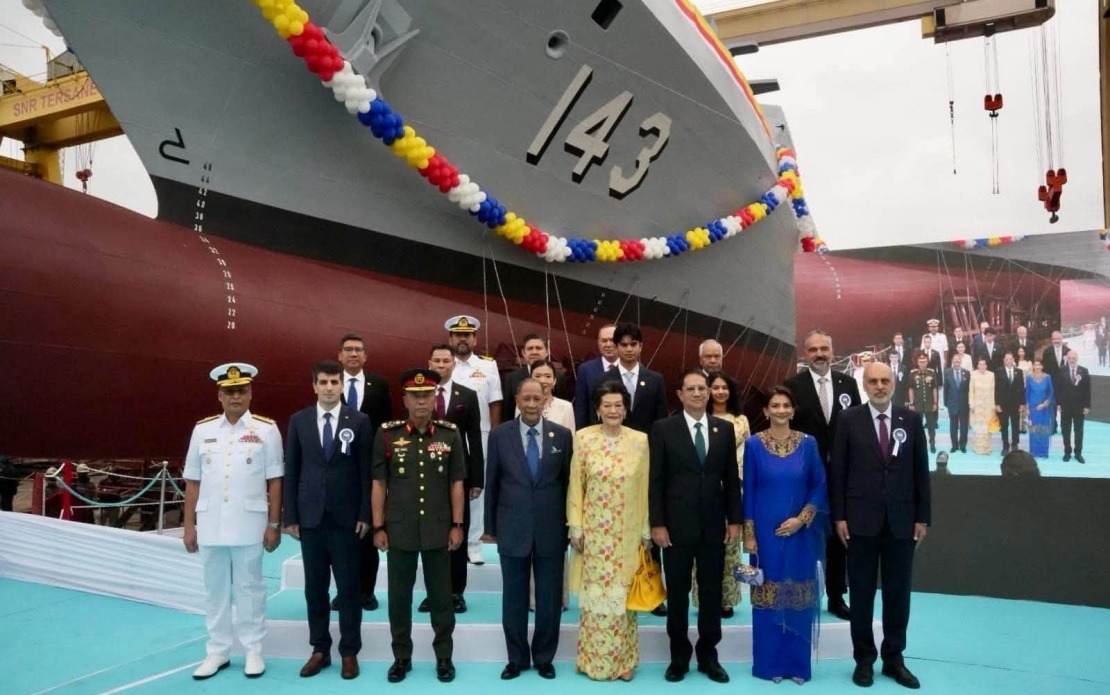
The Royal Malaysian Navy faces mounting pressure to strengthen its operational capabilities in response to an increasingly volatile maritime environment, Defence Minister Datuk Seri Mohamed Khaled Nordin underscored during the launch of the third Littoral Mission Ship Batch 2 vessel. Named Tunku Osman Jewa in honour of the late General Tan Sri Tunku Osman Tunku Mohammad Jewa, a former Armed Forces chief and member of the Kedah royal family, the ship's commissioning marks a significant milestone in Malaysia's naval modernisation drive. The vessel's naming reflects both contemporary defence priorities and historical recognition, bridging the armed forces' institutional memory with its future operational posture.
The defence ministry has made clear its commitment to equipping the RMN with vessels and systems capable of protecting Malaysian territorial waters and advancing the nation's maritime interests amid geopolitical complexities affecting Southeast Asia. The Littoral Mission Ship programme represents precisely this strategic calculus—acquiring platforms designed for operations in the shallow and congested waters characterising the region's maritime domain. Such vessels prove increasingly essential as naval competition intensifies throughout Southeast Asia, where traditional boundaries between constabulary and military functions blur significantly, particularly in contested waters and along shipping lanes critical to regional commerce.
The Tunku Osman Jewa launch ceremony drew Malaysia's highest ceremonial representation, with the Sultan of Kedah, Al Aminul Karim Sultan Sallehuddin Sultan Badlishah, and the Sultanah of Kedah, Sultanah Maliha Tengku Ariff, gracing the occasion. This royal attendance underscores the political importance attached to naval acquisition programmes, reflecting how defence procurement intersects with state-level protocols and dynastic histories. The ceremony's formality signals that the government views naval modernisation not merely as a technical military matter but as a component of national sovereignty and regional standing.
Completion of the three-ship Littoral Mission Ship Batch 2 series represents the culmination of a procurement initiative fundamentally distinctive in Malaysia's recent defence acquisition history. The programme constitutes the first Government-to-Government collaboration between Malaysia and Türkiye for the procurement of Royal Malaysian Navy warships, opening a new dimension in bilateral defence relations. This partnership diverges from Malaysia's historical reliance on European, American, and Asian suppliers, potentially reshaping defence procurement patterns and signalling a diversification strategy across the Turkish defence industrial ecosystem. Turkish naval shipbuilding has expanded significantly over the past decade, with Istanbul-based yards developing considerable expertise in constructing vessels suited to regional maritime conditions.
The three LMSB2 vessels are scheduled for complete delivery to the Royal Malaysian Navy by the end of 2027, establishing a timeline within which Malaysia must absorb significant operational and maintenance responsibilities. The programme's completion necessitates extensive training protocols for RMN personnel, infrastructure adaptations at naval bases, and the development of supply chains for spare parts and technical support. These considerations extend beyond mere vessel acquisition, demanding institutional adjustments throughout the maritime command structure and requiring coordination across multiple government agencies responsible for naval operations, logistics, and strategic planning.
Minister Mohamed Khaled contextualised the Littoral Mission Ship programme within the broader 15-to-5 Transformation Plan, a comprehensive modernisation strategy intended to reshape the RMN's operational footprint and technological sophistication. This overarching initiative envisions reducing the total naval fleet from fifteen distinct vessel categories to five consolidated classifications, streamlining operations, reducing training complexity, and focusing maintenance resources. Such transformation agendas, while tactically sound, invariably generate institutional friction as naval personnel adjust to new systems and cultural adjustment within an established military hierarchy. The consolidation model theoretically produces operational efficiencies but demands significant managerial attention during implementation phases.
Malaysia's maritime security challenges have intensified markedly over the past decade, encompassing traditional sovereignty concerns alongside transnational maritime crime, piracy, and unauthorised resource extraction. The Straits of Malacca, through which approximately one-quarter of global maritime trade transits, represents a particular strategic focus requiring enhanced naval presence and surveillance capabilities. Littoral mission ships, with their shallow-draft design and relatively modest crew requirements, prove ideally suited for persistent presence operations, maritime constabulary functions, and responsive deployment across Malaysia's extensive exclusive economic zone. Their acquisition therefore reflects strategic prioritisation of capability over raw tonnage, acknowledging resource constraints while maintaining operational relevance.
The Türkiye partnership carries broader geopolitical implications for Malaysia's defence positioning within Southeast Asia's security architecture. Turkish defence industrialisation represents a non-Western alternative for military procurement, potentially offering cost advantages and customisation options relative to traditional suppliers. The success of this initial programme may encourage similar partnerships across additional defence categories, from aviation to ground forces systems. Such diversification reduces dependency on any single supplier nation while potentially strengthening bilateral relations with an increasingly influential Middle Eastern power with expanding global defence market reach.
Staffing and training represent critical challenges as the three new vessels enter service. The RMN must recruit, vet, and train hundreds of additional personnel across multiple specialisations—from engineering and navigation to combat systems operation and maintenance. Training pipelines extending into 2028 and beyond will determine operational effectiveness, requiring coordination with Turkish defence institutions for knowledge transfer and expertise development. The success of earlier acquisition programmes provides some confidence, yet each new platform generation introduces technological challenges requiring sustained institutional commitment beyond the initial procurement phase.
The maritime security environment confronting Malaysia continues evolving in ways that acquisition timelines cannot always address. By 2027, when all three Littoral Mission Ships enter service, regional maritime conditions may have shifted significantly, potentially rendering some design assumptions less relevant. This temporal disconnect between procurement conception and operational deployment represents a perpetual challenge for military planners, necessitating flexibility in doctrine development and tactical employment strategies. The RMN's officer corps must therefore prepare operating concepts that maximise these vessels' utility across potential future scenarios rather than simply replicating past operational patterns.
Financially, the LMSB2 programme represents substantial capital commitment within Malaysia's defence budget, necessarily affecting resource allocation for other military priorities. The government's declared commitment to completing deliveries by 2027 signals sustained political will despite potential budgetary pressures. However, true cost calculation extends beyond purchase price to encompass life-cycle expenses including crew training, maintenance infrastructure, fuel consumption, and eventual decommissioning. Long-term budgeting frameworks must accommodate these persistent obligations while simultaneously addressing emerging security challenges and modernisation requirements across the broader armed forces establishment.

