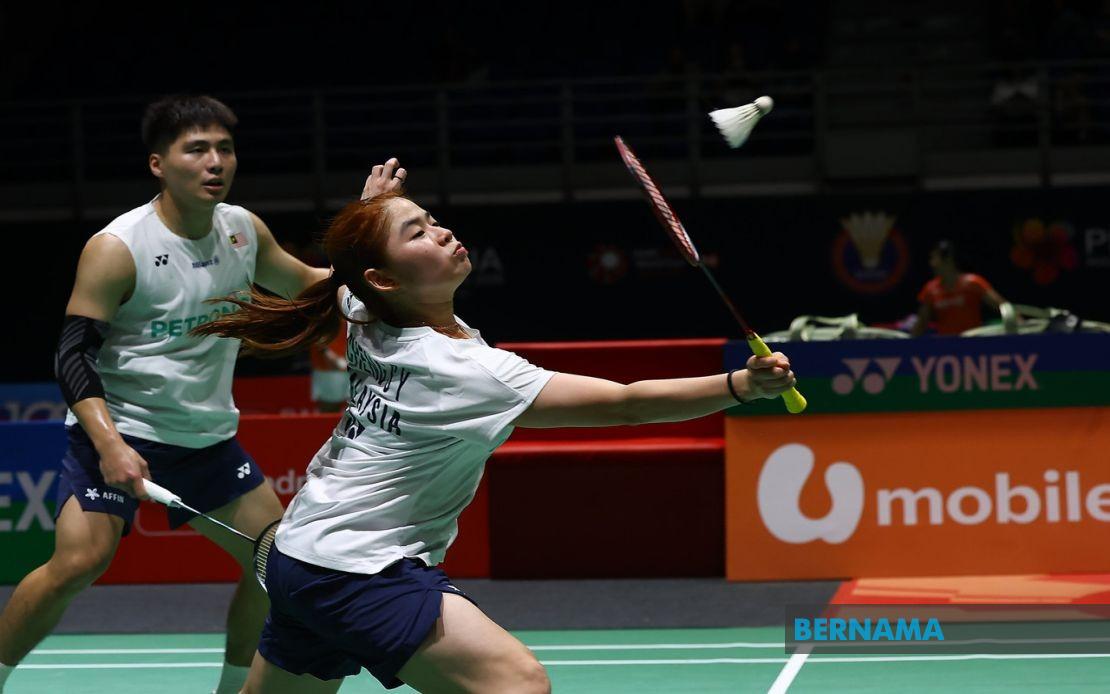
Malaysia's involvement in the Japan Open badminton championship came to an end on July 18 when both of its remaining pairs fell in the semifinal stage in Tokyo, capping what had been an encouraging run through the tournament for both combinations.
The unseeded mixed doubles partnership of Jimmy Wong and Cheng Su Yin encountered Hong Kong's Tang Chun Man and Tse Ying Suet in their semifinal match. What unfolded was a tightly contested battle that stretched across 69 minutes of intense rallies before the Hong Kong pair prevailed with a scoreline of 21-17, 18-21, 15-21. The Malaysian pair's performance throughout the championship suggests they possess the technical capability and tactical awareness to compete effectively against the sport's elite partnerships, even if they ultimately fell short against experienced opposition.
Wong and Cheng had demonstrated admirable resilience through earlier rounds to reach this stage, overcoming higher-ranked opponents in a manner that captured the attention of Malaysian badminton followers. Their journey through the draw represented a positive narrative for the sport in the country, showing that emerging talent could still challenge the established hierarchy of international pairs. Despite the defeat, their semifinal appearance validates the investment in developing this particular pairing.
The men's doubles situation saw Goh Sze Fei and Nur Izzuddin Rumsani facing South Korea's Kim Won Ho and Seo Seung Jae, ranked as the world's premier partnership in the men's doubles category. The Malaysian duo battled gamely throughout the 58-minute encounter but ultimately could not find the consistency required to upset the top-seeded Koreans.
Goh and Nur Izzuddin encountered difficulty establishing their rhythm in the opening game, finding themselves substantially outplayed as they conceded a 12-21 defeat. However, they exhibited considerable character in the second game, reversing the momentum decisively to record a 21-11 victory and force the contest into a deciding third set. That final game proved decisive in favour of the South Koreans, who closed out the match 21-13 to secure their place in the final.
The Malaysian men's doubles pair's head-to-head record against the South Korean combination stands at three losses from five competitive meetings. This statistical backdrop suggests that while Goh and Nur Izzuddin have demonstrated they can compete at the highest level, the Korean partnership possesses a slight edge in their personal matchups. Such meetings at major championships serve as valuable learning experiences, providing insights into tactical adjustments and physical conditioning requirements needed to compete consistently against world-class opposition.
From a Malaysian badminton perspective, the tournament highlighted both the progress being made by emerging players and the challenges that remain in the sport. The fact that the country fielded pairs competitive enough to reach the semifinal stage at a prestigious event like the Japan Open demonstrates the depth of talent within the domestic badminton ecosystem. Coaches and administrators can draw positives from these performances when assessing the trajectory of the national programme.
The region's badminton landscape remains dominated by powerhouses like South Korea, Indonesia, and Thailand, who consistently produce world-class competitors across multiple categories. Malaysia's presence at this level of competition, while respectable, underscores the work still required to narrow the gap with these established nations. Investment in player development, coaching expertise, and competitive exposure will be critical as the country seeks to improve its standing in international badminton.
For Jimmy Wong and Cheng Su Yin specifically, the Japan Open performance suggests they merit continued opportunities in the mixed doubles circuit at major tournaments. Building consistency against the world's top-ten pairs remains their immediate objective, and the experience garnered in Tokyo will prove invaluable as they continue their development. Tournament mathematics show that unseeded pairs reaching semifinals represents a tangible achievement in the contemporary badminton calendar.
Similarly, Goh Sze Fei and Nur Izzuddin will view their campaign as representative of their competitive standing. Pushing the world number one pair to the brink before succumbing in the decider illustrates their capability, though they must identify specific areas where marginal gains could prove decisive in future encounters. The correlation between physical conditioning and mental resilience in three-game contests will likely form part of their analysis moving forward.
For Malaysian fans and administrators, these semifinal appearances at the Japan Open represent a baseline standard for major championship performances. The challenge now lies in translating these promising results into consistent victories at future tournaments, gradually building momentum that could culminate in medal finishes at prestigious international events.

