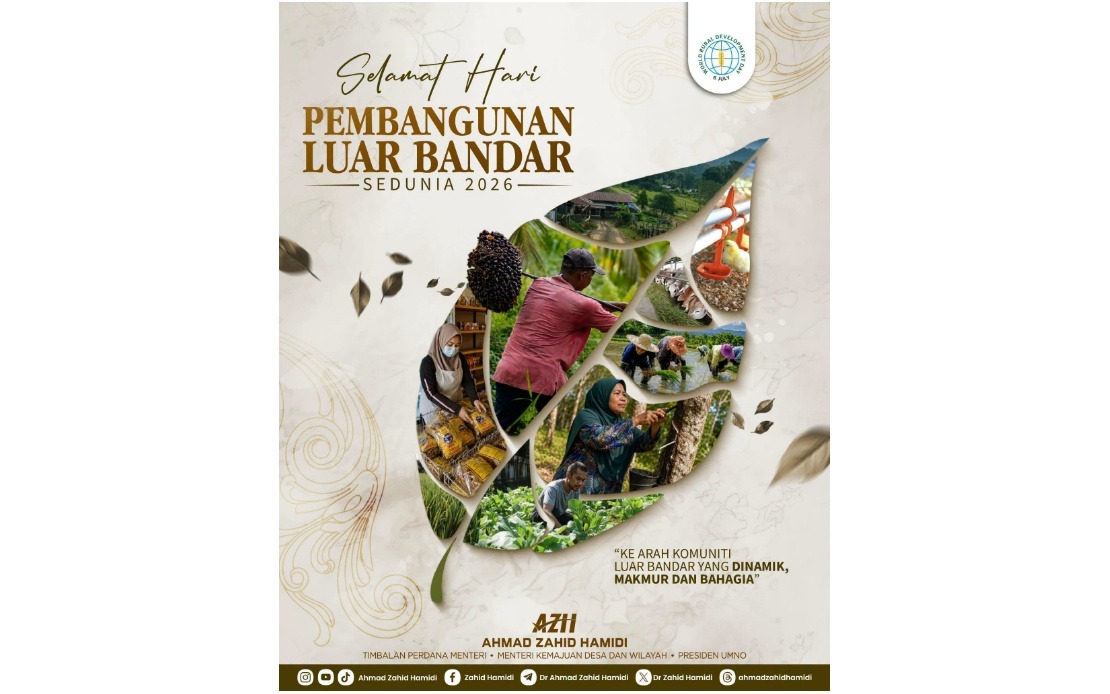
Malaysia has formally entered the global observance of rural development with the inaugural celebration of World Rural Development Day (HPLBS) at the Tun Abdul Razak Stadium in Jengka, near Maran, Pahang. The occasion reflects an intensifying national commitment to addressing the multifaceted challenges facing agricultural communities and regional economies that extend beyond major urban centres, positioning rural advancement as integral to Malaysia's continued progress.
Deputy Prime Minister Datuk Seri Dr Ahmad Zahid Hamidi, who also heads the Ministry of Rural and Regional Development (KKDW), underscored the symbolic and practical significance of designating July 6 as an annual platform for recognising rural communities' contributions. The chosen date carries international resonance, coinciding with the founding of the Centre on Integrated Rural Development for Asia and the Pacific (CIRDAP), a respected multilateral institution that has shaped agricultural and community development strategies across the Asia-Pacific region for decades. This alignment positions Malaysia within a broader regional conversation about rural transformation while acknowledging CIRDAP's historical influence on shaping development frameworks across Asia.
The ministry's vision extends beyond ceremonial recognition, focusing on substantive improvements in how rural populations access economic opportunities and essential services. Ahmad Zahid articulated expectations that countryside communities would progressively enjoy expanded commercial possibilities, strengthened financial circumstances, improved infrastructure and amenities, and ultimately enhanced living standards consonant with Malaysia's trajectory as a middle-income nation. This framing suggests an administration increasingly conscious that rural development remains unfinished business, with persistent gaps in wealth distribution, digital connectivity and institutional capacity.
The inaugural celebration proceeded under the thematic banner "Toward Vibrant, Prosperous and Happy Rural Communities," language that signals aspirational rather than merely remedial intent. The theme encompasses three foundational pillars that reflect contemporary development thinking: community innovation, rural digitalisation and rural entrepreneurship development. These dimensions reveal sophisticated understanding that sustainable countryside progress requires more than infrastructure investment or subsidies; it demands cultural shifts toward problem-solving locally, technological adoption to overcome geographical disadvantage, and cultivation of business mindsets among farming families and regional entrepreneurs.
Community innovation as a development pillar acknowledges that rural residents themselves possess valuable knowledge about local challenges and can generate contextually appropriate solutions when supported with resources and platforms. This contrasts with older top-down models where government agencies designed interventions in distant offices, often producing programmes misaligned with actual community needs and aspirations. By elevating innovation as a strategic priority, KKDW signals intention to facilitate rather than dictate rural development pathways.
Rural digitalisation constitutes perhaps the most transformative of the three pillars, addressing a persistent structural disadvantage facing Malaysian countryside regions. Limited broadband infrastructure, inadequate digital literacy and sparse technology adoption have historically constrained rural communities' access to market information, financial services, educational resources and government assistance. Serious investment in bridging digital divides could enable smallholder farmers to access commodity price data in real-time, connect directly with urban consumers through e-commerce platforms, and utilise agricultural technology that increases productivity and sustainability.
Entrepreneurship development represents the third pillar, recognising that traditional subsistence farming provides insufficient pathways to prosperity for expanding rural populations. Supporting business formation among countryside residents—whether in agricultural value-added processing, rural tourism, digital services, or manufacturing—creates employment diversity and income growth beyond seasonal agricultural cycles. Successful entrepreneurship initiatives typically require accessible financing, business training, mentorship networks, and market linkages; their absence has historically constrained rural economic dynamism compared to urban settings.
For Malaysian policymakers, the inaugural World Rural Development Day celebration arrives at a critical juncture. Regional disparities between developed urban corridors and lagging countryside areas have widened despite decades of development spending, contributing to rural-urban migration that drains communities of young talent and economic dynamism. Simultaneously, global agricultural challenges—climate volatility, input cost inflation, market competition from larger producers—threaten traditional farming livelihoods. These pressures make strategic rural development increasingly consequential for national cohesion and sustainable growth.
The designation of July 6 as an annual commemoration institutionalises rural development on Malaysia's policy calendar, potentially enhancing political accountability for progress on this agenda. Regular celebration creates recurring opportunities for assessing achievements, identifying gaps, and recommitting resources. International alignment through CIRDAP affiliation enables knowledge exchange with other Asia-Pacific nations addressing comparable rural challenges, enriching Malaysian approaches with comparative experience from countries at varying stages of development transformation.
For Southeast Asian observers, Malaysia's formalisation of rural development day reflects broader regional recognition that countryside prosperity remains foundational to national stability and shared prosperity. Agricultural communities across Southeast Asia face intensifying pressures from climate change, globalised competition and youth emigration. Successful models for community-driven innovation, digital inclusion and rural entrepreneurship developed in Malaysia could inform policy discussions across the region, while regional experience can inform Malaysian programme refinement.
Implementation will determine whether this inaugural celebration catalyses genuine transformation or remains largely symbolic. KKDW's effectiveness in translating thematic pillars into funded programmes, institutional capacity, and measurable community outcomes will shape whether July 6 observances eventually mark genuine progress toward vibrant, prosperous rural Malaysia or serve primarily commemorative function. The coming months will reveal governmental commitment to translating rhetoric about rural elevation into sustained resource allocation and political priority.

