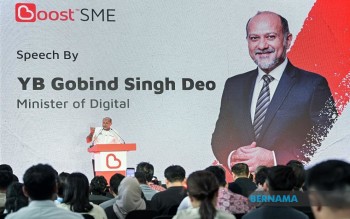
Malaysia's ambition to establish itself as a digital powerhouse is gaining concrete momentum, with Digital Minister Gobind Singh Deo affirming that the country remains on course to have the digital economy account for 30 per cent of gross domestic product by 2030. Speaking to reporters in Kuala Lumpur on August 18 following the launch of the Boost SME platform, Gobind outlined the strategic framework that underpins this trajectory, emphasising that substantial policy work already underway provides a solid foundation for achieving the milestone.
The digital sector's contribution to Malaysia's economy has already climbed to 25.5 per cent as of the previous year, representing significant progress toward the 2030 target. This incremental gain reflects the cumulative effect of various digitalisation initiatives across the economy, though bridging the remaining gap to 30 per cent will require sustained effort and continued investment in both infrastructure and human capital. The five-percentage-point expansion needed over the coming years is achievable but demands coordinated action across government, private sector, and educational institutions.
Gobind identified the National Artificial Intelligence Action Plan 2026-2030 and Malaysia Digital 2030 as primary catalysts driving the digital transformation agenda. These comprehensive policy frameworks represent government commitment to positioning artificial intelligence as a cornerstone of economic development, aligning with Prime Minister Datuk Seri Anwar Ibrahim's broader vision of transforming Malaysia into an AI Nation by 2030. The dual-track approach ensures that strategic planning encompasses both immediate near-term objectives and longer-term systemic change.
Implementation responsibility has been vested in the MyDigital Corporation, which operates under the remit of the Digital Ministry and carries the mandate to ensure all related policies achieve their designated targets. This institutional arrangement reflects recognition that policy formulation alone proves insufficient without robust execution mechanisms and accountability frameworks. The corporation's establishment demonstrates government understanding that digital transformation requires specialised institutional capacity distinct from traditional bureaucratic structures.
Small and medium enterprises occupy central importance in Malaysia's digital economy strategy, as these businesses collectively employ millions and contribute substantially to GDP and employment. The forthcoming Budget 2027 will direct significant focus toward empowering SMEs through artificial intelligence adoption, acknowledging that widespread economic digitalisation cannot succeed without broad-based business participation across company sizes. The emphasis on SME engagement represents a deliberate pivot away from top-down approaches that might benefit only large corporations with substantial technology budgets.
A persistent barrier to SME technology adoption has been cost, and the Digital Ministry has identified affordability as a critical policy variable. By prioritising mechanisms to reduce the financial burden of implementing AI solutions, government seeks to democratise access to advanced digital tools that previously remained beyond the reach of smaller operators. This approach recognises that Malaysia's competitive advantage in the regional and global economy increasingly depends on enabling the entire business ecosystem to leverage cutting-edge technologies rather than concentrating digital capabilities among elite enterprises.
Equally important as cost reduction is ensuring that SMEs possess the knowledge and understanding necessary to deploy AI effectively. Gobind stressed that the ministry remains committed to comprehensive capability development, extending beyond mere access to include education, training, and support mechanisms that enable business owners and managers to comprehend how artificial intelligence can address specific operational challenges. This holistic approach to technology adoption acknowledges that digital tools produce maximum value only when wielded by informed users who understand their applications and limitations.
The launch of the Boost SME platform represents a concrete manifestation of these strategic objectives. Developed by Boost, a digital financial services and mobile wallet application, this fully digital business banking platform integrates diverse financial services, solutions, and payment functionalities into a unified ecosystem designed specifically for SME needs. By consolidating previously fragmented services into a cohesive digital environment, the platform removes friction points that have historically complicated SME engagement with banking and financial infrastructure.
Boost SME explicitly targets underserved segments of the Malaysian business community, addressing a gap between enterprise banking products designed for large corporations and retail banking services oriented toward individual consumers. Many SMEs have historically occupied an awkward middle position, lacking access to sophisticated financial infrastructure customised to their operating requirements and growth trajectories. This platform aims to unlock new growth opportunities by providing previously unavailable digital tools tailored to smaller business scales and operational complexities.
The integration of digital banking, financial solutions, and payment capabilities within a single platform represents efficiency gains that extend beyond mere convenience. By eliminating the need for SMEs to maintain relationships with multiple service providers, the consolidated approach reduces administrative overhead and simplifies financial management. For businesses operating with limited dedicated finance personnel, such streamlining can free resources for deployment toward core operational activities and strategic expansion.
Malaysia's digital economy strategy must be understood within the broader Southeast Asian context, where digital adoption and AI readiness increasingly determine competitive positioning. Regional competitors including Singapore, Indonesia, and Thailand are pursuing parallel digitalisation initiatives, creating pressure for Malaysia to maintain pace while carving out distinctive advantages. The emphasis on inclusive SME empowerment potentially provides Malaysia with a differentiated approach, emphasising broad-based economic participation rather than concentration of digital capabilities.
The trajectory toward 30 per cent digital economy contribution by 2030 carries implications extending beyond economic statistics. Successful realisation would signal Malaysia's capacity to navigate fundamental economic transformation in an era of rapid technological change, demonstrating resilience and adaptability in a multipolar global economy. More concretely, a digitally empowered SME sector would contribute to employment stability, income distribution, and regional economic development beyond Kuala Lumpur's metropolitan core, supporting government objectives of inclusive and geographically balanced growth.

