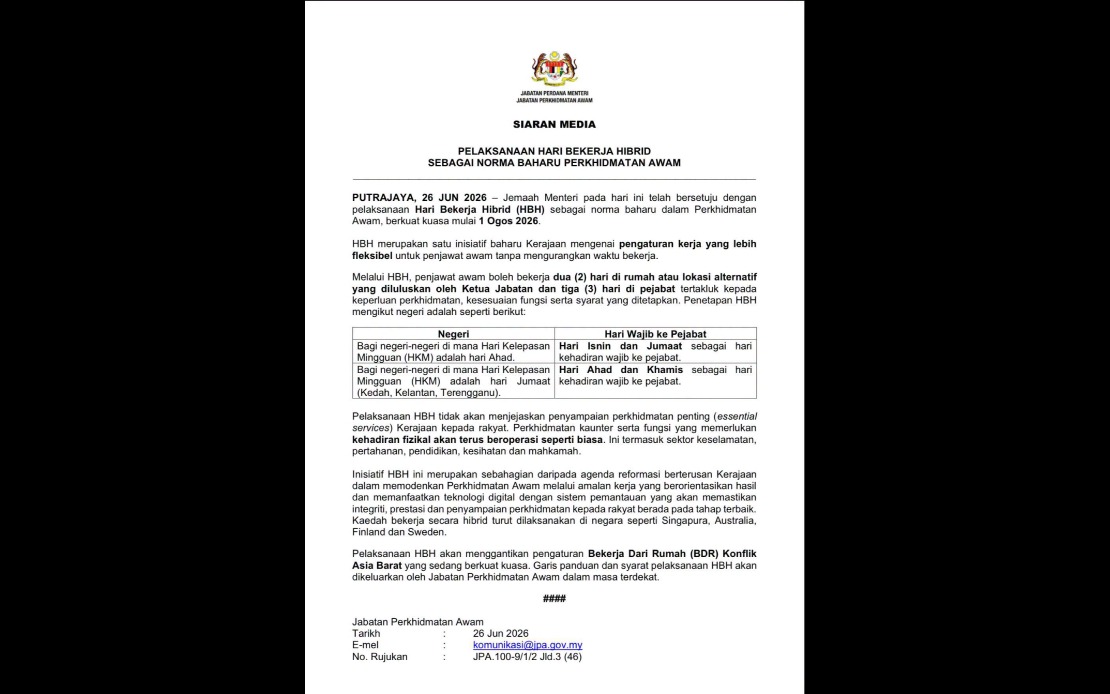
Malaysia's public service is entering a new era of workplace flexibility following Cabinet approval for a structured hybrid work arrangement that takes effect on August 1. The Public Service Department announced the decision on June 26, marking a significant departure from the pandemic-era work-from-home provisions that have governed the civil service for the past few years. The Hybrid Work Day framework represents a deliberate recalibration of how Malaysia's approximately 1.6 million public sector employees will balance office presence with remote work options.
Under the new hybrid structure, civil servants will divide their working week between their home or an alternative location sanctioned by their department head, and the traditional office environment. The arrangement stipulates three mandatory office days and two permitted remote work days each week, though participation remains contingent on the specific service requirements, functional suitability of the role, and conditions established by individual departments. This flexibility is designed to accommodate the diverse nature of public sector work, ranging from frontline service delivery to administrative and professional functions that may be better performed away from physical premises.
The hybrid model replaces the existing Work From Home arrangement that became widespread during the COVID-19 pandemic. Rather than a complete return to traditional office-based work, the Public Service Department has crafted a compromise that acknowledges evolving expectations around workplace flexibility whilst maintaining government capacity to deliver essential services. The department emphasises that the total working hours remain unchanged, with the restructuring focused on location flexibility rather than reduced commitments from civil servants.
Crucially, the framework includes safeguards designed to protect public service delivery standards. Government functions requiring direct interaction with the public—including counter services in regulatory agencies, security and defence operations, teaching in government schools, healthcare provision, and judicial functions—will continue operating under traditional full-time office attendance protocols. This exclusion preserves critical frontline services whilst allowing administrative, planning, and support functions greater flexibility in their work arrangements.
The framework acknowledges Malaysia's religious and cultural diversity by accommodating states observing different weekly rest days. In Kedah, Kelantan, and Terengganu, where Friday is the official weekly holiday, Thursday and Sunday are designated as mandatory office attendance days. Conversely, states observing Sunday as the rest day—the majority configuration—have Monday and Friday designated as compulsory office days. This nuanced approach demonstrates recognition that public service coordination must align with existing state-level holidays and working week structures.
The Public Service Department has positioned this initiative within a broader modernisation strategy aimed at transforming how government operates in the digital age. By introducing results-based work practices and encouraging greater adoption of digital technologies, Malaysia joins a growing international movement toward performance-oriented rather than presence-oriented management. The department cited examples from Singapore, Australia, Finland, and Sweden as precedent, suggesting that hybrid arrangements are increasingly standard practice among developed nations seeking to optimise workforce productivity and satisfaction.
Implementation will include monitoring mechanisms designed to ensure standards in integrity, performance accountability, and service quality do not deteriorate under the new arrangement. The Public Service Department has signalled that detailed guidelines and specific operational conditions will be released subsequently, allowing departments time to assess which roles and functions can effectively operate under the hybrid model. This phased communication approach suggests the department recognises that different agencies face distinct operational challenges and may require customised implementation strategies.
For Malaysian private sector observers, the government's adoption of hybrid work carries symbolic weight. Many multinational companies and progressive Malaysian firms have already implemented similar arrangements, and government endorsement may influence broader corporate culture and expectations around workplace flexibility. The civil service, as Malaysia's largest employer, sets precedent that ripples throughout the economy regarding acceptable work arrangements and employee expectations around autonomy and flexibility.
The August 1 implementation date provides a two-month transition period for departments to prepare systems, communication protocols, and monitoring frameworks. This timeline also allows civil servants to adjust personal arrangements and coordinate with supervisors regarding their individual hybrid schedules. The staggered rollout reduces organisational disruption compared to immediate implementation, though it also extends the period of uncertainty for those awaiting specific guidance on how their roles will be affected.
From a regional perspective, Malaysia's move toward structured hybrid work reflects broader Southeast Asian workforce trends. As economies compete for talent and seek to improve public sector efficiency, flexible work arrangements become increasingly important for attraction and retention. Malaysia's framework—combining flexibility with accountability and service-delivery protection—offers a pragmatic model that balances competing priorities, potentially influencing how other regional governments approach similar reforms.
The success of this initiative will ultimately depend on departmental implementation and how effectively monitoring mechanisms enforce consistency. Organisations with strong digital infrastructure and results-oriented management cultures will likely leverage hybrid arrangements more effectively than those still transitioning to modern management practices. Disparities in implementation could create perceptions of fairness concerns, particularly if some departments maintain stricter office requirements whilst others grant greater flexibility.

