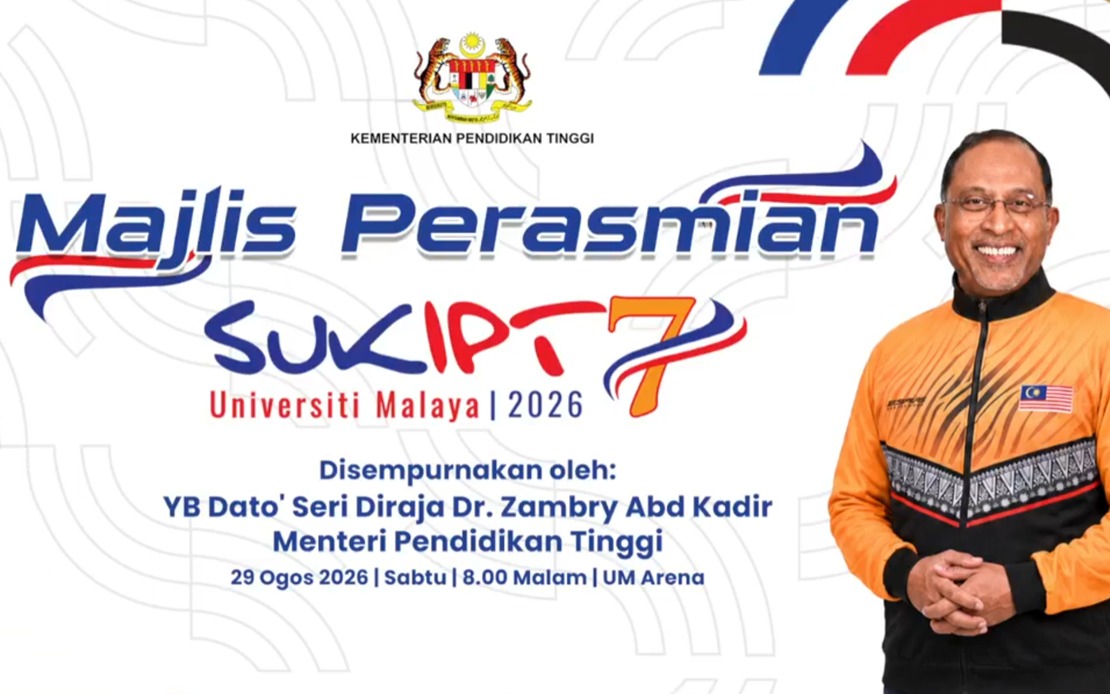
The achievements of athletes from Malaysia's higher education institutions (IPT) demonstrate that university sports programmes can effectively cultivate elite talent capable of competing at the highest international levels, according to Higher Education Minister Datuk Seri Dr Zambry Abdul Kadir. Speaking at the opening of the Higher Education Institution Games (SUKIPT) 2026 at Universiti Malaya Arena in Kuala Lumpur, Zambry underscored how recent medal wins and record-breaking performances have validated the strategic importance of supporting university-based athletic development.
Zambry's remarks come amid a wave of strong performances by IPT athletes on the global stage. The minister cited several standout examples from the Glasgow 2026 Commonwealth Games, where Malaysian university competitors made significant contributions to the nation's medal tally. These successes collectively signal that the country's student-athletes possess the competitive calibre to challenge international opposition and enhance Malaysia's sporting reputation abroad.
Among the notable achievements highlighted were weightlifting performances from two separate institutions. Muhammad Erry Hidayat representing Universiti Putra Malaysia secured gold in the men's 79-kilogramme category, while his counterpart Muhammad Aniq Kasdan from Universiti Teknologi MARA claimed victory in the men's 60-kilogramme division. These medals underscore the depth of talent emerging from Malaysia's university system across multiple disciplines and weight classifications.
Judo represented another breakthrough for Malaysian university athletes at the Commonwealth Games. Amir Daniel Abdul Majid from Universiti Sains Malaysia etched his name into the history books by becoming the first Malaysian athlete to capture Commonwealth Games gold in the sport. This milestone achievement carries particular significance for the nation's judo programme and reflects years of dedicated training and institutional support. Additionally, Amirul Daniel Abdul Rahim from Universiti Malaya contributed to the medal haul with a bronze finish in lawn bowls, demonstrating the diversity of sporting excellence emerging from Malaysia's tertiary institutions.
Beyond international competition, IPT athletes have been making their mark domestically through impressive record-breaking performances. National 400-metre runner Omar Osman from Politeknik Sultan Ibrahim has distinguished himself through his performances at the Malaysia Games (SUKMA). The domestic arena has also witnessed standout efforts from Muhammad Fadwah of UiTM and Danish Iftikhar Muhammad Rosli from Universiti Pendidikan Sultan Idris, who jointly shattered existing SUKMA records in both the 200-metre sprint and 4x100-metre relay events. These record-breaking efforts indicate that university athletes are not merely meeting existing standards but actively pushing the boundaries of Malaysian athletic performance.
The SUKIPT 2026 competition itself underscores the scale and sophistication of university sports infrastructure in Malaysia. Spanning from late August through early September at Universiti Malaya, the seventh edition of this biennial championship brings together 64 contingents representing a comprehensive cross-section of the higher education landscape. The participating institutions include 20 public universities, 42 private higher education institutions, one polytechnic, and one community college, collectively fielding 8,244 athletes and officials who will compete across 30 different sporting disciplines.
The tournament's structure and incentive schemes reflect a deliberate policy framework designed to encourage both athletic excellence and institutional commitment to sports development. Organisers have allocated 227 gold medals for distribution across the various events, while cash incentives provide tangible rewards for outstanding individual and team performances. Athletes who manage to break national records during the games qualify for substantial prize money of RM20,000, a figure that acknowledges the rarity and value of record-breaking performances. Team achievements are similarly recognised, with the best-performing male and female teams each receiving RM7,000 in prize money. Individual sporting accolades carry their own recognition through Sportsman and Sportswoman of the Games awards, each accompanied by RM3,000.
Zambry's emphasis on universities as talent incubators reflects a broader strategic approach to national sports development. Rather than relying solely on specialised training facilities or national sports councils, the government is leveraging the existing infrastructure and educational mission of higher education institutions to create sustainable pathways for athletic talent. This approach integrates competitive sport with academic pursuits, potentially creating athletes who possess both physical excellence and intellectual capability.
The minister's framing of university sports as a means to "challenge records" and "elevate Malaysia's name on the world stage" suggests recognition that the nation's sporting future depends not on isolated elite programmes but on systemic development across multiple institutions. This distributed approach to talent nurturing potentially creates redundancy and resilience in the system, ensuring that exceptional athletes emerge across different regions and institutional contexts rather than concentrating talent within a small number of premier facilities.
For Malaysian students with sporting aspirations, the success of fellow university athletes demonstrates that higher education need not require sacrifice of athletic ambitions. Conversely, for university administrators, the international visibility and medal achievements generate institutional prestige and student recruitment benefits beyond traditional academic measures. This alignment of institutional and individual incentives may explain why Malaysian universities are increasingly investing resources in sports facilities and coaching programmes.
The implications for Southeast Asian sporting development extend beyond Malaysia's borders. As university systems across the region observe Malaysia's success in developing competitive athletes, institutional sports programmes may receive greater policy support and funding. The model potentially offers smaller nations and developing economies a cost-effective alternative to building expensive national sports academies, instead channelling investment into existing university infrastructure that serves dual educational and athletic functions.
Looking ahead, the continued success of IPT athletes will likely reinforce government commitment to university sports funding and development. Zambry's public endorsement at SUKIPT 2026 signals that higher education sports remain a policy priority within Malaysia's broader sports excellence agenda, particularly as the nation prepares for upcoming international competitions and Commonwealth Games engagements.

