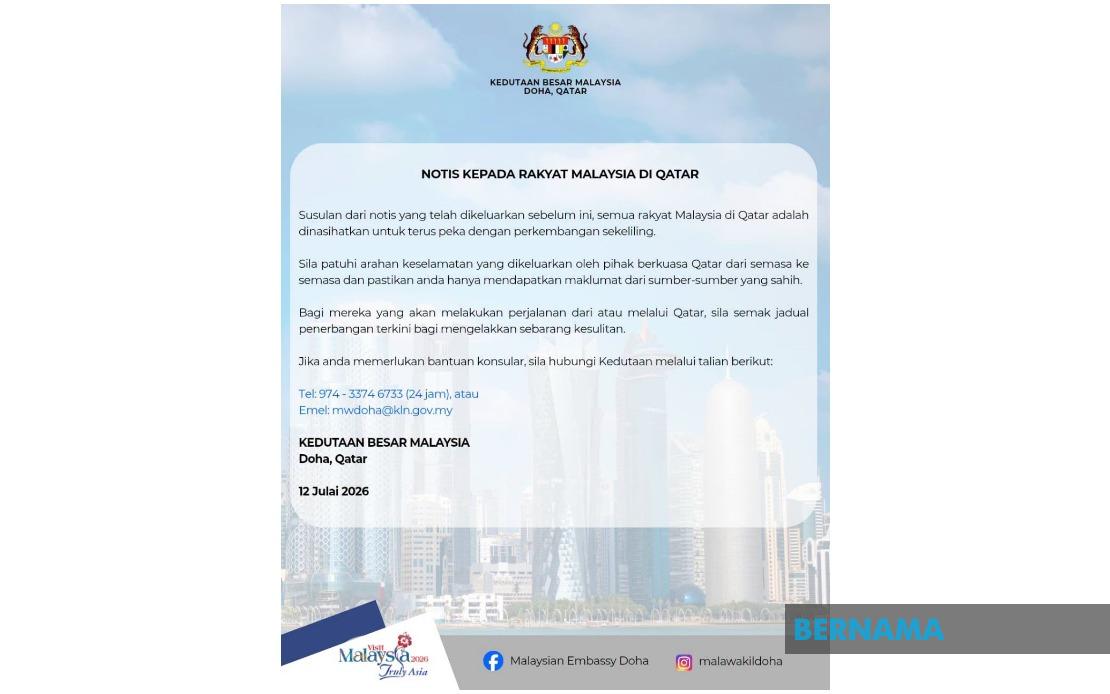
The Malaysian Embassy in Doha has issued a formal advisory to Malaysian nationals residing in or transiting through Qatar, urging strict adherence to security protocols put in place by Qatari authorities in the wake of intensifying military confrontations between the United States and Iran. Uploaded through the embassy's official social media channels, the notice emphasises the importance of remaining vigilant about immediate surroundings whilst maintaining constant awareness of the evolving security situation in the strategically vital Gulf region.
The embassy's guidance specifically calls on Malaysians to observe all security directives as they are issued by Qatari officials, whilst simultaneously cautioning residents to rely exclusively on officially sanctioned information channels rather than unverified reports. This dual emphasis reflects growing concern about the rapid spread of misinformation during geopolitical crises, which can trigger unnecessary panic or prompt individuals to make poor safety decisions based on rumour rather than fact.
Travellers planning journeys originating from Qatar or passing through the emirate have been advised to monitor the latest airline schedules closely to mitigate the risk of encountering service interruptions. The diplomatic mission has recognised that heightened military activity in the region carries tangible consequences for commercial aviation, potentially affecting departure times, route changes, or sudden cancellations that could leave passengers stranded.
Citizens experiencing difficulties or requiring immediate consular support have been provided with direct contact pathways. The embassy operates a round-the-clock assistance hotline accessible at +974-3374 6733, with supplementary email channels available for non-urgent matters, ensuring that Malaysians in distress can reach qualified diplomats regardless of time zone or local business hours.
The advisory comes in response to a dramatic escalation of military operations within the Strait of Hormuz region, one of the world's most economically critical maritime chokepoints. On Sunday, the United States military conducted its third significant strike against Iranian targets within a single week, reflecting the dangerous acceleration of tit-for-tat military actions that have transformed the Gulf from a zone of contested diplomatic negotiation into an active theatre of military engagement.
The Iranian Islamic Revolutionary Guard Corps navy announced on Sunday that the Strait of Hormuz would be subject to closure effective immediately and continuing until formal conditions were satisfied. The pronouncement specified that no commercial or military vessels would be permitted passage through the waterway until what Iranian officials characterised as American regional interventions come to a definitive end, thereby weaponising control of one of the world's most vital maritime passages.
This dramatic escalation stands in stark contrast to diplomatic progress achieved just weeks earlier. In June, Tehran and Washington had signed a Pakistan-mediated memorandum of understanding intended to terminate the broader regional conflict that had commenced in late February. That agreement had encompassed commitments to halt all active military operations simultaneously across multiple fronts, to lift the comprehensive naval blockade that the United States maintained around Iranian territorial waters, and crucially, to restore normal shipping traffic through the Strait of Hormuz.
Despite the existence of this formal written agreement between the two powers, the underlying tensions evidently remain unresolved, with both sides using military force this week to contest control over commercial shipping movements through the contested waterway. The persistence of violence despite official agreements suggests that fundamental disagreements about implementation, verification mechanisms, or broader strategic objectives remain unbridged beneath the surface of diplomatic language.
For Malaysia specifically, the implications of extended instability in the Gulf region carry substantial weight. As a maritime trading nation heavily dependent on stable passage through the Strait of Hormuz, any prolonged disruption to shipping flows would directly impact Malaysian import and export commerce, potentially increasing transport costs and creating supply chain complications for Malaysian manufacturing and trading sectors. The Strait represents the essential commercial artery through which Middle Eastern energy resources reach Malaysian ports and Asian markets more broadly.
The situation also underscores the broader vulnerability of Southeast Asian nations to geopolitical disturbances originating thousands of kilometres away. Malaysia's citizens working in the Gulf region, whether in professional capacities, commercial ventures, or labour positions, remain directly exposed to whatever security consequences unfold from the US-Iran confrontation. The embassy's advisory represents the Malaysian government's attempt to mitigate risks through early warning and coordinated guidance, though ultimately the trajectory of this conflict remains determined by decisions made in Washington and Tehran.
The Qatari government, as the host nation for the affected Malaysian nationals, maintains significant diplomatic relationships with both the United States and Iran, positioning it as a potential mediator, though its ability to influence either party remains uncertain. Qatar's hosting of major international institutions and maintaining neutrality during regional conflicts provides some measure of security for foreign nationals within its borders, yet the advisory suggests that no location in the immediate vicinity of active hostilities remains entirely insulated from risk.
As military tensions persist and diplomatic progress stalls, Malaysian citizens in Qatar and throughout the Gulf region should remain attentive to official communications whilst preparing contingency arrangements for potential travel disruptions or escalated security requirements. The embassy stands ready to provide assistance, though the ultimate resolution to this confrontation depends on decisions far beyond the reach of any single nation's diplomatic infrastructure.

