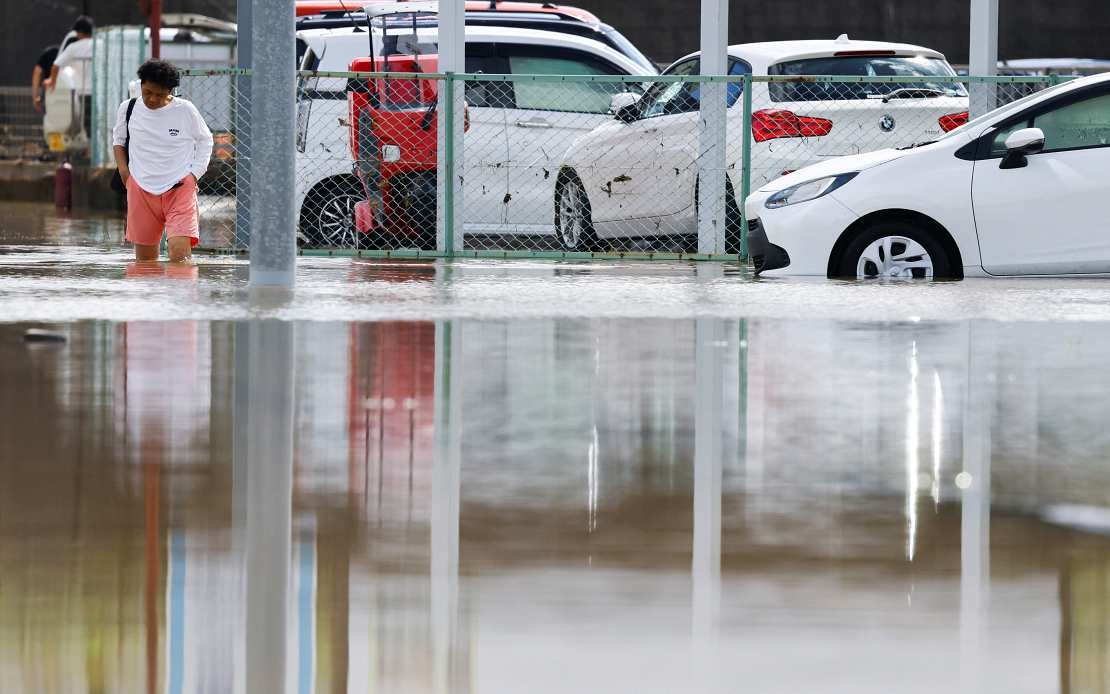
The Malaysian Embassy in Tokyo has issued a precautionary advisory for Malaysian nationals residing in or visiting Japan, urging them to refrain from non-essential travel in light of catastrophic flooding that has engulfed Chiba Prefecture and the broader Kanto region. The alert underscores growing concerns for the safety of Malaysian citizens caught within one of Japan's most critical weather emergencies in recent memory, with infrastructure across eastern Japan brought to near-standstill by relentless torrential downpours that show no signs of abating.
The scale of disruption across Japan's eastern corridor has proven unprecedented. Transport networks that normally move millions daily have collapsed under the weight of floodwaters, with both road and rail systems rendered largely inoperable across Chiba and surrounding prefectures. This cascading failure of transport infrastructure has created a humanitarian bottleneck, with approximately 7,000 travellers finding themselves stranded at Narita International Airport alone. Many of these individuals remain unable to reach their intended destinations or return home, compounding the already dire situation unfolding across the region.
The human toll of the disaster continues to mount. According to reports from Kyodo News, at least eight fatalities have been confirmed as a direct result of the relentless rainfall pounding eastern Japan. These deaths underscore the severity of the natural disaster and highlight why the Malaysian Embassy has deemed it necessary to issue such forceful guidance to its nationals. The confirmed fatalities represent only the immediate human cost; thousands more remain at risk from secondary hazards including landslides, structural collapse, and contaminated water supplies.
Japanese meteorological authorities have declared a Level 5 rain warning—the highest classification in Japan's weather alert system—across more than one-third of all municipalities within Chiba Prefecture, an area located in immediate proximity to Tokyo. This designation indicates conditions deemed catastrophic, with rainfall rates and accumulated precipitation far exceeding normal seasonal patterns. The Japan Meteorological Agency maintains that such events pose an imminent threat to life and property, justifying the extraordinary measures being implemented by local and national government authorities.
Evacuation operations have reached massive proportions. At the height of the crisis, evacuation orders encompassed more than 400,000 people, requiring coordinated efforts across multiple prefectures and government agencies. These evacuation directives targeted residents of low-lying areas and flood-prone zones deemed especially vulnerable to inundation. The scale of these precautionary measures demonstrates Japanese authorities' determination to prevent the disaster from claiming additional lives, though the logistical challenges of moving and sheltering such large numbers of people have proven immense.
The Malaysian Embassy's guidance specifically directs its nationals to exercise heightened caution around flooded and depressed terrain, emphasising the importance of remaining attentive to developments on the ground. Citizens have been instructed to monitor broadcasts from Japanese authorities closely, tracking both weather updates and evacuation directives as conditions evolve. This localised, real-time information proves critical for anyone attempting to navigate affected zones, as conditions can shift rapidly and unexpectedly in weather emergencies of this magnitude.
For Malaysians seeking the most current and authoritative weather information, the embassy has directed them to consult the Japan Meteorological Agency directly via its English-language website at www.jma.go.jp/jma/indexe.html. This portal provides continuously updated warnings, forecasts, and advisories in English, allowing Malaysian nationals to access the same intelligence that informs Japanese government decision-making. Regular consultation of this resource remains essential for anyone in Chiba or surrounding prefectures seeking to understand evolving hazard conditions.
The Malaysian Embassy has established dedicated communication channels for citizens requiring urgent assistance. During regular business hours, Malaysian nationals can contact the Embassy of Malaysia in Tokyo at +81-3-3476-3840, while an emergency hotline operates outside these hours at +81-70-1471-9756 to handle critical situations. Email contact remains available through two dedicated addresses: [email protected] for consular matters and [email protected] for general enquiries. These multiple pathways ensure that Malaysians can reach diplomatic support regardless of the time or nature of their emergency.
The timing of this disaster carries particular significance for Malaysia-Japan relations and broader Southeast Asian regional stability. Japan represents a major trading partner, investment source, and tourism destination for Malaysia, with thousands of Malaysian nationals engaged in business, education, and long-term residence across the country. Major Japanese manufacturing operations and supply chains that serve Malaysian and regional industries now face significant disruption, potentially reverberating through multiple sectors of the Malaysian economy in coming weeks. The flooding thus constitutes not merely a humanitarian crisis but an economic event with transnational implications.
For Malaysian travellers currently planning trips to Japan or the Kanto region specifically, the advisory effectively suspends routine tourism activities and non-essential business travel to affected zones until conditions stabilise. This represents a prudent approach given the unpredictable nature of weather systems and the potential for conditions to deteriorate further. Even areas appearing unaffected at present may face inundation or transport disruption with minimal warning, making unnecessary presence in the region genuinely hazardous.
The broader context of climate change and increasing weather volatility has rendered such extreme precipitation events increasingly common across East Asia. Japan's sophisticated early warning systems and disaster management infrastructure have likely prevented far greater loss of life, yet the scale of the current crisis demonstrates that even advanced nations struggle to fully mitigate the impacts of unprecedented weather phenomena. Malaysia, facing its own climate-related challenges, observes Japan's response with particular interest, as similar extreme weather patterns increasingly threaten Southeast Asian countries including Malaysia itself.

