Financial institutions across Malaysia are reshaping lending criteria by requiring companies to submit comprehensive environmental, social and governance reports as a condition for loan approval. This shift represents a fundamental realignment in how banks assess credit risk and borrower viability, moving beyond traditional financial metrics to encompass broader sustainability performance indicators. The development reflects global capital market trends where institutional investors and lenders increasingly weigh environmental and governance factors alongside conventional accounting measures, effectively gatekeeping access to funding for businesses unprepared for disclosure requirements.
Prathab V, principal consultant at ESGright Sdn Bhd, a Kuala Lumpur-based firm specialising in sustainability advisory and training, explains that this banking sector pivot creates both immediate pressure and long-term advantage for Malaysian enterprises. Companies demonstrating robust sustainability credentials gain preferential access to capital markets and secure stronger positioning for future expansion, while those neglecting these requirements risk competitive disadvantage as markets increasingly discriminate based on ESG performance. The dynamic creates a competitive sorting mechanism where sustainability commitment becomes inseparable from financial viability in the eyes of major lenders.
While Malaysia's regulatory framework mandates sustainability reporting exclusively for listed companies on Bursa Malaysia, unlisted firms and small-to-medium enterprises face no mandatory obligation. However, this legal distinction increasingly matters little in practice. Capital providers—banks, investment funds, and institutional lenders—have begun independently imposing disclosure requirements regardless of regulatory status, effectively extending de facto mandates across the business ecosystem. This banker-led standardisation bypasses formal regulatory channels, creating pressure on even small family businesses and unlisted manufacturers to develop sustainability reporting capacity to maintain financing relationships.
The Malaysian government has actively promoted voluntary sustainability adoption through industry regulators and published guidelines, recognising that market forces may outpace formal legislation in driving adoption. Prathab notes that companies excelling at sustainability reporting attract what he terms "smart capital"—investment and financing from sophisticated institutional actors who price in long-term risk exposure. Conversely, laggard firms eventually lose competitive ground not through sudden crisis but through gradual marginalisation as suppliers, customers, and financiers increasingly preference counterparts demonstrating sustainability commitment. This creates cumulative disadvantage for holdout companies regardless of their operational fundamentals.
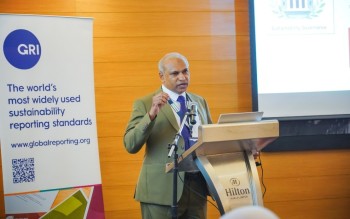
The urgency of capacity building became evident at a recent gathering co-organised by ESGright and the Global Reporting Initiative, where approximately 40 senior corporate sustainability officers and industry stakeholders convened to examine ESG reporting's evolving landscape. Participants represented companies with combined market capitalisation exceeding RM380 billion, underscoring how sustainability discourse now dominates strategy discussions among Malaysia's largest enterprises. The dialogue highlighted that sustainability reporting, while sometimes perceived as burdensome compliance exercise, increasingly functions as fundamental business infrastructure equivalent to financial accounting systems.
ESGright's rapid ascent within global sustainability training networks illustrates Malaysia's emerging prominence in this field. Since 2023, the firm has grown to become the fifth-largest Global Reporting Initiative professional trainer worldwide by participant volume, and ranks third across the Asia-Pacific region. Malaysia itself hosts one of ASEAN's highest concentrations of GRI-certified sustainability professionals, a credential reflecting both government commitment and market-driven demand for expertise. This professional ecosystem positions Malaysian firms and consultants to influence regional sustainability standards development, potentially shaping how Southeast Asian competitors navigate disclosure requirements.
The International Financial Reporting Standards Foundation recently appointed ESGright as Malaysia's first approved education partner for delivering qualifications in sustainability-related financial disclosure aligned with International Sustainability Standards Board standards. This recognition grants the firm authority to certify corporate professionals, investors, auditors and practitioners in emerging sustainability accounting frameworks increasingly adopted by institutional investors globally. The appointment reflects international confidence in Malaysian capacity to deliver world-standard sustainability education while simultaneously creating comparative advantage for Malaysian companies whose staff hold IFRS-endorsed credentials.
Robin Hodess, chief executive of the Global Reporting Initiative, emphasises that while ASEAN businesses demonstrate strong commitment to ESG principles, implementation pathways differ fundamentally between large corporations and resource-constrained SMEs. She advocates for proportionate disclosure frameworks tailored to SME operational realities rather than uniform requirements borrowed from large-company reporting models. SMEs particularly risk compliance burnout when faced with disclosure obligations designed for multinational enterprises with dedicated sustainability departments. Strategic ESG adoption for SMEs should emphasise disclosures most meaningful for their specific competitive challenges—particularly supply chain qualification requirements that increasingly determine access to major customer relationships.
The supply chain dimension increasingly defines ESG's practical importance for Malaysian SMEs. Large Malaysian and multinational corporations increasingly condition supplier relationships on demonstrated sustainability performance, creating cascading requirements that flow backward through value chains. Export-oriented manufacturers supplying multinational brands face explicit demand for environmental certifications and labour practice documentation. Even domestic suppliers to major Malaysian corporations encounter these requirements. For SMEs lacking internal sustainability capacity, this represents simultaneous threat and opportunity—threat because non-compliance risks customer loss, opportunity because even modest sustainability improvements can unlock supply chain relationships previously unavailable.
Large Malaysian corporations, particularly those listed on Bursa Malaysia, had already embraced Global Reporting Initiative standards well before regulatory mandates required it, Hodess observes. This early adoption reflected management recognition that ESG credibility facilitates international market access and investor relations. Companies with Global Reporting Initiative-aligned disclosure demonstrate to institutional investors and international customers that their governance systems meet globally recognised standards, effectively reducing friction for export operations and cross-border partnerships. Malaysia's early corporate movers in ESG disclosure created template frameworks that subsequently influenced smaller firms and regional competitors.
Complexity proliferation presents an emerging challenge as sustainability reporting frameworks and disclosure requirements multiply. Companies now navigate multiple overlapping standards—Global Reporting Initiative, IFRS sustainability standards, Bursa Malaysia requirements, and increasingly industry-specific frameworks—creating compliance burden that grows with each new standard introduction. Prathab identifies "compliance fatigue" as a significant barrier, particularly for companies lacking dedicated sustainability teams. The challenge involves balancing rigorous disclosure obligations against core business imperatives to generate shareholder returns. This tension proves especially acute for capital-constrained firms unable to simultaneously fund sustainability infrastructure development and mainstream operational investments.
Prathab recommends that companies adopt strategic focus rather than attempting comprehensive excellence across all sustainability dimensions. Rather than distributing resources thinly across environment, social and governance categories, companies achieve greater impact by identifying their most material sustainability challenges and developing distinctive excellence in those specific areas. A manufacturing company might prioritise environmental performance and emissions reduction while a labour-intensive service business might emphasise workforce practices and community relations. This focused approach creates authentic sustainability value rather than generating superficial disclosure compliance, ultimately building investor and stakeholder confidence more effectively than scattered partial efforts across numerous categories.
The convergence of banking requirements, international capital flows, supply chain imperatives and emerging professional standards means Malaysia's business ecosystem faces structural reorientation toward sustainability integration. Companies treating ESG as peripheral compliance burden risk strategic marginalisation, while those embedding sustainability into operational and strategic decision-making position themselves advantageously for evolving capital markets. The transition creates immediate costs—training, reporting infrastructure, process redesign—but delayed adaptation likely proves more expensive as financial access gradually constricts for laggard firms and competitive advantage accumulates among early movers.

