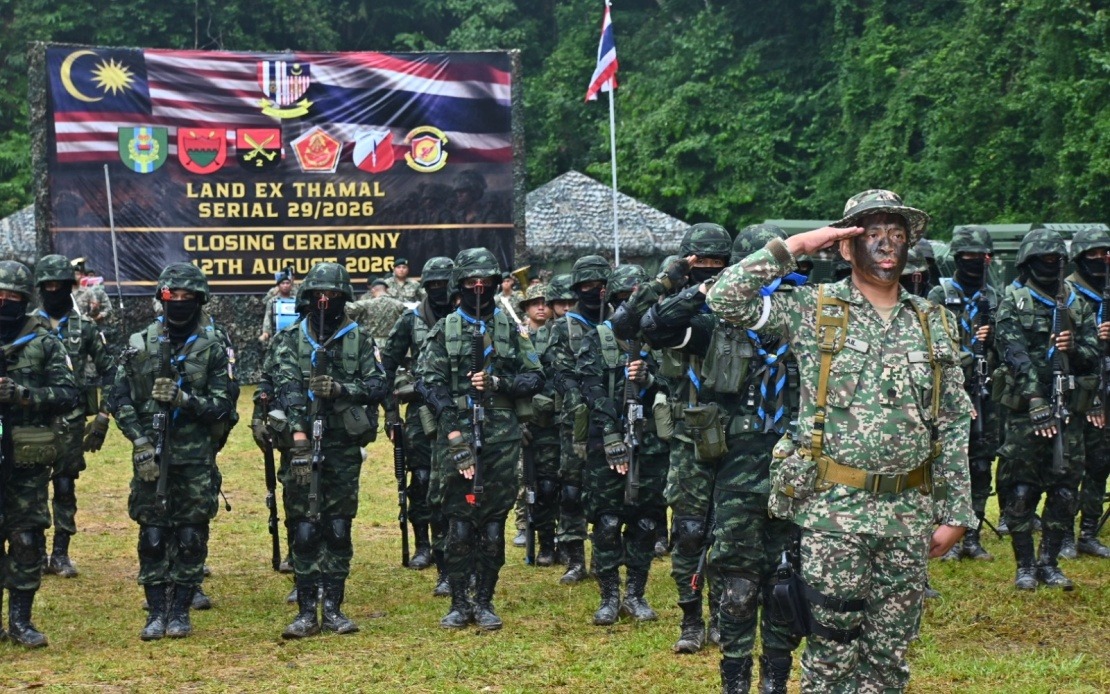
Over 250 troops from the Malaysian Army and Royal Thai Army have gathered in Gerik to conduct a comprehensive joint military exercise designed to sharpen their tactical proficiency and deepen operational coordination between the two nations. Exercise LAND THAMAL Series 29/2026, which began on August 5, represents a significant effort by both countries to strengthen their defence relationship through hands-on training and collaborative planning. The exercise involves 197 Malaysian personnel and 55 Thai counterparts, all working in concert to develop enhanced interoperability while learning from each other's military doctrines and field practices.
The 2nd Malaysian Infantry Division has structured the month-long exercise across three distinct phases, each designed to build progressively on the previous stage. The Cross Training Exercise phase allows troops to become familiar with their counterparts' techniques and procedures before moving into practical field scenarios. This is followed by the Field Training Exercise phase, where soldiers experience authentic combat situations including navigating obstacles, establishing forward operating bases, conducting reconnaissance patrols, and executing tactical manoeuvres against simulated enemy positions. The third component, Combined Military Civil Action, extends the exercise beyond purely military objectives to include humanitarian and community engagement activities that underscore the military's broader role in regional stability.
The tactical content of the field training exposes participating troops to the full spectrum of modern warfare scenarios that could realistically emerge in the Southeast Asian context. Soldiers practise coordinated responses to various operational challenges, from complex ambush scenarios to coordinated attacks on fortified positions. The emphasis on base setup and patrolling reflects the exercise's focus on border security operations, a practical concern given Malaysia and Thailand's shared maritime and land borders. By rotating Thai and Malaysian personnel through these scenarios, both militaries gain invaluable insight into how their counterparts approach common security challenges and tactical problems.
The underlying philosophy of Exercise LAND THAMAL extends beyond pure military training objectives. By rotating personnel through shared experiences and collaborative planning, the exercise builds mutual understanding and professional respect that translates into improved coordination during actual operations. Officers and soldiers who have trained together develop informal networks and personal relationships that facilitate communication and trust when real operational challenges arise. This human dimension of military cooperation often proves as valuable as any technological enhancement or procedural alignment.
The exercise was formally inaugurated on August 5 at Gerik Airstrip through a joint ceremony presided over by Brigadier General Datuk Mohd Zaini Hashim, who commands the 30th Malaysian Infantry Brigade, and Senior Colonel Taweeporn Kanatong, his Thai counterpart from the 5th Infantry Brigade. Taweeporn's remarks during the opening ceremony articulated the broader strategic significance of the exercise, noting that it serves to fortify the bilateral relationship between Malaysia and Thailand while simultaneously enhancing both nations' capacity to respond to the complex security environment facing the region. The commander specifically highlighted how the exercise prepares both militaries to address natural disasters, security threats, armed conflicts, and transnational security issues that require coordinated responses across borders.
Regional security challenges have become increasingly multifaceted in recent years, extending far beyond traditional military confrontations to encompass terrorism, maritime piracy, people trafficking, and environmental emergencies. The exercise's design acknowledges this reality by incorporating scenarios and training modules that reflect these contemporary threats. Malaysia and Thailand, as neighbouring nations with shared interests in maritime security and border integrity, benefit substantially from the standardised procedures and mutual understanding that such joint exercises establish. The ability to coordinate rapidly and effectively during a genuine crisis depends fundamentally on prior preparation and familiarity with one's counterpart's standard operating procedures.
The success of Exercise LAND THAMAL Series 29/2026 reflects the durability and maturity of the defence relationship between the Malaysian Army and Royal Thai Army. This is not the first such exercise between the nations, but rather part of a sustained series that has been refined and expanded over multiple iterations. The fact that both militaries continue to invest substantial resources in this annual exercise demonstrates their commitment to maintaining a stable and cooperative security environment in the region. For Malaysia, such cooperation with Thailand is particularly significant given their shared border and maritime interests in the Andaman Sea and upper Strait of Malacca.
Beyond the tactical training benefits, Exercise LAND THAMAL strengthens the institutional relationship between the two armed forces at multiple levels. Junior officers and soldiers gain exposure to their Thai counterparts' perspectives on leadership and military values, while senior commanders solidify working relationships that facilitate smoother coordination on routine security matters. The exercise also generates goodwill between the broader civilian populations of both countries, demonstrating their governments' commitment to peace and cooperation in the region rather than military competition or rivalry.
The inclusion of the Combined Military Civil Action component through the Jiwa Murni Programme underscores how modern military exercises can serve multiple strategic objectives simultaneously. By having Malaysian and Thai troops jointly undertake community service activities at Sekolah Menengah Kebangsaan Sultan Idris Shah II in Gerik, the exercise sends a clear message that the military exists to serve civilian populations and support national development. This community engagement element proves particularly valuable in building public support for defence expenditures and military cooperation, as local residents witness firsthand the positive contributions that armed forces can make beyond security operations.
For Malaysia specifically, the exercise reinforces the principle of strategic autonomy in defence matters. Rather than relying solely on relationships with extraregional powers, Malaysia strengthens its defence capabilities through direct cooperation with immediate neighbours. Thailand, similarly, benefits from deepening ties with a key Southeast Asian counterpart. This bilateral approach to security challenges complements Malaysia's broader engagement through regional institutions like the ASEAN Regional Forum and the East Asia Summit, creating multiple layers of institutional cooperation that collectively enhance regional stability.
The continuation of Exercise LAND THAMAL demonstrates that both Malaysia and Thailand recognise the inherent logic of military cooperation in a shared security environment. The exercise addresses practical training needs, builds institutional capacity, develops personal relationships, and reinforces diplomatic commitments. By conducting such exercises regularly and transparently, both nations also signal to the broader region their commitment to peaceful resolution of differences and collaborative management of common challenges. In an era of increasing great power competition and regional uncertainty, such steady bilateral cooperation represents a tangible investment in Southeast Asian stability and prosperity.

