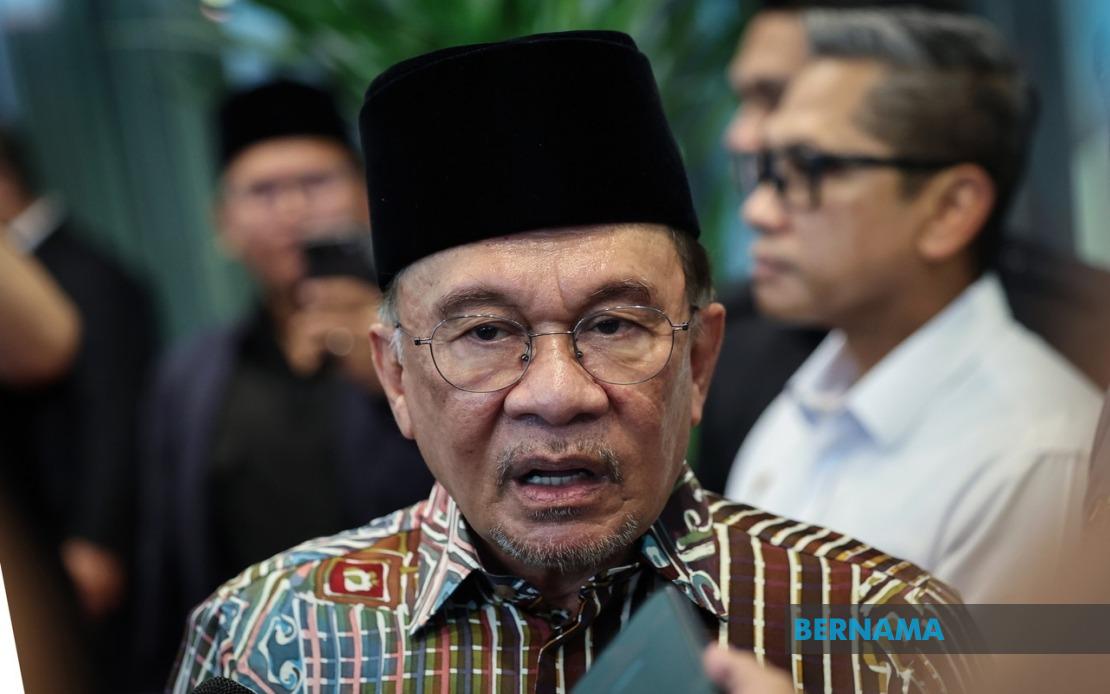
Prime Minister Datuk Seri Anwar Ibrahim has drawn a firm line on refugee conduct in Malaysia, declaring that the government will take uncompromising enforcement action against any group—regardless of their status—that breaks the law, disrupts public order, or attempts to occupy areas without authorisation. Speaking at the closing ceremony of the International Wakaf Dakwah Convention 2026 in Kuala Lumpur on July 27, Anwar outlined a zero-tolerance approach that signals a hardening stance on refugee management in the country.
The Prime Minister's comments came in response to a significant gathering of several hundred Rohingya refugees who assembled outside the UNHCR office on Jalan Bukit Petaling on the same morning. According to reports, the group had arrived in the capital on three buses from Penang early that day, creating an unscheduled public congregation that disrupted traffic and raised concerns about unauthorised assemblies in residential and commercial areas. This incident appears to have triggered the government's swift policy articulation, with Anwar using the platform to communicate his administration's position directly to the public.
Anwar has instructed the Royal Malaysia Police (PDRM), the Immigration Department (JIM), and local authorities (PBT) to enforce existing laws rigorously. Refugees found without proper travel permits or documentation are to be referred immediately to immigration authorities for processing and detention, whilst those carrying valid documents will initially receive a formal warning. Any subsequent violations will result in prosecution under relevant statutes. This tiered enforcement approach suggests the government recognises differing circumstances among the refugee population whilst maintaining firm boundaries on legal compliance.
The Prime Minister emphasised that Malaysia's legal framework applies uniformly to all persons within its borders, including refugees and asylum seekers. He reiterated that no group has the right to spontaneously occupy public spaces, particularly in urban areas where such gatherings obstruct traffic and pose security challenges. This framing positions refugee conduct as a matter of law and order rather than purely humanitarian concern, reflecting broader public sentiment about managing large populations with uncertain legal status.
Whilst acknowledging that some refugees genuinely seek protection through the UNHCR—the international body mandated to assist displaced persons—Anwar made clear that such protection-seeking does not exempt individuals from Malaysian law. The government's position appears to distinguish between sympathising with refugees' underlying circumstances and tolerating behaviour that infringes on local residents' safety and convenience. This nuance is significant for understanding how Malaysia's approach differs from blanket opposition to refugee presence.
The underlying tension in Malaysia's refugee situation stems from the country's ambiguous legal status regarding refugee protection. Malaysia is not a signatory to the 1951 Refugee Convention, meaning refugees lack formal legal status and protection mechanisms beyond UNHCR oversight. This creates a grey zone where refugees operate without citizenship rights yet cannot be easily processed under standard immigration law. Anwar's directive appears designed to clarify government expectations: regardless of this legal ambiguity, public order and traffic flow take precedence.
The Rohingya situation specifically carries particular weight for Malaysia, which hosts one of Southeast Asia's largest Rohingya populations—estimated at over 180,000 individuals, predominantly in Kuala Lumpur and Selangor. Many arrived following the 2017 military crackdown in Myanmar that forced approximately 700,000 Rohingya across the border to Bangladesh. Malaysia's Rohingya community, though not officially recognised as refugees, represents a persistent humanitarian and security challenge that governments struggle to balance against public concerns about overcrowding and resource strain.
The government's firm rhetoric also addresses rising anxiety among Malaysian citizens about unauthorised gatherings and occupation of public spaces. Urban communities increasingly report concerns about visible concentrations of refugee populations in certain areas, ranging from economic competition for informal employment to cultural and social tensions. By publicly instructing enforcement agencies to respond decisively, Anwar signals that government will not permit grievances to fester through neglect or perceived indifference to community concerns.
This enforcement direction must be understood within Malaysia's broader security framework. The country classifies refugee issues not merely as humanitarian matters but as intersecting with immigration control, public order, and national security. Unauthorised assemblies—particularly those involving foreign nationals—trigger concerns about potential exploitation by criminal networks, human trafficking syndicates, or other illicit activities. The government's firm stance reflects these layered concerns alongside the immediate practical issue of traffic disruption.
Implementing these directives uniformly across Malaysia's diverse jurisdictions will present operational challenges. Local authorities in Kuala Lumpur, Petaling Jaya, and other urban centres must develop consistent protocols whilst Immigration Department resources remain stretched by existing caseloads. Police forces simultaneously manage multiple competing priorities, and coordination between PDRM, JIM, and local authorities historically encounters implementation gaps. The test of Anwar's policy will lie in sustained, proportionate enforcement that achieves public order objectives without creating humanitarian crises.
For the broader refugee population and civil society organisations supporting them, this statement marks a significant tightening of conditions. Whilst Anwar framed the approach as targeting law-breakers rather than all refugees, the practical effect may chill refugee advocacy and community organising. UNHCR offices, which have historically served as focal points for refugee assistance and communication, may face increased pressure as gathering sites themselves become enforcement priorities. This represents a subtle but meaningful shift in the operating environment for refugee support work.
The international dimension merits consideration as well. Malaysia's approach contrasts with UNHCR's advocacy for refugee rights and dignity, potentially creating diplomatic tension. However, the government's position reflects majority Malaysian public opinion, which tends to support stricter refugee management. Balancing international humanitarian obligations against domestic political pressures remains an enduring challenge for Malaysian policymakers, with this enforcement directive representing one government's attempt to recalibrate that equilibrium.
Moving forward, the government's actual implementation of these directives will determine whether this represents genuine policy change or rhetorical emphasis. The coming weeks will reveal whether enforcement intensifies, how local authorities operationalise instructions, and whether refugee communities and advocacy groups respond with escalation or adjustment. For Malaysia's refugee populations and host communities alike, this moment represents a clarification of state expectations even as underlying questions about refugee protection, integration, and long-term solutions remain unresolved.

