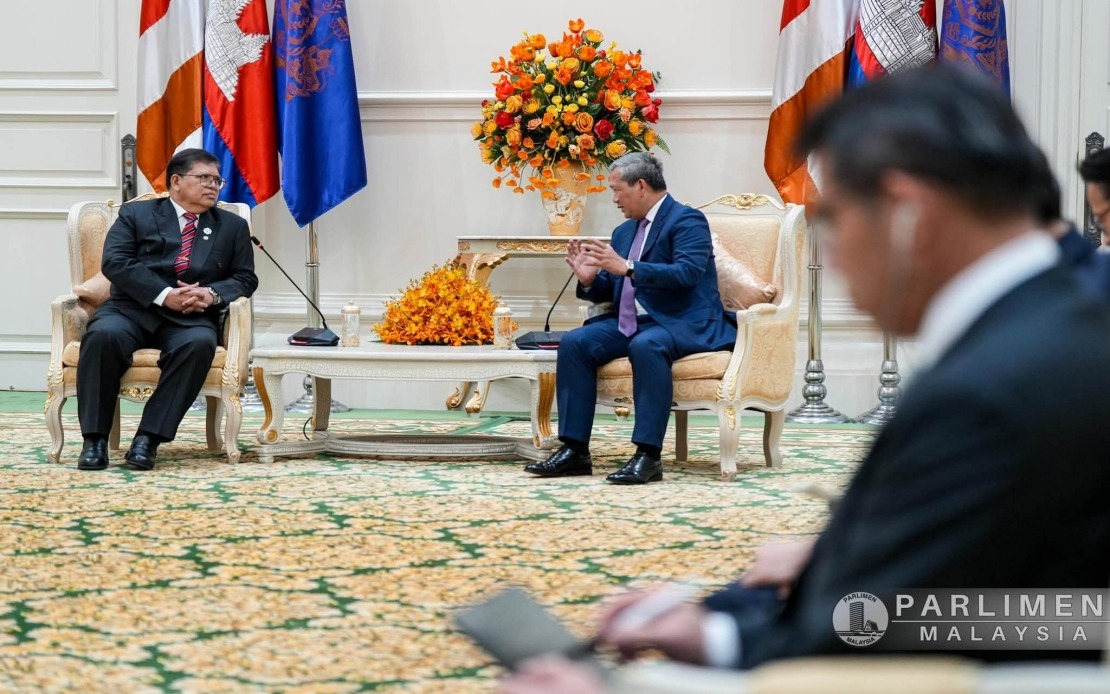
Malaysia is pushing for continued dialogue and diplomatic engagement to resolve the escalating border tensions between Cambodia and Thailand, with parliament speaker Tan Sri Johari Abdul warning that unilateral approaches could destabilise the broader Southeast Asian region. Speaking after meetings in Phnom Penh during the Second Inter-Parliamentary Speakers' Conference, Johari emphasised that ASEAN's effectiveness depends on member states' willingness to manage their differences through negotiation rather than confrontation, a principle that carries particular weight given Malaysia's own experience navigating territorial disputes within the grouping.
The border dispute between Cambodia and Thailand has periodically flared into military confrontations over the past two decades, with civilians in border communities bearing the heaviest costs through displacement and economic disruption. Johari's intervention signals Malaysia's recognition that allowing the conflict to escalate unchecked could trigger a broader destabilisation affecting supply chains, refugee flows and security cooperation across the region. His diplomatic initiative reflects a growing concern among ASEAN governments that the organisation's consensus-based model faces mounting pressure from unresolved boundary disputes that pit member states against one another.
During his engagement with Cambodian Prime Minister Hun Manet at the parliamentary conference, Johari explicitly acknowledged Phnom Penh's grievances regarding the situation along its shared frontier with Thailand, demonstrating Malaysia's understanding of Cambodia's domestic pressures. This recognition serves an important diplomatic function, validating Cambodia's concerns whilst simultaneously encouraging restraint and continued reliance on negotiation. Malaysia's balanced approach reflects its experience as a country that has successfully managed maritime boundary disputes with Singapore and Thailand through sustained dialogue rather than military escalation.
Johari articulated Malaysia's commitment to supporting mechanisms that bring disputing parties back to the negotiating table, positioning Malaysia as a potential mediator or facilitator in future peace initiatives. This role aligns with Malaysia's broader vision within ASEAN of being a stabilising force that champions dialogue over confrontation. The emphasis on preserving regional peace and stability speaks to Malaysia's economic interests, given that ASEAN-wide instability would disrupt trade flows and investment patterns that benefit the Malaysian economy significantly.
Beyond the immediate border crisis, Johari's discussions with Hun Manet ranged across parliamentary cooperation, economic collaboration, and human capital development—areas where Malaysia sees significant potential for expanded engagement. The parliamentary connection is particularly valuable in a regional context where legislators can sometimes influence government positions and public opinion in ways that formal diplomatic channels cannot. Regular inter-parliamentary dialogue creates informal networks of understanding that can provide flexibility during crises.
Both officials highlighted opportunities to deepen Malaysia-Cambodia ties through youth exchange programmes and joint initiatives in technical and vocational education. These people-to-people connections serve a dual purpose: they genuinely advance shared prosperity whilst simultaneously building social bonds that make military confrontation more psychologically difficult for populations that have human connections across borders. Youth engagement particularly helps counter nationalist sentiment that can sometimes escalate border disputes into broader conflicts.
The discussion of Technical and Vocational Education and Training expansion reflects recognition that economic interdependence and shared development challenges can anchor relationships more effectively than formal treaties alone. By creating institutional frameworks for skills training exchanges and industry collaboration, Malaysia and Cambodia are building structures that give both governments stakes in stability and peaceful coexistence. Such initiatives also position both nations to benefit from broader regional value chains as Southeast Asia continues its economic integration.
Johari's appreciation for Cambodia's facilitation of Malaysian business operations underscores an often-overlooked dimension of ASEAN relations: the private sector's interest in stability. Malaysian companies operating in Cambodia have significant sunk costs and employment relationships that depend on ongoing peace. When governments acknowledge the business community's role in stability, they validate economic interdependence as a peace-building mechanism. This creates pressure on political elites to avoid military escalation that would damage investor confidence and corporate profits.
The timing of these comments during an inter-parliamentary conference is strategically significant, as such forums allow legislators from different countries to build personal relationships and understanding outside the formal constraints of diplomatic protocol. Speakers and senior parliamentarians often have greater flexibility to express nuanced positions than executive-branch officials, and their statements can sometimes be more influential in shaping public discourse and legislative positions in their home countries. Johari's emphasis on ASEAN unity carries weight precisely because it comes from the parliamentary sphere rather than from the foreign ministry.
Malaysia's consistent messaging on this issue reflects a conscious decision to position itself as a voice for ASEAN institutionalism and regional cooperation at a moment when the organisation faces significant pressures. From the Myanmar crisis to South China Sea tensions to internal border disputes, ASEAN's relevance depends on demonstrating that member states can manage problems through the organisation's mechanisms. Malaysia's advocacy for dialogue in the Cambodia-Thailand dispute serves a broader systemic interest in preserving ASEAN's problem-solving capacity and collective decision-making authority.
The commitment to long-standing bilateral ties and shared prosperity, as emphasised by Johari, signals that Malaysia views the Cambodia-Thailand dispute as ultimately resolvable through patient diplomacy rather than as an intractable conflict. This optimism, grounded in Malaysia's own experience resolving boundary disputes, offers a model for other ASEAN countries facing similar challenges. By refusing to allow bilateral disputes to calcify into permanent enmity, ASEAN member states create space for future negotiated settlements even when current tensions run high.

