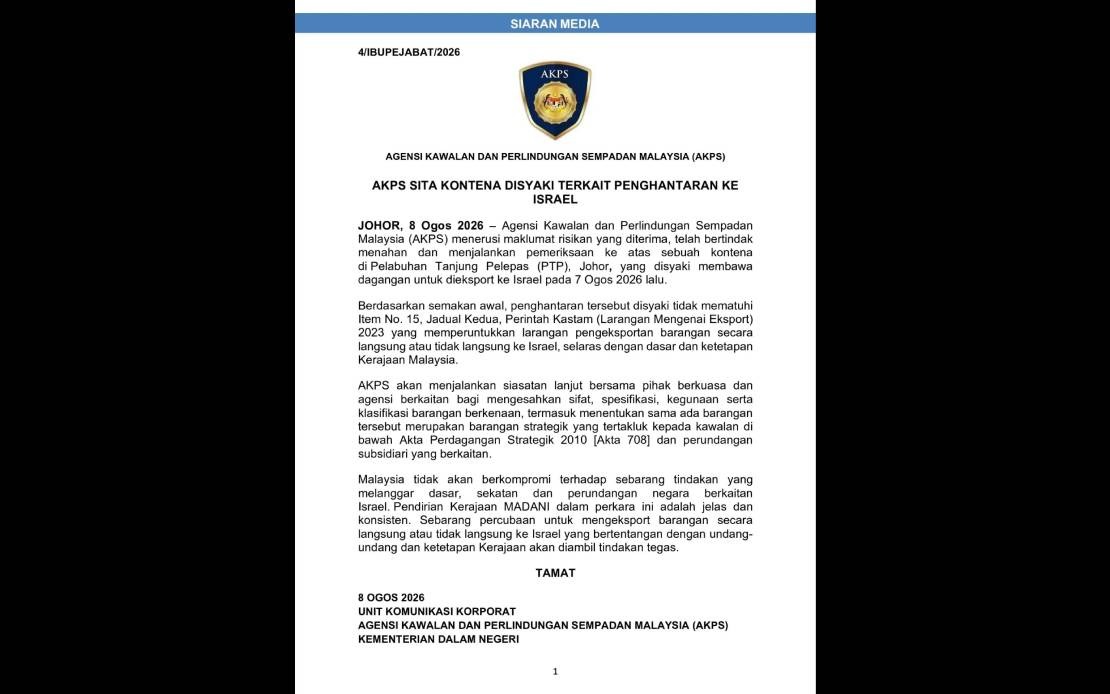
Prime Minister Datuk Seri Anwar Ibrahim has lauded the Malaysian Border Control and Protection Agency (AKPS) for its rapid interception of a container at the Port of Tanjung Pelepas in Johor, which was suspected of containing goods intended for export to Israel. The seizure represents a decisive enforcement action that demonstrates Malaysia's unwavering commitment to preventing its territory and infrastructure from being exploited to facilitate commerce that could strengthen or sustain Israel's military and economic capacity, particularly in light of the ongoing Palestinian crisis.
In remarks shared through his social media platform, Anwar emphasised that the AKPS operation exemplifies Malaysia's determination to maintain strict controls over its ports and logistics networks. The interception prevents Malaysia from inadvertently becoming a conduit for international trade relationships that contradict the country's foreign policy objectives and its principled stance on supporting Palestinian rights. This vigilance reflects a broader governmental commitment to ensuring that Malaysia's economic infrastructure aligns with its diplomatic principles and moral obligations toward the Palestinian people.
The government's position is anchored in Malaysia's membership of The Hague Group, a coalition of nations that coordinate efforts to maintain pressure on Israel through economic and trade restrictions. Anwar reiterated that Malaysia remains bound by this international commitment, which seeks to leverage economic measures as a non-violent mechanism to encourage compliance with international humanitarian law and the principles of the Geneva Conventions. The Prime Minister framed the container seizure as a concrete manifestation of Malaysia's participation in this broader multilateral effort.
Additionally, Anwar highlighted that the interception is consistent with a ban that has been formally in place since December 2023. This ban explicitly prohibits Israeli-registered ships and vessels transporting cargo to Israel from accessing Malaysian ports, effectively closing Malaysia's maritime gateways to direct Israeli commercial shipping. The policy represents one of the most stringent trade restrictions Malaysia has imposed against Israel and signals the government's determination to move beyond rhetorical support for Palestinian causes into concrete economic enforcement measures.
The AKPS statement provided further operational detail, confirming that customs officials detained and thoroughly inspected the container in question at the Port of Tanjung Pelepas. The agency determined that the shipment appeared to violate Item No. 15 of the Second Schedule of the Customs (Prohibition of Exports) Order 2023, which creates a legal framework banning direct or indirect export of goods destined for Israel. This regulatory instrument translates government policy into enforceable customs law, giving border officials the statutory authority to act unilaterally when suspicious shipments are identified.
The legal framework underpinning the seizure is significant for understanding how Malaysia operationalises its diplomatic stance. The Customs Order establishes a comprehensive export prohibition regime that goes beyond merely blocking direct shipments to Israel; it also captures indirect routes and transshipment operations intended to circumvent the ban. This breadth reflects awareness that determined traders might attempt to obscure Israel-bound goods by routing them through intermediary jurisdictions or using shell companies and third-party consignees to mask the ultimate destination.
For Malaysian readers and businesses, the seizure serves as a stark reminder that compliance with Israel-related trade restrictions is now a serious enforcement priority rather than an aspirational policy statement. Companies involved in logistics, manufacturing, and export operations must conduct thorough due diligence on their supply chains and customer bases to ensure they do not inadvertently become vectors for prohibited trade. The AKPS action demonstrates that even sophisticated supply chain strategies may be detected through modern customs inspection techniques and intelligence gathering.
The timing of Anwar's public commendation of the AKPS suggests that the government views these enforcement actions as politically valuable, signalling resolve to both the Malaysian electorate and the broader Muslim world. For a Prime Minister who has emphasised Malaysia's role as a bridge between the Islamic world and the international community, visible enforcement of pro-Palestinian trade measures reinforces his credibility on the issue while also positioning Malaysia as a leader among developing nations willing to impose economic costs on Israel.
From a regional perspective, Malaysia's hardening stance on Israel trade stands in contrast to the more ambivalent or pragmatic approaches adopted by some neighbouring ASEAN economies. While countries such as Singapore and Thailand maintain more normalised commercial relationships with Israeli entities, Malaysia has chosen to move in the opposite direction, establishing increasingly restrictive measures. This divergence reflects both Malaysia's distinct domestic political calculations and its particular historical and religious considerations regarding the Israeli-Palestinian conflict.
The container seizure also underscores the practical challenges facing international trade in the era of politicised commerce. Shippers, freight forwarders, and port operators across Southeast Asia must now navigate an increasingly complex patchwork of national restrictions, requiring real-time knowledge of multiple jurisdictions' policies. Malaysia's aggressive enforcement of its export prohibitions will likely prompt logistics companies to recalibrate their routing strategies, potentially redirecting some regional trade flows away from Malaysian ports and toward alternative hubs in jurisdictions with less stringent Israel-related restrictions.
Looking forward, the sustainability of Malaysia's trade stance will depend on maintaining consistent enforcement over time. One-off seizures, while symbolically important, lack deterrent power unless businesses perceive a genuine risk of detection and penalties. The government has signalled through Anwar's remarks that AKPS operations will continue, suggesting a sustained enforcement commitment. However, the effectiveness of customs controls remains inherently limited when determined importers can exploit the complexity of global supply chains and the opacity of corporate structures used to mask commercial interests.
The incident also raises questions about intelligence-sharing between Malaysia and other nations aligned with its pro-Palestinian policies. Determining how the suspicious container was identified in the first place—whether through routine inspection, intelligence tips, or data analytics—remains unclear, but the sophistication of modern customs enforcement suggests that Malaysia may be receiving assistance from international partners to identify problematic shipments. Such cooperation, while undisclosed in official statements, likely forms part of a broader security and trade verification apparatus operating among nations that oppose Israeli commerce.
Anwar's emphasis on Malaysia's commitment to international law and humanitarian principles frames the trade restrictions as expressions of universal values rather than sectarian concerns. By invoking human rights frameworks and international humanitarian law, the government positions its Israel policy within a broader context of defending vulnerable populations and upholding global norms. This rhetorical strategy may help sustain domestic political support for economically costly trade restrictions by connecting them to abstract principles that transcend Malaysia's particular geopolitical interests.

