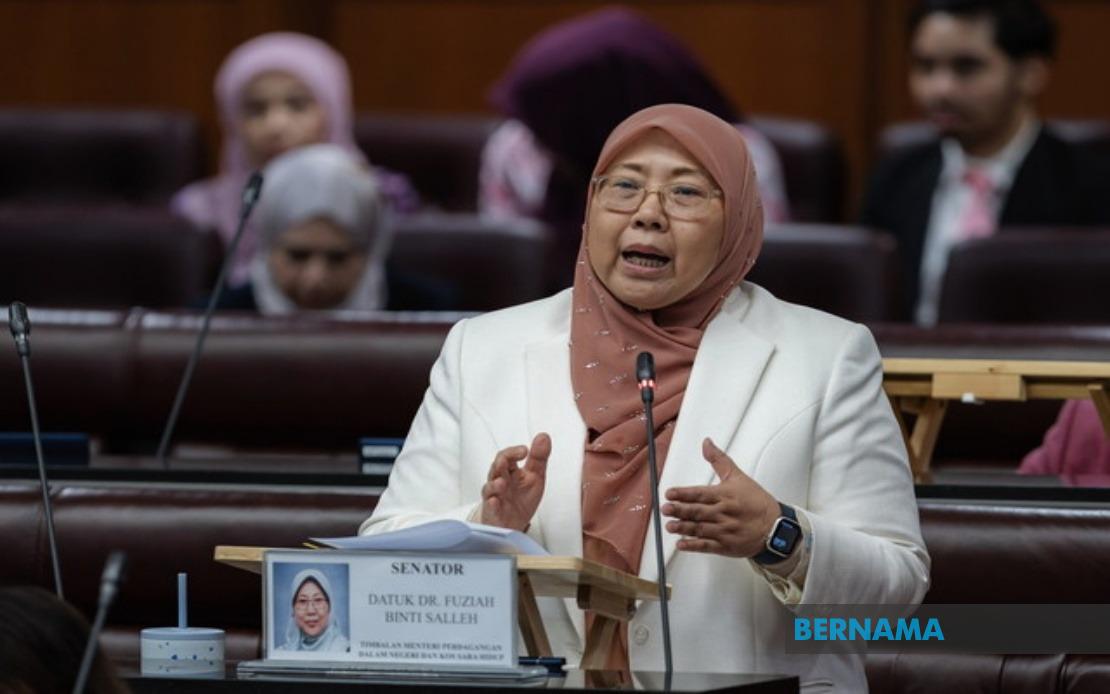
Malaysia's government has clarified that artificial intelligence developers seeking to train models using copyrighted material must first obtain permission from copyright holders, reaffirming the protections enshrined in the Copyright Act 1987. Deputy Domestic Trade and Cost of Living Minister Datuk Dr Fuziah Salleh made this position explicit during parliamentary proceedings at the Dewan Negara, drawing a clear line that the requirement applies uniformly whether copyrighted works are used for AI applications or conventional purposes.
The minister's statement addresses growing global concerns about the unconsented use of creative works to train large language models and other AI systems. As artificial intelligence increasingly relies on vast datasets drawn from books, articles, images, and other protected material, creators and publishers worldwide have raised alarms about potential economic harm and intellectual property violations. Malaysia's explicit reaffirmation of its existing legal framework signals that local copyright protections remain intact even as technology evolves rapidly.
Under Section 27 of the Copyright Act 1987, the terms governing such use—including licensing fees, royalty structures, and rights allocation—remain subject to negotiation between copyright owners and those seeking to use their works. Fuziah elaborated that these arrangements can be formalized through direct licensing agreements, outright rights assignments, or through Collective Management Organisations that represent copyright holders' interests. The existence of CMOs provides an institutional pathway for creators to collectively manage permissions and compensation without individually negotiating with every AI developer or technology company.
Fuziah's clarification emerged in response to parliamentary questioning from Senator Datuk Wu Him Ven, who sought government assurance that local creative industry professionals would be protected from having their works incorporated into AI systems without consent or compensation. The senator's line of questioning reflects broader anxiety in Malaysia's creative sector about the commercial implications of unrestricted AI training on copyrighted material. Without explicit approval mechanisms and royalty frameworks, creators feared they might see their intellectual property monetized while receiving nothing in return.
The government has not yet undertaken a formal impact assessment examining how AI-generated content might displace local creative workers or depress earnings across Malaysia's music, publishing, film, and graphic design industries. This represents a notable gap in policy development, particularly given that several countries including the United States, European Union nations, and the United Kingdom have initiated comprehensive studies on AI's labour market effects. Fuziah acknowledged this shortcoming while defending the government's deliberate, consultative approach. She emphasized that rapid technological change requires continuous engagement with industry stakeholders, legal experts, and international peers before hasty policy reforms are introduced.
Malaysia's current copyright framework extends protection only to original works demonstrating human creativity, skill, and intellectual effort. Works generated entirely by artificial intelligence systems, lacking substantial human creative contribution, fall outside the scope of copyright protection under existing law. This distinction becomes increasingly relevant as AI systems grow more sophisticated and capable of producing seemingly original content with minimal human intervention. The government has not yet clarified where the legal boundary lies between human-assisted AI creation and fully automated generation, a critical question that will shape future copyright enforcement.
Remarkably, Malaysia has recorded no court cases to date involving copyright infringement claims specifically related to AI training or AI-generated content. This absence of litigation reflects either compliance with existing law or, alternatively, the nascent stage of AI deployment in Malaysia compared to technology hubs in North America, Europe, and East Asia. Either way, it suggests that Malaysia's creative industries have not yet mobilized legal action to test the extent of copyright protection in AI contexts, potentially because the scale of AI-driven content generation in Malaysia remains smaller than in more advanced tech markets.
The government's cautious posture reflects international uncertainty about how to balance copyright protection with AI innovation. Some jurisdictions have attempted to expand fair use exceptions to permit AI training, arguing that this benefits technological progress and ultimately consumers. Others have proposed statutory licensing schemes that automatically compensate copyright holders when their works are used for AI purposes. Malaysia appears to be taking neither extreme approach, instead maintaining existing copyright rules while signalling openness to future regulatory adjustments once clearer evidence of economic impact emerges.
For Malaysia's creative professionals—writers, musicians, visual artists, and software developers—the government's position offers reassurance that intellectual property rights remain enforceable but also highlights the practical challenge of monitoring and enforcing those rights. Identifying when copyrighted works have been incorporated into AI training datasets is technically difficult, and pursuing claims against international technology companies entails substantial legal costs. The reliance on CMOs as intermediaries suggests the government favours collective rather than individual enforcement, but Malaysian CMOs would need stronger resources and legal support to effectively represent creators' interests in disputes with major AI developers.
The statement also reflects Malaysia's broader positioning as a developing nation attempting to protect local creative industries while remaining attractive to global AI investment and innovation. Unlike stringent regulatory approaches that might deter technology companies from operating locally, Malaysia's framework preserves copyright protections without imposing new administrative burdens on AI development. This balanced approach aims to accommodate both creator protection and technological progress, though it remains uncertain whether the existing Copyright Act 1987 provides sufficient clarity for the novel challenges posed by large-scale AI training.
Government consultation with international partners and other countries will inform Malaysia's next steps. Nations that have moved faster to establish AI-specific copyright policies or licensing mechanisms—including proposed frameworks in the European Union and ongoing legislative debates in the United States—may offer useful models. However, Malaysia's experience and technological capacity may differ sufficiently that wholesale adoption of foreign approaches would prove inappropriate. The government's emphasis on continued stakeholder engagement and international learning suggests policymakers are genuinely seeking informed solutions rather than reactive measures.
The absence of formal impact assessments remains a notable vulnerability in Malaysia's policy position. Creative industry workers and their representatives have legitimate concerns about how AI might reshape labour markets and creator earnings, yet government data on these questions remains sparse. Commissioning independent research on AI's effects on employment, income distribution, and creative sector vitality would strengthen Malaysia's ability to craft evidence-based policies and protect vulnerable populations within the creative industries. Until such evidence is gathered, the government's cautious approach, while defensible, risks leaving creators exposed to competitive disruption without clear governmental support or adjustment mechanisms.

