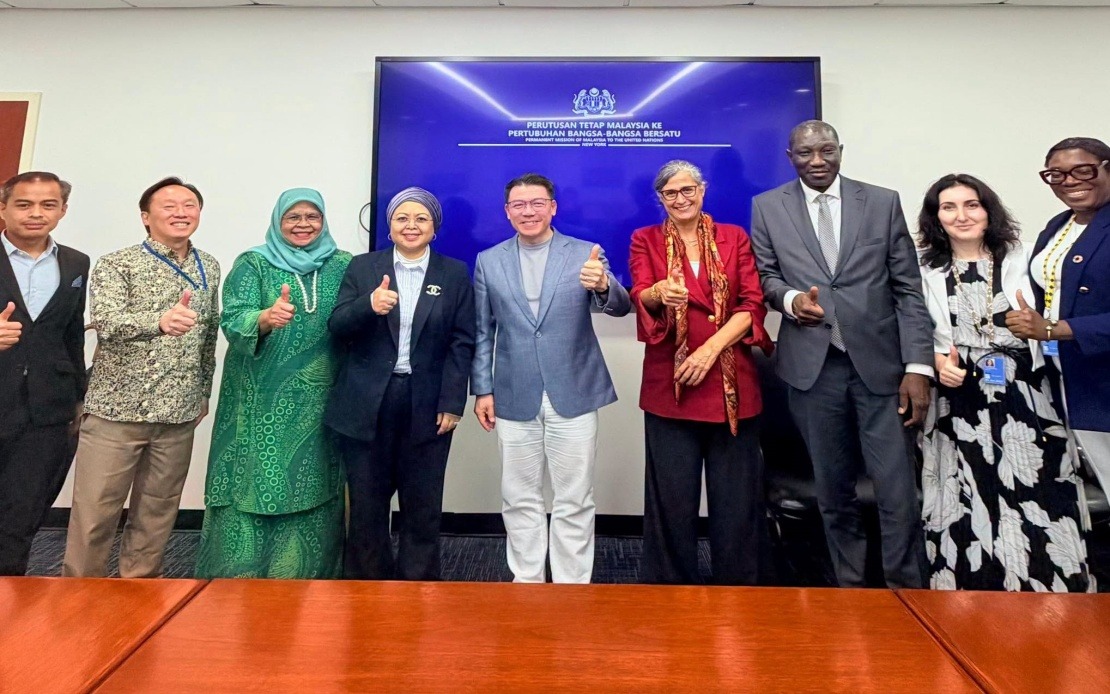
Malaysia has issued a forceful appeal for concrete global action to advance the implementation of the New Urban Agenda, calling on the international community to transform commitments into measurable progress before the 2030 deadline arrives. Housing and Local Government Minister Nga Kor Ming delivered this message while participating in the High-Level Meeting on the Midterm Review of the New Urban Agenda at the United Nations Headquarters in New York, signalling that the region takes its urban development responsibilities seriously.
Nga's intervention carries particular weight given Malaysia's position as President of the UN-Habitat Assembly, a role that positions the country as a significant voice on global urban policy. Speaking in his official capacity, he argued that the current midterm review represents far more than a stocktaking exercise. Rather, he framed it as a critical juncture where nations must demonstrate serious intent by redirecting resources and political will toward implementing solutions that benefit the billions of urban dwellers worldwide. With only four years remaining until 2030, he emphasized that continuing patterns of slow progress are fundamentally incompatible with the scale and urgency of urban challenges facing member states.
The minister identified three interconnected crises demanding immediate attention: the escalating global housing shortage that has left millions homeless or inadequately sheltered, the digital divide that has created a two-tier urban system where connectivity and access to digital services remain unevenly distributed, and the mounting imperative to build climate resilience into urban infrastructure. Each of these challenges carries profound implications for Malaysia and neighbouring Southeast Asian nations, where rapid urbanization has intensified demand for affordable housing, stretched municipal services, and exposed vulnerabilities to climate impacts including flooding and extreme weather events. The framing of these issues underscores a recognition that urban development cannot proceed along narrow economic lines but must integrate social equity and environmental sustainability.
Central to Malaysia's advocacy is the Asia-Pacific Urban Action Platform, which the country has championed alongside regional partners as a mechanism for translating global Sustainable Development Goals into locally appropriate initiatives. This platform facilitates knowledge transfer across borders, enables cities to learn from one another's experiences, and strengthens mechanisms for financing green infrastructure projects that would otherwise face funding constraints. For Southeast Asia specifically, this represents a valuable opportunity to address urbanization in culturally and contextually appropriate ways rather than importing wholesale solutions designed for different geographical and economic contexts.
Malaysia has substantiated its advocacy with concrete domestic achievements. The country has already certified more than 500 million square feet of green-index buildings, reflecting a substantial commitment to low-carbon urban development. The government has set targets to expand this portfolio further before 2030, demonstrating that sustainable urbanism at scale remains achievable through sustained political commitment and strategic investment. These figures provide tangible evidence that can inform discussions at the international level, particularly when engaging developing nations that face resource constraints in implementing green building standards.
The minister grounded Malaysia's international activism within the broader MADANI Economy framework, which integrates urbanization policy with wider economic objectives centred on inclusivity and sustainability. This domestic policy anchoring ensures that Malaysia's UN advocacy reflects genuine strategic priorities rather than rhetorical positioning. The framework articulates an explicit commitment to ensuring that urban development benefits reach across all population segments and geographic regions, directly addressing concerns that rapid urbanization has created winner and loser communities.
Nga's statement reflected sophisticated recognition that meaningful urban transformation cannot be achieved through top-down mandates alone. Instead, he identified strong political commitment, locally driven solutions, and collaborative partnerships among government institutions, international development partners, and local stakeholders as the essential ingredients for sustainable urban development. This multi-stakeholder approach acknowledges that cities operate within complex ecosystems involving municipal governments, civil society organizations, grassroots communities, and development agencies that must coordinate effectively to achieve systemic change.
The two-day High-Level Meeting itself carried the thematic focus of accelerating and scaling urban agenda implementation toward 2036, bringing together UN member states, senior government officials, mayors and regional leaders, and civil society representatives. This convening structure reflected recognition that urban challenges transcend national boundaries and that peer learning among cities provides valuable insights for policy adaptation. The participation of local government leaders marked a departure from earlier approaches that focused primarily on national governments, reflecting a growing acknowledgment that mayors and city administrations often implement urban policy on the ground and therefore deserve voice in global agenda-setting.
Malaysia's intervention also carried implicit messaging about regional leadership and development priorities. By assuming the presidency of UN-Habitat Assembly and actively shaping discussions around sustainable urbanism, Malaysia positions itself as a thoughtful voice on global development issues while simultaneously advancing regional interests. Southeast Asia faces some of the world's fastest urbanization rates, with millions migrating to cities annually in search of economic opportunity. The region's success in managing this demographic transition while maintaining environmental integrity and social cohesion will determine whether the Sustainable Development Goals are achievable in practice, making Malaysia's advocacy particularly consequential.
The minister explicitly called upon fellow member states to move beyond rhetorical commitments and leave the High-Level Meeting with renewed determination and practical plans for implementation. This challenge carries an undertone of frustration with previous international meetings that produced declarations but limited tangible action. By pressing for concrete commitments rather than aspirational language, Malaysia implicitly argues that the development community has exhausted tolerance for gap between pledges and performance, particularly given that only four years remain to meet the 2030 targets that nations endorsed several years ago.
Malaysia also recognized the contributions of key international figures and institutions, including UN Secretary-General António Guterres, Executive Director of UN-Habitat Anacláudia Rossbach, and President of the 80th UN General Assembly session Annalena Baerbock, alongside the work of grassroots communities and civil society organizations. This inclusive acknowledgment reflected understanding that advancing the urban agenda requires coordination across institutional hierarchies and that local communities possess essential knowledge and legitimacy that must inform global policy frameworks.
Looking forward, Malaysia's messaging suggests that the country intends to leverage its UN-Habitat Assembly presidency to push the international community toward more ambitious, specific, and measurable urban development commitments. For Southeast Asia, this leadership position offers opportunities to shape regional approaches to urbanization that reflect local contexts while remaining aligned with global frameworks. The coming years will reveal whether Malaysia's call for stronger action catalyzes meaningful shifts in international commitment, or whether the New Urban Agenda remains primarily aspirational despite the urgency of urban challenges affecting billions worldwide.

