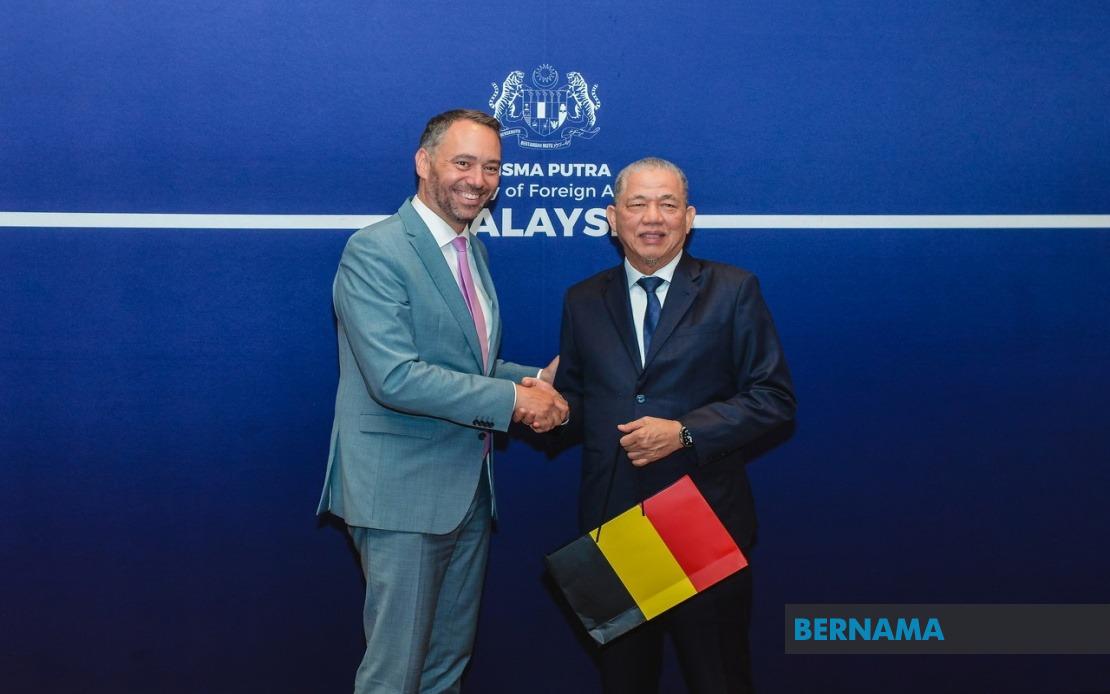
Malaysia has moved to reassure Belgium that freedom of navigation through the South China Sea will remain guaranteed, with Deputy Prime Minister Datuk Seri Fadillah Yusof emphasising ASEAN's unwavering commitment to regional stability and unimpeded maritime commerce. The assurance came during a bilateral meeting between Fadillah and Belgium's Deputy Prime Minister and Minister of Foreign Affairs, European Affairs, and Development Cooperation, Maxime Prévot, who arrived in Malaysia on Thursday for a two-day working visit—his first trip to the country since taking office in February 2025.
The timing of Malaysia's reassurance reflects heightened international anxiety about the security of critical shipping lanes following incidents in other regions. Prévot had specifically sought Malaysia's assessment of the regional security landscape, including the possibility that the South China Sea could experience disruptions similar to those witnessed in the Strait of Hormuz, where shipping has faced repeated threats from various actors. Malaysia's explicit guarantee against blockades and its reaffirmation of ASEAN principles directly addresses these European concerns, signalling that the bloc remains committed to maintaining the rules-based international order that underpins global trade.
For Malaysia, which itself depends heavily on uninterrupted passage through these waters, the pledge underscores the country's strategic interest in preserving the status quo. Fadillah, who also holds the portfolio of Minister of Energy Transition and Water Transformation, framed the commitment as rooted in ASEAN's foundational principles of neutrality, peace, and open access. This messaging is crucial not only for reassuring European partners but also for projecting stability to all nations with maritime interests in Southeast Asia, particularly amid ongoing geopolitical tensions in the region.
The bilateral discussion extended beyond security matters to encompass a comprehensive agenda of economic and people-to-people cooperation. Belgium expressed its commitment to expanding bilateral trade with Malaysia and indicated willingness to reconsider its travel advisory for Sabah, suggesting that security assessments of the state may be revisited. This shift in Belgium's stance towards Sabah could have practical implications for tourism and business activity in the state, provided the advisory is indeed downgraded. Such diplomatic gestures often precede tangible improvements in investment flows and visitor numbers.
A particularly intriguing dimension of the talks involved Belgium's interest in Malaysia's halal ecosystem. The Belgian delegation proposed that Malaysia's halal standards and certification systems be examined as a potential model for adoption across the European Union. This recognition of Malaysian expertise opens pathways for the country's Islamic finance and halal industries to expand their influence in European markets and regulatory frameworks. Malaysia's position as a global halal hub could translate into competitive advantages for local companies seeking to serve European consumers increasingly interested in halal-certified products and services.
Cooperation in energy transition emerged as another priority area, with Belgium keen to leverage its technological expertise and advanced materials capabilities to support Malaysia's decarbonisation efforts. The discussions reflected bilateral interest in fostering deeper commercial ties, with both sides seeking to encourage Belgian investment in Malaysia's green economy. For Malaysian policymakers, Belgian expertise in renewable energy technologies and sustainable materials represents a valuable resource as the country works to meet its carbon reduction commitments and transition away from fossil fuel dependency.
The presence of Foreign Ministry Secretary-General Tan Sri Amran Mohamed Zin and Belgium's Ambassador to Malaysia Peter Van Acker at the luncheon underscored the diplomatic significance attached to the engagement. Bilateral meetings at this level typically signal broader intentions to strengthen institutional relationships between governments and facilitate business linkages between private sectors. The fact that Prévot chose Malaysia as an early destination in his international itinerary since assuming his ministerial role suggests Belgium views Southeast Asia and Malaysia specifically as important partners in its strategic calculus.
From a regional perspective, Malaysia's role as a bridge between ASEAN and the European Union becomes increasingly important as global supply chains undergo realignment and geopolitical competition intensifies. The country's ability to reassure external partners about maritime security while maintaining relationships with all stakeholders in the South China Sea reflects a delicate diplomatic balancing act. Malaysia's consistent messaging about open access and rules-based governance helps reinforce ASEAN's collective credibility on these matters, even as individual member states navigate complex bilateral relationships with major powers.
The engagement also highlights Malaysia's broader strategy of leveraging sectoral strengths—such as halal certification and Islamic finance—to deepen partnerships with non-Muslim-majority nations. This approach demonstrates that Malaysia can offer practical value and expertise beyond traditional trade in commodities and manufacturing, positioning itself as a knowledge economy with distinct competitive advantages. As Belgium and other European nations seek to diversify their supply chains and develop new trade relationships, Malaysia's emerging strengths in specialised sectors provide compelling commercial opportunities.

