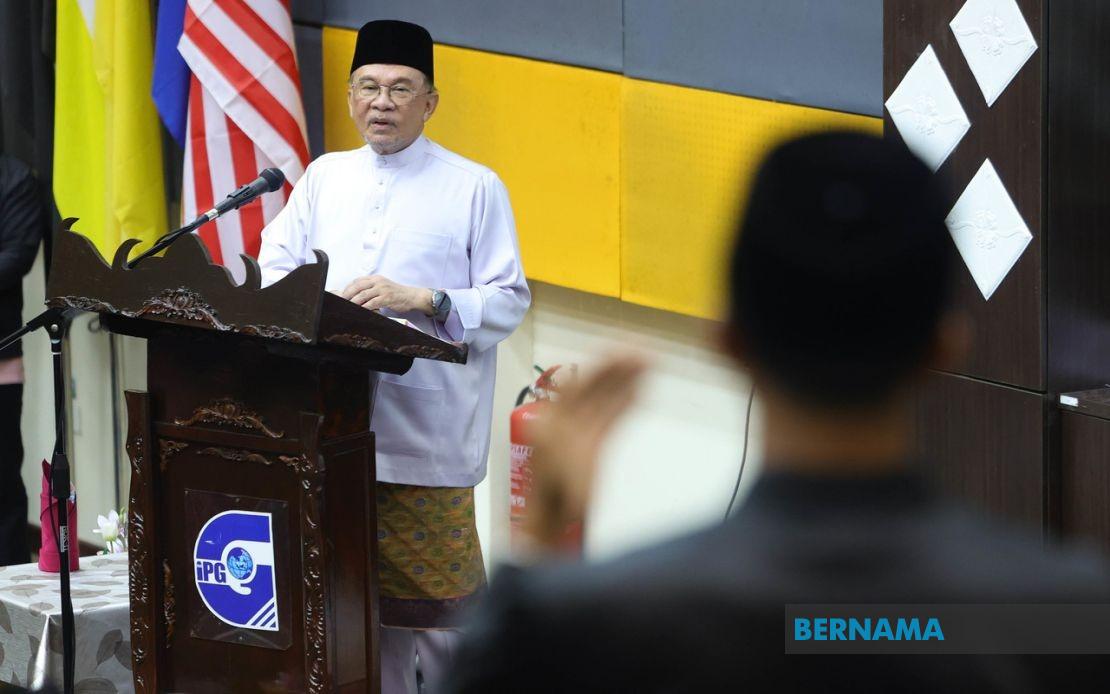
Prime Minister Datuk Seri Anwar Ibrahim has called for a fundamental reimagining of Malaysia's teacher workforce, arguing that educators must straddle two worlds simultaneously: mastering cutting-edge technologies like artificial intelligence while remaining deeply rooted in moral and ethical principles. Speaking in Nilai on July 17, Anwar outlined a vision for national education that rejects the false choice between technological advancement and humanistic development, instead positioning both as essential pillars of a competitive and cohesive society.
The prime minister's intervention into education policy reflects growing concerns across Southeast Asia about how nations can harness rapid technological change without sacrificing the cultural and religious values that bind diverse communities together. Anwar emphasised that Malaysia cannot afford to stand still as global competitors race ahead in emerging fields like artificial intelligence, quantum computing, and advanced data science. Yet he warned that technical prowess divorced from ethical grounding would ultimately undermine rather than strengthen the nation, creating a generation of skilled technicians devoid of moral compass.
This dual emphasis on innovation and values addresses a tension that policymakers across the region struggle to resolve. While countries like Singapore, South Korea, and China have invested heavily in STEM education, Malaysia faces the additional complexity of managing religious and racial diversity in its curriculum and teaching force. Anwar's framing suggests that ethical education is not an impediment to technological progress but rather a prerequisite for it, enabling society to deploy new capabilities responsibly and equitably.
The Prime Minister articulated his philosophy through a memorable metaphor: Malaysian educators and students must "reach for the skies while keeping our roots on the ground." This captures the dual imperative of technical excellence and cultural continuity. He stressed that mastery of modern technology without corresponding development of character among both teachers and students represents an incomplete and ultimately dangerous approach to education reform. The statement reflects anxiety about how rapid globalisation and technological adoption can erode local traditions and community bonds, particularly in a multiracial nation where shared values serve as social glue.
Anwar further elevated education to the apex of national priorities, placing it above economic policy or infrastructure development. He argued that the country's capacity to compete globally and adapt swiftly to international change depends first and foremost on having world-class teachers and curricula. This positioning signals a potential reallocation of resources and political attention toward the education sector, which has long grappled with underfunding, teacher shortages, and outdated curricula in some areas.
A significant portion of his address focused on the dangers of allowing racial and religious prejudice to contaminate educational spaces. Anwar warned explicitly that education would fail in its fundamental mission if teachers or students succumbed to hatred toward other communities. This concern has particular resonance in Malaysia, where periodic episodes of communal tension and inflammatory rhetoric have threatened social cohesion. By framing tolerance and interfaith understanding as educational imperatives rather than political niceties, Anwar positions the classroom as a frontline in protecting national unity.
The Prime Minister articulated a vision of multicultural education in which diversity becomes a source of strength rather than division. He emphasised that no nation, regardless of power or wealth, can endure if it deliberately cultivates ethnic or religious animosity among its population. Instead, Malaysia's strength lies in developing citizens who value tolerance, mutual respect, and shared humanity across religious and cultural lines. This vision challenges both narrow nationalism and uncritical globalisation, offering instead a localism rooted in genuine pluralism.
Anwar's comments reflect ongoing deliberation within Malaysian policymaking circles about how to integrate international best practices in science and technology education while preserving the distinctive character and values that define Malaysian society. The challenge is not merely pedagogical but deeply political, touching on questions of national identity, religious freedom, and social contract. His framing attempts to resolve potential tensions by arguing that these goals are complementary rather than contradictory.
Education Minister Fadhlina Sidek and Institut Pendidikan Guru Kampus Pendidikan Turki (IPGKPT) director Dr Kartini Abdul Mutalib attended the event, suggesting coordination at the highest levels of the education bureaucracy. Their presence indicates that calls for curriculum and teacher training reform are likely to translate into concrete policy initiatives in the coming months. The involvement of teacher training institutions is particularly significant, as these bodies shape not only what teachers know but how they approach their profession and their students.
The implications of Anwar's vision extend beyond Malaysia's borders. Throughout Southeast Asia, nations grapple with similar tensions between technological modernisation and cultural preservation. Malaysia's approach, emphasising complementarity rather than trade-off, may influence regional debates about education policy. If successfully implemented, the model could demonstrate how developing nations can compete technologically while strengthening rather than weakening social cohesion and shared identity.
For Malaysian educators, the challenge now lies in translating this vision into classroom practice. Teachers will need substantial professional development to deepen their own understanding of emerging technologies while simultaneously becoming more skilled facilitators of ethical reasoning and interfaith dialogue. This requires not just investment in training programmes but also restructuring how teachers' work is evaluated and rewarded, ensuring that character education and values development are recognised as legitimate professional priorities alongside subject matter expertise.
The success of this approach will depend on whether Malaysia can maintain political commitment to education even as governments change, and whether the teaching profession attracts and retains the calibre of talent necessary to deliver such an ambitious vision. Without competitive salaries, manageable class sizes, and genuine professional autonomy, even the finest curriculum design will struggle to take root in Malaysian schools. Anwar's rhetorical commitment to education as the nation's top priority must be matched by sustained budgetary allocation and systemic reform.

