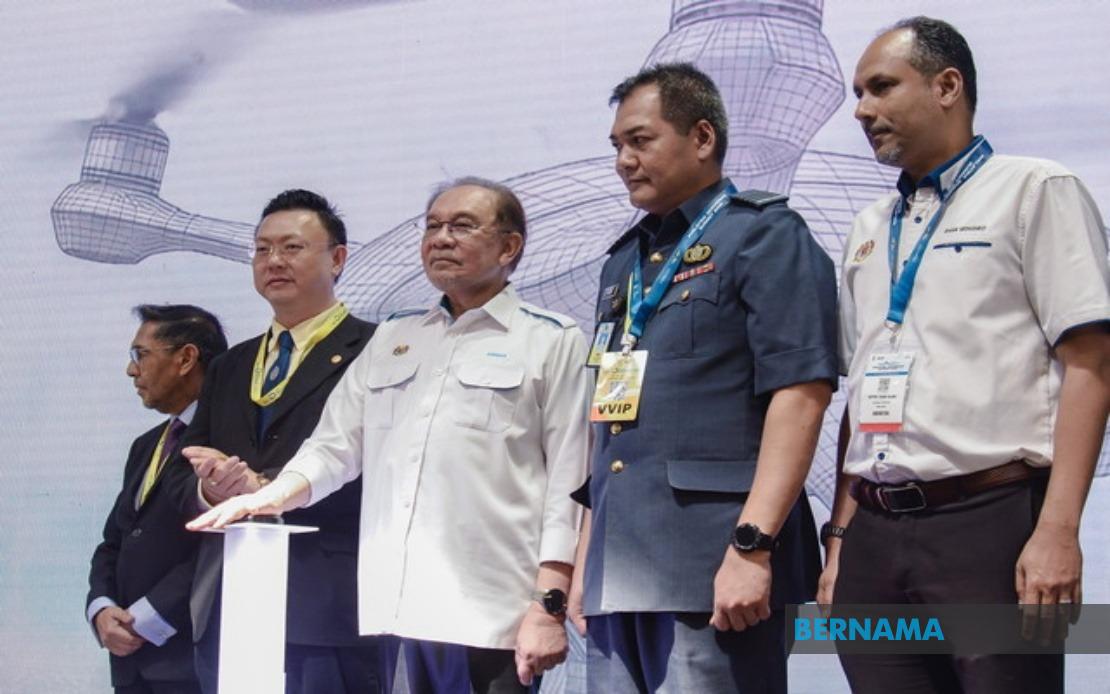
Prime Minister Datuk Seri Anwar Ibrahim has signalled that Malaysia's economic competitiveness hinges on its ability to swiftly embrace emerging technologies, with particular emphasis on the unmanned aerial vehicle (UAV) or drone industry. Speaking at the closing ceremony of the MyDrone Expo 2026 (MDX2026) in Sepang on June 27, Anwar underscored the urgency of technological advancement, positioning drone development as integral to Malaysia's broader economic ambitions in an increasingly digitalised global marketplace.
The drone sector represents far more than a niche industrial segment. Anwar characterised UAV technology as a convergence point between artificial intelligence, digital transformation, and innovation—a combination that generates tangible economic multiplier effects. By treating drones not merely as defence or aerospace tools but as enablers of productivity across civilian sectors, the Prime Minister articulated a comprehensive vision for how the technology could reshape Malaysia's competitive positioning. This framing signals a departure from siloed thinking about emerging technologies, instead viewing drone capabilities as interwoven with broader digital economy objectives.
The scale of opportunity underpinning Anwar's push is substantial. The global UAV market alone is projected to surpass USD55 billion by 2030, while the nascent low-altitude economy—encompassing airspace between ground level and conventional aircraft altitudes—is emerging as an investment magnet. For Southeast Asia's largest economy, the timing is critical. The gap between aspiration and execution in emerging technology sectors has historically disadvantaged Malaysian firms and entrepreneurs relative to regional and global competitors. Anwar's intervention suggests heightened policy attention to narrowing this gap before international players consolidate market share.
The MyDrone Expo 2026, jointly organised by the World UAV Federation (WUAVF) Malaysia Chapter and the Malaysia UAV Development Association (MUDA), demonstrated genuine industry momentum. The three-day event exceeded attendance and participation expectations, hosting more than 100 exhibition booths and drawing delegates from 46 countries. This international engagement reflects existing regional interest in Malaysia as a potential drone development hub, though realising that potential requires deliberate policy choices and infrastructure investments.
Anwar's directive to Cabinet ministers, policymakers, research establishments, and government agencies represents a formal commitment to systemic ecosystem support. Rather than piecemeal initiatives, this signals an all-of-government approach to removing regulatory bottlenecks and facilitating industry development. The specificity of naming research institutions and agencies suggests that fragmented governance structures—sometimes a challenge in Malaysian policy implementation—have been flagged for coordination and streamlined decision-making in this domain.
The policy articulation extends beyond aerospace and defence applications, which have traditionally dominated UAV discussion in Malaysia. Anwar explicitly highlighted civilian commercial uses, particularly in plantation agriculture, where drone technology can substantially enhance productivity monitoring, pest management, and resource optimisation. This cross-sectoral application potential is significant for Malaysia, given agriculture's enduring importance to rural economies and employment, even as the nation aspires to become a high-income technology-driven economy.
Regulatoryframework modernisation figures prominently in Anwar's stated priorities. Existing regulations governing airspace usage, drone certification, pilot licensing, and operational parameters were designed in an era of less sophisticated technology. Updating these frameworks to facilitate innovation while maintaining safety and security represents a genuine challenge requiring technical expertise, stakeholder consultation, and international coordination. Malaysia's progress on this front will substantially influence whether the country attracts drone manufacturers, research facilities, and service companies.
Research funding enhancement and testing-certification infrastructure development complete the policy toolkit Anwar outlined. These elements address persistent bottlenecks in Malaysia's innovation ecosystem. Without adequate funding for R&D and accessible facilities for prototyping and certification, companies and researchers face incentives to relocate to jurisdictions offering superior support. Singapore and South Korea have already invested substantially in drone infrastructure, creating competitive pressure for Malaysia to accelerate its own development trajectory.
Anwar's emphasis on collaboration between private enterprise, government research institutions, and universities echoes successful models in other advanced technology domains. The Prime Minister specifically referenced existing faculties in artificial intelligence and quantum computing, suggesting these could serve as templates for building comparable drone industry talent pipelines. This institutional approach—rather than relying solely on market forces or individual entrepreneurs—acknowledges that technological leadership requires sustained human capital development embedded within educational and research institutions.
For Malaysian stakeholders across technology, manufacturing, agriculture, and infrastructure sectors, Anwar's signal carries strategic implications. Government commitment to drone sector development opens genuine opportunities for firms willing to invest in capabilities, workforce training, and market positioning. Conversely, the timeline implicit in his remarks—emphasising speed and competitive urgency—suggests that delays in strategic positioning could be costly.
The regional dimension warrants consideration. Southeast Asian countries including Thailand, Vietnam, and Indonesia are simultaneously exploring drone technology opportunities. Malaysia's ability to establish itself as a credible regional hub depends on executing faster than competitors while maintaining regulatory standards that international partners respect. The presence of delegates from 46 countries at the MyDrone Expo indicates existing recognition of Malaysia's potential, but potential unrealised becomes competitor advantage squandered.
Anwar's framing of drone technology as central to Malaysia's economic future reflects broader recognition that traditional competitive advantages—geographic location, manufacturing cost structures, commodity resources—face structural headwinds. Technology adoption and innovation capacity have become decisive factors distinguishing economically dynamic nations from those experiencing stagnation. For a middle-income economy seeking advanced-economy status, the Prime Minister's message is clear: technological leadership is not optional but existential to national prosperity.

