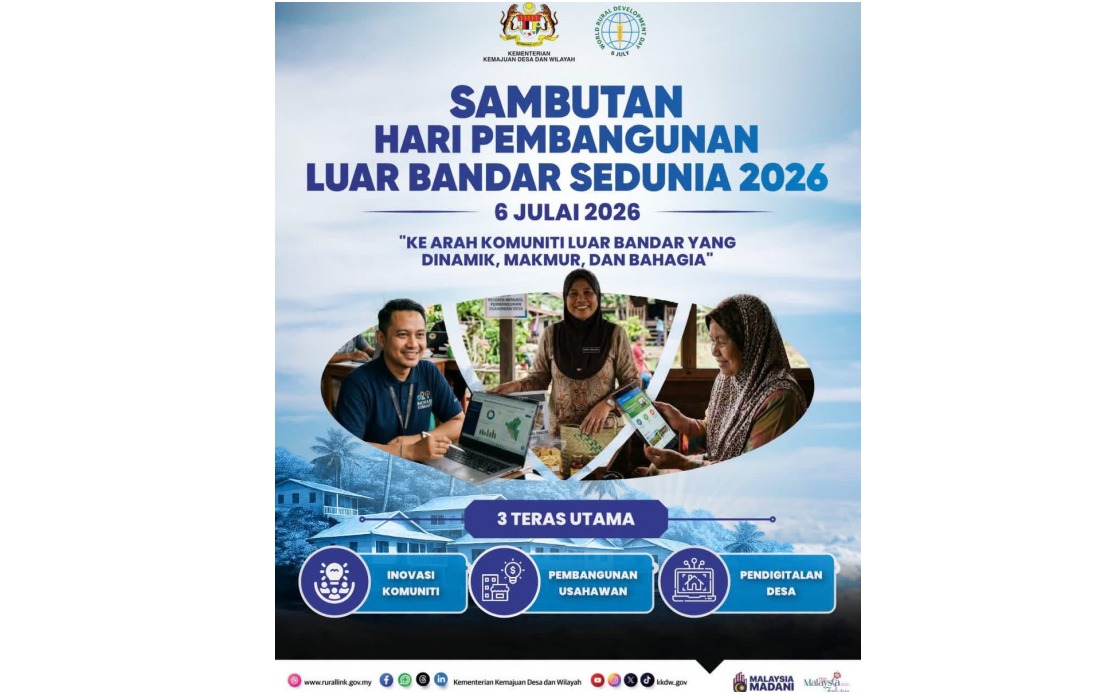
Malaysia will join the global community in observing World Rural Development Day for the inaugural time, with the Deputy Prime Minister and Minister of Rural and Regional Development Datuk Seri Dr Ahmad Zahid Hamidi set to officiate the event tomorrow at Tun Abdul Razak Stadium in Jengka, near Maran in Pahang. The milestone celebration represents a significant moment for the nation's commitment to advancing rural prosperity and reflects Malaysia's alignment with international development frameworks designed to uplift agricultural communities and non-urban populations.
The gathering, themed "Toward Vibrant, Prosperous and Happy Rural Communities," has been organised by the Ministry of Rural and Regional Development to recognise the essential contributions rural populations make to national advancement and their pivotal role in achieving the United Nations Sustainable Development Goals. Rather than viewing rural areas as peripheral to economic progress, the ministry's framing positions farming communities and regional settlements as integral stakeholders whose development trajectories directly influence Malaysia's capacity to meet global development targets by 2030.
The United Nations General Assembly formally designated World Rural Development Day on September 6, 2024, establishing July 6 as the annual commemoration date. This date coincides with the anniversary of the establishment of the Centre on Integrated Development for Asia and the Pacific, an institution deeply invested in regional prosperity. The global observance launched for the first time worldwide on July 6, 2025, and Malaysia has now joined as an active participant, implementing the official celebration beginning in 2026 and positioning itself among nations prioritising rural transformation.
Three strategic pillars will anchor Malaysia's inaugural WRDD observance. Community innovation serves as the first thrust, emphasising how rural populations can harness creativity and local knowledge to solve development challenges. The second pillar, rural digitization, addresses the persistent digital divide that has historically marginalised agricultural regions from technology-driven opportunities and e-commerce integration. The third focus on rural entrepreneur development seeks to cultivate a new generation of commercially-minded agricultural professionals capable of scaling traditional livelihoods into competitive enterprises. Collectively, these thrusts are designed to expand economic possibilities for rural dwellers, democratise access to digital infrastructure and tools, and foster communities equipped with contemporary business competencies.
The celebration will feature several recognition and announcement components demonstrating government appreciation for rural sector achievements. The Rural Aspiration Award MADANI represents official acknowledgement of outstanding rural development initiatives and community leaders driving positive change. The Felda Plan Excellence Award honours productivity gains within federal land development authority schemes. A separate launch of the My Rural Insight Journal will provide a platform for documenting rural narratives and research-based insights into regional development pathways. Additionally, the event will announce Felcra Bhd's Interim Distributable Profit Distribution 1/2026, delivering financial benefits to shareholders in federal land consolidation authority schemes.
For Malaysian readers and observers, this celebration arrives at a crucial juncture when rural economies face mounting pressures from climate variability, labour shortages and market volatility. By elevating rural development to the status of official global commemoration and anchoring Malaysia's participation in this international framework, the government signals recognition that countryside prosperity cannot be deferred without consequences for overall national stability and inclusive growth. The emphasis on digitization particularly resonates across Southeast Asia, where connectivity gaps between urban and rural zones remain a significant development impediment.
The event at Jengka holds particular symbolic weight, as Pahang represents one of Malaysia's significant agricultural regions producing palm oil, rubber, rice and other commodities essential to export earnings and domestic food security. Holding the inaugural WRDD celebration in this constituency underscores commitment to agricultural heartlands rather than merely paying ceremonial respect to rural communities from urban administrative centres.
The Ministry of Rural and Regional Development's continued advocacy through this celebration reflects institutional positioning that improving rural wellbeing represents not peripheral charity but fundamental governance obligation. Exhibition booths and interactive activities will provide public engagement opportunities, inviting citizens to explore how rural development initiatives, government agencies and community programmes intersect to create tangible economic and social improvements.
For Southeast Asian context, Malaysia's participation in the WRDD framework aligns with broader ASEAN recognition that shared rural development challenges—agricultural modernisation, youth migration to cities, infrastructure deficits—require coordinated regional approaches and policy learning. The celebration thus extends beyond national borders to connect Malaysian rural communities with parallel development efforts across Indonesia, Thailand, Philippines and other regional neighbours facing comparable structural transformations in countryside economies and demographics.

