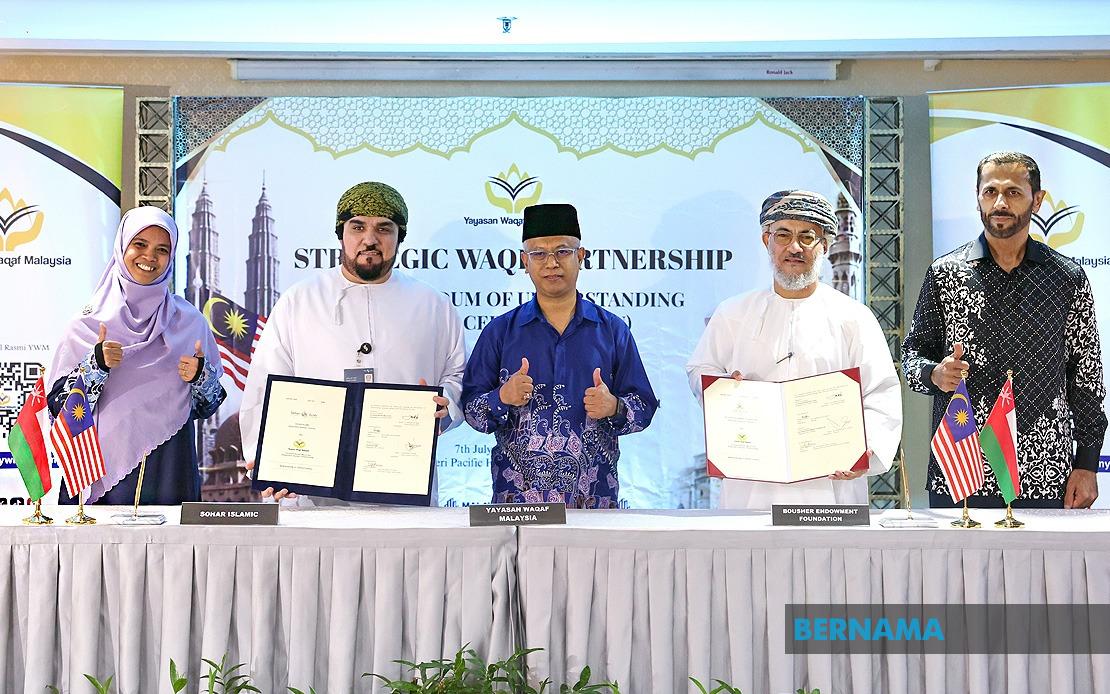
Malaysia is consolidating its standing as a centre of excellence in waqf development through a freshly inked collaboration with two prominent Omani financial institutions, signalling the country's broadening influence in Islamic social finance across the Arabian Peninsula. The Malaysian Waqf Foundation (YWM) has signed a memorandum of understanding with Sohar Islamic and the Boushar Endowment Foundation, cementing a partnership designed to harmonise expertise, facilitate knowledge exchange, and transfer proven governance methodologies between the two nations. The accord underscores how Malaysia's institutional approaches to endowment asset management have attracted notice far beyond its borders, positioning the country as a trusted knowledge partner in a sector increasingly central to Islamic economies.
The formalisation of ties between YWM and its Omani counterparts carries symbolic weight within Malaysia's broader diplomatic and economic objectives. Deputy Minister in the Prime Minister's Department (Religious Affairs) Marhamah Rosli characterised the arrangement as a bilateral milestone that elevates Malaysia's standing internationally whilst benefiting Muslim communities across regions. She noted that such collaborations typically flow in the opposite direction, with Malaysia traditionally importing foreign expertise; this partnership reverses that dynamic, with Malaysian professionals now exporting knowledge about waqf structuring and administration to Gulf state partners. The arrangement demonstrates confidence in Malaysia's institutional capacity and signifies a maturation of the nation's Islamic financial architecture.
Central to the partnership's credibility is the appointment of YWM chief executive officer Dr Ridzwan Bakar as Waqf Adviser to the Sultanate of Oman. This personal credentialing reflects substantive recognition of Malaysia's waqf expertise by Omani leadership and institutions. Rather than a ceremonial role, Ridzwan's advisory position reflects genuine demand for Malaysian insights into productive asset development and endowment governance. He explained that proactive outreach by YWM during visits in 2023 and 2024 created the opening, with Omani counterparts receptive to exploring cooperative ventures. The iterative nature of relationship-building—multiple invitations for advisory engagement, repeated consultations—demonstrates that mutual benefit extends beyond single transactions to sustained institutional partnerships.
YWM's international expansion extends well beyond Oman, with the foundation cultivating networks across multiple Gulf Cooperation Council states. According to Ridzwan, the organisation maintains active partnerships with institutions in Kuwait, Qatar, and the United Arab Emirates, reflecting a deliberate strategy to position Malaysia as a regional thought leader in waqf innovation. This multi-country engagement creates what amounts to a knowledge and investment ecosystem, where Malaysian expertise serves as connective tissue linking Gulf capital with Southeast Asian development opportunities. The cumulative effect elevates Malaysia's soft power in the Islamic financial sector whilst creating channels through which Arab investment can flow into domestic initiatives.
The development of productive waqf assets represents a gateway for attracting substantial strategic investment, particularly from Arab countries with accumulated capital seeking ethical and religiously compliant investment vehicles. Ridzwan articulated how waqf structuring—when coupled with transparent governance and transparent asset management—appeals to investors seeking alignment between financial returns and Islamic principles. By positioning itself as custodian and innovator in this space, Malaysia creates investment corridors that benefit both foreign capital providers and domestic asset development. The strategy recognises that waqf assets, when professionally managed and allowed to generate returns, can catalyse broader economic strengthening across the country.
YWM currently operates three investment products through Kenanga Investors, functioning as platforms designed to attract international capital into Malaysian waqf initiatives. These vehicles represent the practical infrastructure through which abstract partnerships translate into capital flows. Rather than theoretical frameworks, the existence of established investment products with demonstrated track records makes Malaysia's waqf ecosystem tangible and investable for Gulf-based institutions. The products serve a dual function: they provide Malaysian asset managers with access to international capital pools whilst offering foreign investors exposure to Islamic social finance initiatives conducted under transparent governance standards. This infrastructure advantage partly explains why Omani and other Gulf institutions view Malaysian partnership as valuable.
The collaborative framework emphasises knowledge transfer and best-practice sharing in waqf governance and management—domains where Malaysia has developed institutional sophistication. Waqf administration requires balancing multiple objectives: preserving asset principal, generating sustainable returns, ensuring equitable distribution to beneficiaries, maintaining Islamic compliance, and adapting to evolving market conditions. Malaysia's institutional experience across these dimensions provides concrete methodologies that Omani partners can adapt to local contexts. Rather than imposing standardised models, effective knowledge transfer involves understanding how Malaysian approaches function within their institutional and regulatory environment, then identifying principles and practices applicable to Omani circumstances.
The ultimate objective extends beyond institutional prestige to tangible community benefit. Ridzwan emphasised that waqf asset development should be understood as foundation-building work that precedes—and enables—expanded charitable distribution. The conventional framing of waqf emphasises immediate charitable disbursement; Ridzwan reframed this as a longer-term economic strategy. By developing waqf assets through productive investment, the endowment base grows, generating larger sustainable returns that eventually benefit broader population segments. This approach explicitly targets not only traditional asnaf categories (religious scholars, the poor, and other prescribed beneficiary groups) but also middle-income households in the B40 and M40 income ranges. The partnership thus reflects contemporary thinking about how Islamic social finance can contribute to inclusive economic development rather than merely supplementing welfare provision.
For Malaysia, the Oman partnership carries implications beyond the immediate financial relationship. It validates the regulatory and governance frameworks that Malaysian authorities have constructed around waqf administration, signalling to other Islamic financial centres that Malaysia's institutional infrastructure merits emulation. As Gulf states increasingly prioritise Islamic social finance and sustainable development objectives, Malaysia's demonstrated expertise becomes a competitive asset in positioning itself as a preferred partner for capacity-building and knowledge exchange. The partnership strengthens Malaysia's narrative as a bridge economy—connecting Muslim-majority Asian nations with Arab financial centres whilst positioning Southeast Asia as a serious participant in global Islamic finance discussions.
Moreover, the collaboration exemplifies how Malaysian institutions can assert leadership in niche sectors where domestic expertise has developed significant depth. Rather than remaining a taker of international standards and practices, Malaysia increasingly shapes regional approaches to Islamic financial innovation. The Oman partnership demonstrates that this leadership is recognised by peer institutions in geographically and culturally proximate regions, validating Malaysia's institutional development path. As other Muslim-majority countries consider modernising their waqf systems, Malaysia's growing track record of international partnerships and advisory engagements positions the country as a natural destination for study, imitation, and collaboration.
The memorandum of understanding signed by Ridzwan, Sohar Islamic's Fahad Akbar Al Zadjali, and Boushar Endowment Foundation chairman Malik Hilal Al Yahmadi, witnessed by Marhamah and Omani Deputy Head of Mission Mohamed Najeeb Al Bulushi, formalises commitments that will likely unfold over years. Initial phases will likely focus on diagnostic assessments of Omani waqf structures, identification of reform opportunities, and piloting of specific Malaysian methodologies within Omani contexts. Success will depend on sustained engagement, willingness by both parties to adapt approaches to local circumstances, and commitment to measuring outcomes in terms of actual community benefit rather than merely institutional recognition. The partnership's long-term significance will ultimately rest not on the prestige of signing ceremonies but on whether collaborative arrangements translate into improved waqf governance, expanded asset bases, and demonstrable benefits flowing to intended beneficiaries across Oman and Malaysia.

