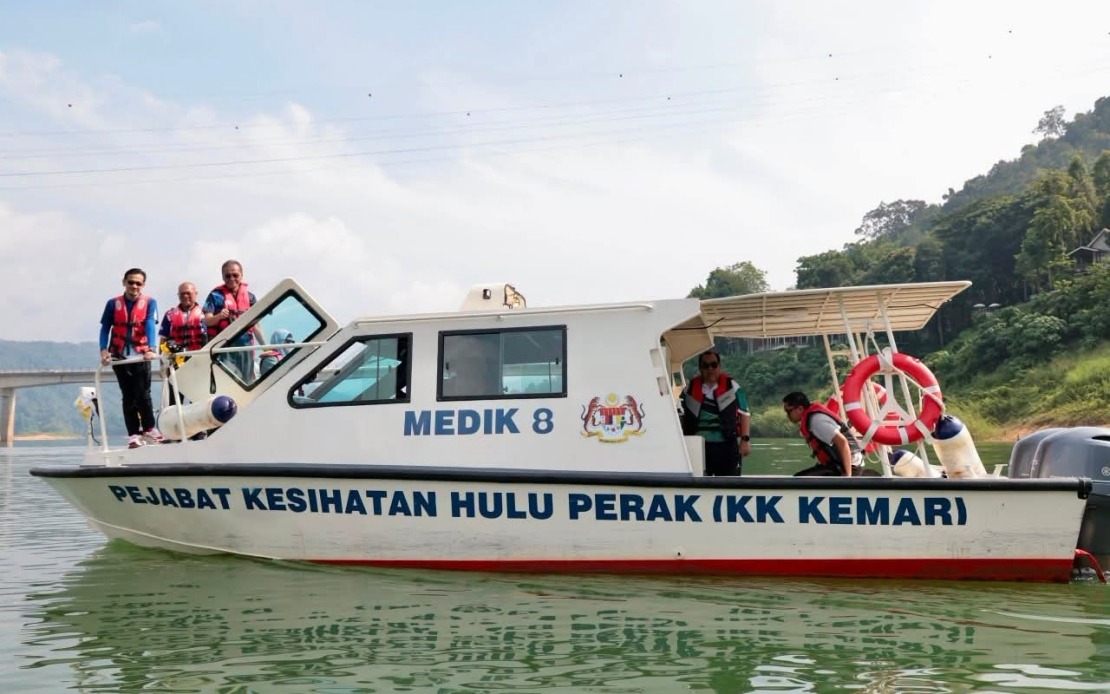
The Ministry of Health has taken a significant step towards bridging the healthcare gap for indigenous communities by commissioning Medic Boat 8, a RM350,000 multipurpose vessel designed to serve the Kemar Resettlement Scheme in Gerik, Hulu Perak. Health Minister Datuk Seri Dr Dzulkefly Ahmad launched the service at Belum Rainforest Resort jetty, marking an expansion of the government's commitment to ensuring that geography and terrain do not determine access to medical treatment for Malaysia's most vulnerable populations.
The boat represents a critical addition to the Ministry's existing fleet of six vessels. For the more than 4,500 Orang Asli residents who inhabit the Kemar area, waterways serve as the primary lifeline connecting dispersed settlements to the outside world. This reality underscores why traditional road-based healthcare infrastructure falls short in addressing their medical needs. The 12-passenger capacity of Medic Boat 8 enables the simultaneous transport of patients, medical personnel, and essential equipment through terrain where conventional ambulances cannot venture.
The initiative gains particular significance within the broader policy framework of Malaysia MADANI, the government's development agenda centred on equitable access to public services. Health Minister Dr Dzulkefly Ahmad explicitly articulated this principle in his comments, stating that challenging geography should never impede healthcare delivery. This declarative commitment reflects a recognition that indigenous and remote communities have historically experienced systemic inequities in medical access—a pattern that persists across Southeast Asia's developing regions.
Expanding boat-based services also reduces emergency response times substantially. Traditionally, Orang Asli residents experiencing medical crises faced extended delays waiting for overland routes to become accessible, particularly during monsoon seasons when river conditions render certain routes impassable. The dedication of a dedicated medical vessel with trained operators fundamentally transforms the speed and reliability with which urgent cases can reach treatment facilities in larger towns.
The operational dimension of this service depends entirely on personnel commitment. Healthcare workers—encompassing doctors, nurses, and boat operators—must navigate unpredictable river currents, monsoon conditions, and logistical challenges that few medical professionals elsewhere in Malaysia routinely confront. The Minister's acknowledgement of these frontline workers reflects the often-underestimated human factor in delivering healthcare to marginalised communities. Their willingness to operate under adverse conditions constitutes the practical foundation upon which policy commitments rest.
This expansion forms part of a gradual but incomplete transformation in how Malaysia addresses healthcare disparities among indigenous populations. The Orang Asli, numbering roughly 180,000 across the peninsula, have historically experienced higher rates of communicable diseases, maternal mortality, and preventable illnesses compared to general population averages. Structural barriers including distance, transport infrastructure deficits, and economic constraints have perpetuated these health inequalities. Boat services, while innovative within Malaysia's context, represent one tool among many needed to close these gaps comprehensively.
The economic investment warrants consideration within broader healthcare budgeting priorities. A RM350,000 vessel serves a population of 4,500, yielding a per-capita infrastructure cost that would be considered exceptional in urban settings. Yet this expenditure reflects the genuine marginal cost of delivering equitable services across diverse geographies. Without such targeted investment, the implicit message would be that remote indigenous communities warrant lesser healthcare infrastructure despite facing greater health risks and fewer alternative options.
Peering beyond Hulu Perak, this model carries relevance for other Malaysian regions with dispersed indigenous populations and water-dependent access patterns. Sabah and Sarawak, where indigenous communities constitute substantial portions of the interior population, face comparable geographical constraints. The Medic Boat programme's expansion could inform similar initiatives across East Malaysia, where river systems similarly dominate transport networks and healthcare infrastructure remains inconsistently distributed.
The launch also signals official recognition that healthcare access constitutes a fundamental development indicator. International development frameworks and sustainable development goals increasingly emphasise universal health coverage and equitable service distribution as markers of genuine national progress. Malaysia's investment in indigenous healthcare infrastructure, however incremental, aligns the country's practical policies with these internationally benchmarked commitments.
Looking forward, the sustainability of such services requires sustained funding beyond launch announcements. Maintenance of the vessel, recruitment and retention of trained operators, fuel costs, and equipment replacement represent ongoing expenditures that must be integrated into permanent health ministry budgets rather than treated as one-off allocations. The Kemar community's continued access to emergency medical services ultimately depends on securing these recurrent resources across multiple budget cycles.
The introduction of Medic Boat 8 also underscores the necessity for integrated healthcare planning that begins with understanding community geography rather than imposing standardised templates. Indigenous communities in Hulu Perak have evolved distinct patterns of settlement, livelihood, and movement shaped by centuries of adaptation to riverine environments. Healthcare systems that respect rather than override these realities demonstrate higher effectiveness and community trust. The boat service exemplifies this principle of fitting medical infrastructure to actual community needs rather than vice versa.
As Malaysia continues navigating the transition toward developed-nation status, ensuring that progress reaches remote and indigenous communities remains both a moral imperative and a practical requirement for national cohesion. Initiatives like Medic Boat 8, while relatively modest in financial terms, carry symbolic and substantive significance. They demonstrate that government institutions can adapt their operational models to serve populations whose circumstances diverge from urban norms, creating foundations upon which more comprehensive indigenous health equity can be progressively constructed.

