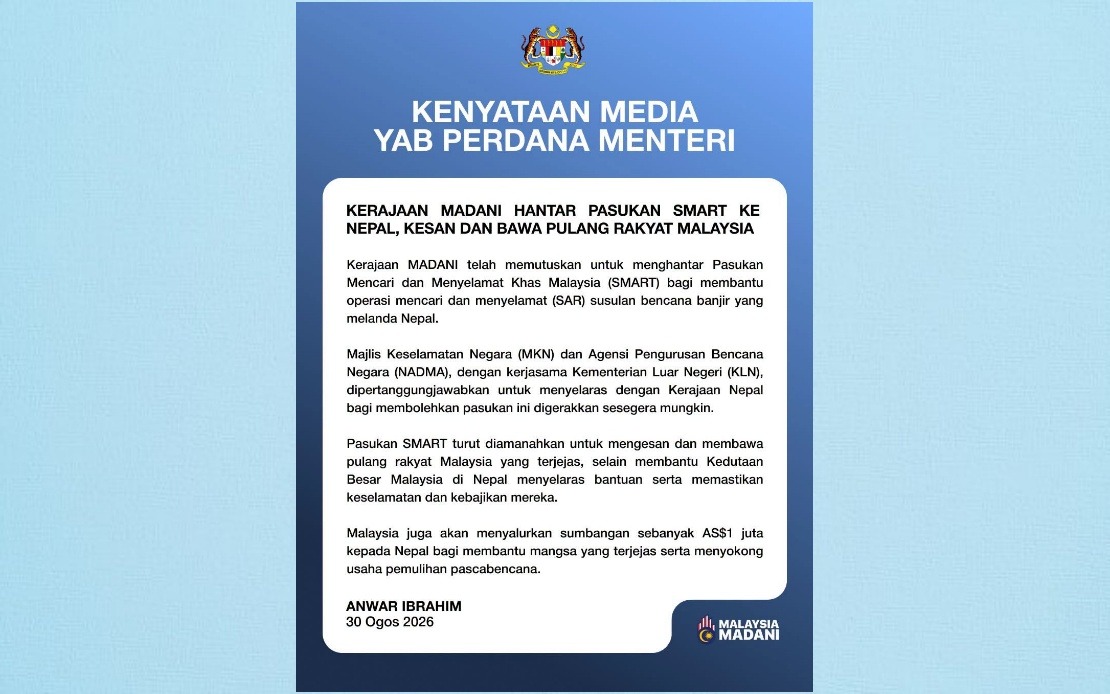
Malaysia's government has committed to a comprehensive humanitarian response to the natural disaster that has ravaged parts of Nepal, with the deployment of specialized personnel and substantial financial assistance marking a significant show of regional solidarity. Prime Minister Datuk Seri Anwar Ibrahim announced on August 30 that the country would dispatch the Special Malaysian Disaster Assistance and Rescue Team (SMART) to support search and rescue operations in the aftermath of catastrophic flooding that struck the Himalayan nation. The decision reflects Malaysia's broader commitment to assisting neighbours during times of crisis and underscores the interconnectedness of the region's disaster response frameworks.
The coordination of this deployment involves multiple layers of Malaysia's government apparatus, demonstrating the institutional seriousness with which the crisis is being treated. The National Security Council and the National Disaster Management Agency have been tasked with working alongside the Foreign Ministry to liaise with Nepalese counterparts and ensure the swift mobilization of the SMART team. This multi-agency approach is designed to streamline communication channels and eliminate bureaucratic delays that might otherwise hinder rapid international response. The Malaysian Embassy in Kathmandu and other diplomatic facilities are playing a crucial logistical role in facilitating the team's arrival and integration with local relief efforts.
Beyond the operational deployment of rescue personnel, Malaysia's contribution extends to the critical humanitarian mission of locating and assisting Malaysian nationals caught in the disaster zone. The Foreign Ministry had previously confirmed that 55 Malaysians had become unreachable following the catastrophic flash floods and landslides that devastated Rasuwa district on August 26. The SMART team carries the responsibility of not only participating in broader search and rescue operations but also specifically targeting these missing citizens, ensuring they receive appropriate assistance and are returned home safely. This dual mandate reflects the government's recognition of its obligation to protect its own citizens while simultaneously contributing to the welfare of Nepal's broader population.
The financial contribution announced by Prime Minister Anwar Ibrahim represents a concrete commitment to Nepal's recovery trajectory in the medium and longer term. The US$1 million pledge is structured to address both immediate humanitarian needs and the post-disaster reconstruction phase that Nepal will face as it assesses the full extent of damage. Such assistance typically flows through multiple channels, including direct government-to-government transfers, contributions to international relief organizations, and support for displaced persons' rehabilitation programmes. The timing of this announcement, made within days of the disaster, signals Malaysia's willingness to act decisively rather than waiting for more comprehensive damage assessments.
The disaster itself reflects the vulnerability of Himalayan communities to extreme weather events, particularly during monsoon seasons when precipitation intensifies the risk of flooding and terrain-triggered hazards. Rasuwa district, located north of Kathmandu, sits in terrain prone to rapid water accumulation and landslide initiation when subjected to heavy rainfall. The scale of destruction—forcing Malaysian authorities to account for dozens of uncontactable citizens—suggests the flooding was not a localized phenomenon but rather a region-wide calamity affecting multiple communities. These patterns are relevant to Malaysian policymakers and disaster management professionals, as climate projections suggest intensifying extreme weather events across South and Southeast Asia, necessitating ever-more sophisticated regional cooperation frameworks.
Malaysia's deployment of SMART personnel carries significant operational implications for how the country positions itself within regional disaster response architecture. The SMART team has established capabilities and experience in international deployments, having participated in relief efforts following other major calamities across Asia. Their presence in Nepal will provide technical expertise in coordinating rescue efforts, managing logistics in challenging terrain, and operating within frameworks established by Nepalese authorities and international organizations. The team's composition typically includes personnel trained in search techniques, medical support, and coordination functions, allowing them to add meaningful capacity to overextended local authorities.
The broader context of Malaysia-Nepal relations has been characterized by limited but functional diplomatic engagement, and this disaster response represents an opportunity to deepen bilateral connections. Historically, Malaysia's most intensive regional disaster assistance has been concentrated within ASEAN frameworks, but the country has increasingly recognized the value of humanitarian outreach beyond immediate geographic proximity. The Nepal response demonstrates that considerations of humanitarian need can transcend traditional regional bloc limitations. This approach aligns with Malaysia's broader foreign policy positioning as a responsible middle power with interests in global stability and regional cooperation.
The coordination mechanisms being activated for this response—involving national security infrastructure, civilian disaster management agencies, and diplomatic channels—showcase institutional preparedness that Malaysia has developed through experience with its own natural disasters and previous international deployments. The National Disaster Management Agency has evolved into a more sophisticated organization over recent years, enabling it to manage complex cross-border operations more effectively than might have been possible in earlier periods. This institutional capacity is particularly valuable when working with international partners who expect coordinated, professional responses from contributing nations.
For Malaysian citizens currently stranded or unaccounted for in Nepal, the government's response provides direct reassurance that official efforts are being mobilized on their behalf. The involvement of the diplomatic mission in coordinating the safety and welfare of affected nationals ensures that consular services operate in tandem with rescue operations. Families of missing Malaysians will likely find some reassurance in the announcement of dedicated efforts to locate their relatives, though the challenging terrain and ongoing weather conditions in Rasuwa district present significant obstacles to rapid resolution.
The financial contribution must be understood within Malaysia's broader aid allocation framework and its evolving approach to international development assistance. While US$1 million represents a meaningful gesture, it is modest relative to Malaysia's overall economic capacity, suggesting a carefully calibrated response that demonstrates commitment while managing fiscal constraints. The funds will likely be administered through established bilateral channels or international mechanisms, ensuring they reach intended beneficiaries efficiently. Nepal's government will face the substantial challenge of managing reconstruction across multiple affected areas, and international contributions from partners like Malaysia provide essential supplementary resources to national recovery efforts.
Regional observers will note that Malaysia's response fits within patterns of growing South-South cooperation and mutual assistance among developing nations in Asia. Rather than waiting for Western-led international relief mechanisms to dominate the response, Malaysia has moved proactively to establish its own contribution framework. This approach reflects broader trends toward regional self-reliance in disaster management and development cooperation. The SMART team deployment, in particular, demonstrates that capabilities built through domestic experience can be effectively internationalized when political will exists to commit resources.
Looking forward, the effectiveness of Malaysia's response will depend on seamless coordination with Nepalese authorities, the rapid deployment of personnel given logistical constraints, and the efficient delivery of financial assistance. The coming weeks will reveal how successfully the SMART team can operate within Nepal's disaster response infrastructure and whether the identified missing Malaysians can be located and supported. For Malaysia's government, the operation represents both a humanitarian imperative and an opportunity to demonstrate institutional competence in managing international crises, factors that will influence how regional and international actors perceive the country's capacity for future collaborative efforts.

