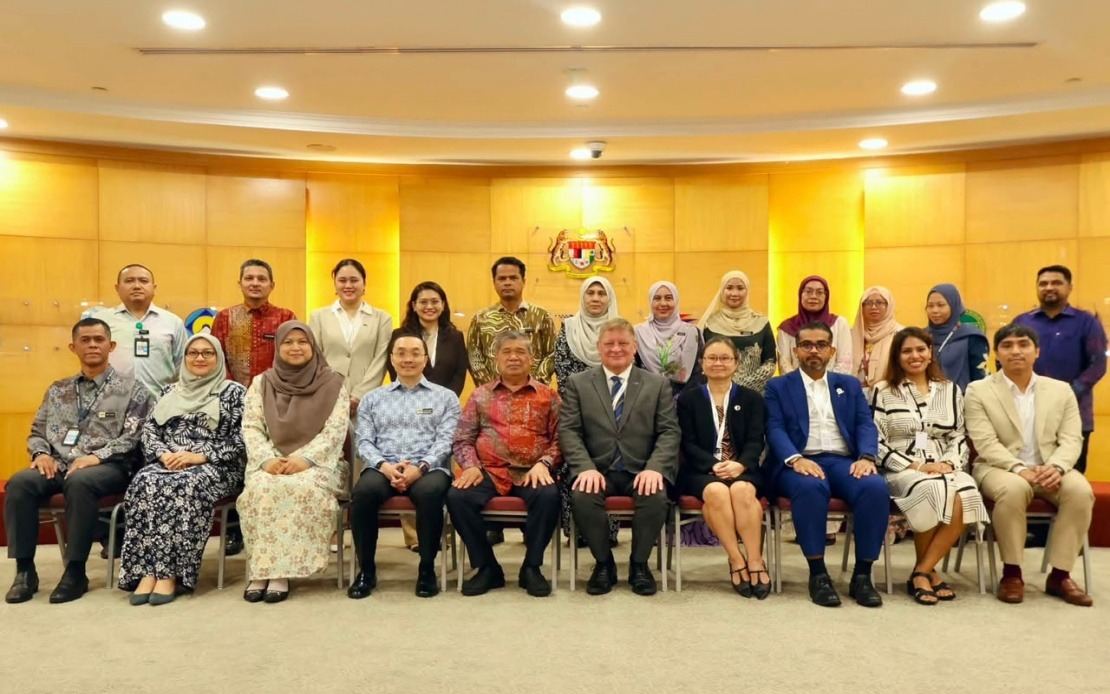
Minister of Agriculture and Food Security Datuk Seri Mohamad Sabu held substantive discussions with Chris Humphrey, executive director of the EU-ASEAN Business Council, and accompanying delegates at the ministry's headquarters in Putrajaya yesterday, signalling Malaysia's commitment to leveraging European expertise in agricultural modernisation. The encounter underscores the growing strategic importance of European partnerships in addressing Malaysia's medium-term food security objectives and technological advancement in farming systems.
The dialogue centred on four interconnected policy priorities that reflect Malaysia's evolving approach to agricultural development. The implementation of the National Agro-Food Policy 2.0, commonly referred to as DAN 2.0, featured prominently in discussions, with both sides recognising its potential to enhance food production resilience and self-sufficiency. Complementing this, the integration of cutting-edge agricultural technologies and Artificial Intelligence applications emerged as a cornerstone for productivity improvements across Malaysia's farming landscape, acknowledging that technological solutions remain essential to competing in regional and global markets.
Beyond policy frameworks, the meeting addressed tangible sectoral challenges requiring collaborative solutions. Strengthening Malaysia's domestic dairy supply chain—an area where the nation has historically relied on imports—received particular attention, reflecting government efforts to reduce food import dependency. Equally significant were discussions around elevating animal health standards and biosecurity protocols, dimensions increasingly critical as Malaysia navigates evolving trade requirements and disease prevention challenges in livestock production.
Minister Mohamad emphasised that the European Union occupies a strategically vital position within Malaysia's agricultural transformation roadmap, functioning simultaneously as a significant trading partner and technological innovator. The minister characterised European engagement as instrumental to Malaysia's broader ambition of reshaping its agri-food ecosystem towards greater sustainability, climate resilience, and technological sophistication—objectives that resonate strongly with regional development priorities across Southeast Asia and align with Malaysia's commitment to carbon-neutral growth.
The timing of this engagement reflects Malaysia's recognition that global headwinds—encompassing persistent food security pressures, accelerating climate impacts, and continuing supply chain vulnerabilities—necessitate deepened international cooperation. By positioning European partners as collaborators in addressing these systemic challenges, Malaysia signals its readiness to embrace knowledge transfer and invest in capacity building mechanisms that strengthen the broader agri-food value chain.
A central dimension of the discussions involved Malaysia's expectation that European enterprises will maintain robust engagement in supporting local agricultural professionals. The minister specifically highlighted the importance of European companies furnishing continuous backing for farmer and breeder capability development, particularly regarding compliance with international quality benchmarks, Sanitary and Phytosanitary standards, market identification, and trade facilitation infrastructure. Such support mechanisms remain crucial for Malaysian agricultural producers seeking to access premium European markets and navigate complex certification requirements.
Both delegations voiced mutual commitment to advancing the Malaysia-European Union Free Trade Agreement negotiations currently underway, recognising that a comprehensive trade accord would provide a durable framework for agricultural commerce and investment flows. The MEUFTA negotiations carry particular significance for Malaysian agribusiness stakeholders, as they offer potential pathways to expanded market access while establishing clearer investment protocols for European technology and capital flows into domestic agriculture.
The ministry underscored the necessity for deeper strategic cooperation linking European corporations with Malaysian counterparts, particularly regarding technological solutions that can modernise supply chain operations across production, processing, and distribution phases. Such collaboration is envisioned as essential to sustaining adequate food availability for Malaysia's population while simultaneously enhancing export competitiveness and value creation within the agri-food sector. The emphasis on strategic partnerships reflects understanding that technological gaps require external expertise and investment rather than solely domestic capability development.
Minister Mohamad utilised the occasion to extend an invitation to the EU-ABC delegation to participate in the Agriculture, Horticulture and Agro-Tourism Exhibition scheduled for 28 August through 6 September 2026 at the Malaysia Agricultural Expo Park in Serdang, Selangor. MAHA 2026 represents a significant platform for showcasing domestic agricultural innovations and attracting international interest in Malaysia's food production capabilities, making European participation particularly valuable for networking and business development opportunities. The invitation reflects Malaysia's strategy to position such exhibitions as focal points for international engagement and sectoral dialogue within the Southeast Asian region.

