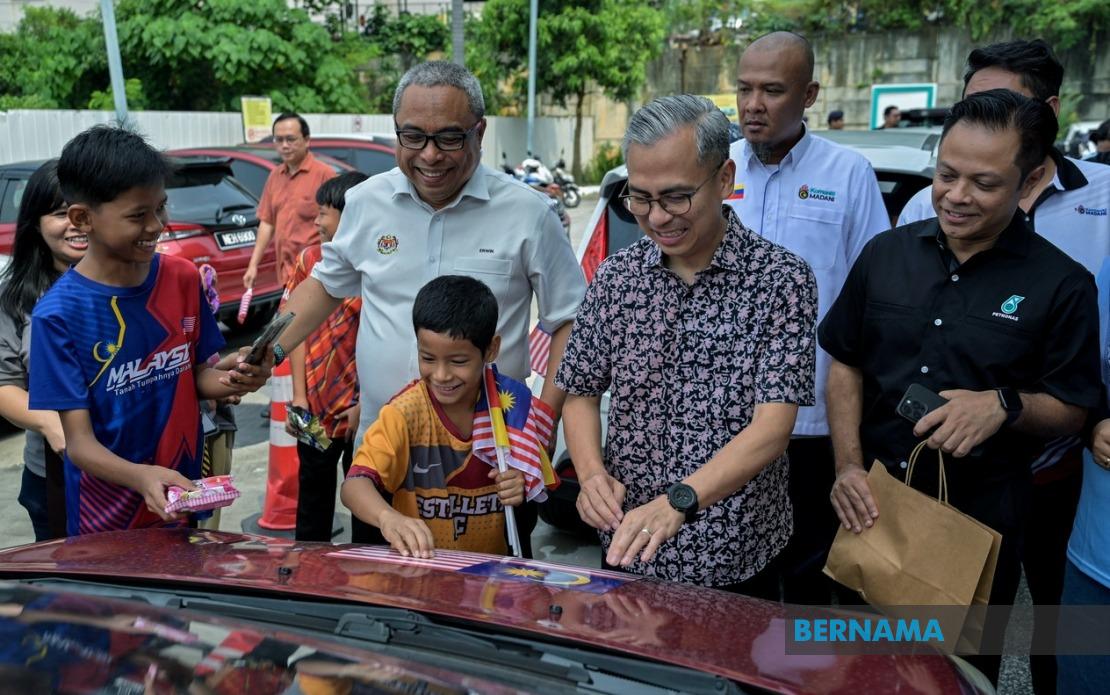
Malaysia will celebrate Malaysia Day 2026 in Kuching, with the Borneo Convention Centre Kuching selected as the venue for the national occasion. Communications Minister Datuk Seri Fahmi Fadzil made the announcement following the inaugural planning session for the event, which brought together federal organizers and Sarawak's leadership to chart the course for next year's festivities. The decision reflects a deliberate shift in how the nation marks this significant date, taking the celebration beyond the traditional concentration in Peninsular Malaysia and into the heart of East Malaysia, where Malaysia's formation is uniquely resonant.
The venue selection process has already undergone practical assessment to ensure its suitability. Fahmi explained that the Borneo Convention Centre possesses comparable spatial capacity to the PICCA Convention Centre in Butterworth, which served as the backdrop for last year's Malaysia Day observance. This benchmarking approach demonstrates the government's effort to maintain consistent standards for the national celebration while adapting to different geographical contexts. The centre's infrastructure and facilities have been deemed adequate to accommodate the expected scale of participants, performers, and attendees, though detailed logistical coordination remains underway.
Sarawak's role as co-host carries particular significance for Malaysia's federal balance. Datuk Seri Abdul Karim Rahman Hamzah, the state's Minister for Tourism, Creative Industry and Performing Arts, has been appointed as co-chairman of the Malaysia Day celebrations, positioning Sarawak as an equal partner in organizing the event rather than merely a host location. This collaborative arrangement reflects an acknowledgment that Malaysia Day, celebrated on September 16, commemorates the formation of the Malaysian federation through the union of Malaya, Singapore, Sabah, and Sarawak in 1963. By anchoring the 2026 celebration in Kuching, the government signals recognition of the eastern states' integral place within Malaysia's constitutional and historical narrative.
The planning timeline indicates a methodical approach to event preparation. Fahmi confirmed that organizers will reconvene on August 24 to delve deeper into the specific arrangements, suggesting that while the venue decision is settled, considerable groundwork remains on programming, security, transportation, and ceremonial elements. Such sequential planning meetings allow stakeholders to address emerging challenges and coordinate across different government agencies and private partners. The compressed timeframe between now and the 2026 celebration underscores the importance of establishing momentum early to ensure the event reflects Malaysia's ambitions for national unity and pride.
Concurrently, the government has moved to enhance public participation in the National Day celebration scheduled for August 31 in Putrajaya. Prasarana Malaysia Bhd, the public transport operator, has committed to maintaining round-the-clock transit services during this period, marking a substantive operational improvement. This decision carries implications extending far beyond mere convenience; it removes a practical barrier that has historically limited attendance, particularly for citizens travelling from distant locations who might otherwise hesitate to journey to Putrajaya due to constraints on return travel. The extension of service hours recognizes that patriotic participation should not be contingent on access to private vehicles or expensive accommodation.
The transport enhancement strategy reflects broader infrastructure improvements being undertaken in conjunction with the August 31 celebrations. Fahmi indicated that multiple facility upgrades are proceeding across the Putrajaya venue, demonstrating a holistic approach to preparing the capital for the influx of visitors and participants. These improvements carry spillover benefits beyond the single day of celebration, as enhanced infrastructure typically continues to serve the broader public long after the specific event concludes. The government's framing of these measures as facilitating not only arrival but also departure suggests recognition that the attendee experience encompasses the entire journey cycle.
The implications for Malaysian citizens are multifaceted. First, the selection of Kuching for Malaysia Day 2026 affirms that national celebrations need not always gravitate toward Peninsular Malaysia's major cities. Second, enhanced transportation infrastructure in Putrajaya for the August 31 National Day demonstrates responsiveness to practical barriers to civic participation. Third, the emphasis on coordination between federal and state governments, evident in Sarawak's co-chairmanship role, projects an image of cooperative federalism. For Southeast Asian observers, the decisions underscore Malaysia's commitment to territorial inclusion and the recognition that national identity formation involves the equitable representation of all constituent regions.
The messaging behind these announcements also carries subtle political weight. By expanding the geographic scope of major national celebrations and improving accessibility for ordinary citizens, the government positions itself as inclusive and forward-thinking. The logistics of hosting such events in different locations requires sustained coordination, investment, and planning—demonstrating governmental capacity and commitment to citizen engagement beyond rhetorical levels. For Sarawak specifically, the opportunity to host Malaysia Day validates the state's historical importance and contemporary relevance within the federation.
Looking ahead, the success of these celebrations will likely set precedents for future Malaysia Day observances. Should the 2026 Kuching event proceed smoothly and garner strong participation, it could establish a rotating or distributed model for national celebrations, preventing them from becoming institutionalized in specific venues. Such an approach would align with modern governance principles emphasizing inclusive representation and equitable resource distribution across all states. The enhanced transport arrangements for the August 31 celebrations, if they prove effective, may similarly become standard features for all major national gatherings, fundamentally shifting how Malaysians experience their civic occasions.

