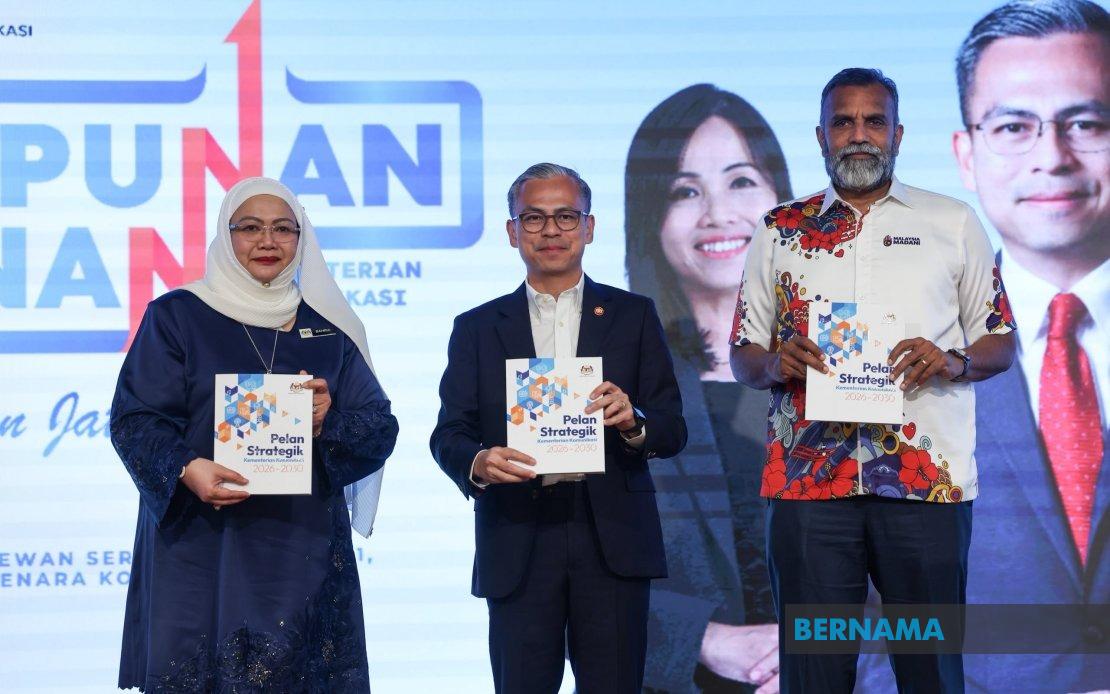
Malaysia's Communications Ministry has announced an ambitious five-year strategic blueprint designed to align the country's digital and media infrastructure with the broader aspirations of the 13th Malaysia Plan and the Malaysia MADANI governance framework. Communications Minister Datuk Seri Fahmi Fadzil formally launched the Communications Ministry Strategic Plan (PSKK) 2026-2030 in Putrajaya, marking a consolidated approach to addressing persistent challenges across the telecommunications, media, and information sectors that have long occupied centre stage in public discourse.
The strategic framework distils the ministry's mandate into three foundational priorities that reflect both immediate citizen concerns and long-term national competitiveness. These pillars—universal broadband access, the cultivation of distinctive creative content, and the establishment of trustworthy information ecosystems—represent a deliberate pivot toward addressing what Fahmi characterised as the most commonly articulated grievances raised by the public and stakeholders with the ministry and its constituent agencies. This responsiveness to constituent feedback underscores an acknowledgment that digital infrastructure and media governance remain politically sensitive domains where tangible improvements directly affect public satisfaction and national development outcomes.
Underpinning these three priorities is an expansive operational architecture comprising 94 individual strategic programmes distributed across four strategic thrusts. This granular approach signals the ministry's intent to move beyond rhetorical commitments toward measurable implementation benchmarks. The first strategic thrust concentrates on fortifying the national communications infrastructure to ensure that connectivity remains inclusive, maintains high quality standards, and incorporates robust security safeguards—a particularly acute concern in Southeast Asia where digital divide patterns persist across urban-rural divides and socioeconomic strata. The second thrust targets the competitive positioning of Malaysia's film and music industries on global markets, recognising the creative economy as a genuine engine for employment, foreign exchange generation, and soft power projection.
The third strategic thrust addresses information delivery frameworks through an integrated lens, moving away from siloed approaches toward coordinated dissemination strategies that can counteract misinformation while promoting institutional transparency. This dimension carries particular significance given regional experiences with digital disinformation campaigns and the erosion of institutional credibility through strategic falsehoods. The fourth thrust reorients service delivery protocols to ensure government agencies and the ministry itself operate with heightened responsiveness to citizen needs and public policy priorities, reflecting broader administrative modernisation imperatives across Southeast Asia.
The overarching vision articulated through this strategic plan—"A Connected, Informed and Creative Malaysia"—encapsulates aspirations that extend beyond the communications portfolio itself. Enhanced connectivity underpins digital economic participation, financial inclusion, and educational access across dispersed populations. An informed citizenry equipped with reliable information channels serves as a prerequisite for democratic accountability and social cohesion. A thriving creative ecosystem generates employment, attracts foreign investment, and positions Malaysia as a regional cultural hub capable of competing with established content production centres in Asia.
For Malaysian readers and businesses, this strategic plan carries tangible implications. The emphasis on universal, high-quality, secure connectivity suggests accelerated roll-out timelines for broadband infrastructure in underserved areas, potentially reshaping economic opportunities in rural and semi-urban zones. Small and medium enterprises dependent on digital platforms stand to benefit from a policy environment explicitly geared toward enhancing internet reliability and accessibility. The creative industries thrust creates potential pathways for local talent to access structured support systems, funding mechanisms, and market development initiatives previously fragmented across multiple agencies.
The strategic plan's focus on information integrity represents a more subtle but equally consequential commitment. By elevating authentic information dissemination to ministerial priority status, the framework acknowledges that digital societies require active institutional stewardship to maintain informational commons against deliberate contamination. This carries particular resonance in the Malaysian context, where election cycles, interethnic relations, and policy debates frequently become battlegrounds for competing narratives and coordinated disinformation efforts. The plan's emphasis on inclusive information delivery also signals an intention to reach populations that might otherwise remain marginalised from official communications.
Regionally, Malaysia's articulation of this communications strategy contributes to broader ASEAN discourse on digital governance. Neighbouring countries grappling with similar challenges—digital divides, content industry development, information ecosystem resilience—may observe the implementation of these programmes as instructive examples. The integration of connectivity, creative content, and information integrity within a unified strategic framework offers a more holistic model than purely sectoral approaches that treat telecommunications infrastructure and media policy as discrete domains.
The ministry's acknowledgment that programmes are already being implemented in accordance with this strategic plan suggests that the PSKK 2026-2030 functions partly as a formalisation and coordination mechanism for initiatives already underway, rather than a wholesale departure from existing trajectories. This incremental approach reduces implementation risk while providing clearer performance measurement frameworks against explicitly stated objectives. Fahmi's confidence that the plan will address the preponderance of complaints historically directed at the ministry hinges on effective execution across 94 disparate programmes—a coordination challenge that will require sustained political commitment and adequate resource allocation across a five-year period spanning multiple election cycles.
The strategic plan's success will ultimately be measured not by its comprehensiveness on paper but by tangible improvements in connectivity speed and reliability, the emergence of Malaysian content capturing regional and international audiences, and measurably enhanced public trust in official information sources. These outcomes remain subject to factors beyond the ministry's direct control, including private sector investment decisions, international geopolitical currents affecting digital supply chains, and the organic evolution of consumer preferences and technological standards. Nevertheless, the publication of this structured, multi-year strategic framework represents a necessary first step toward coherent, evidence-based communications governance aligned with Malaysia's development aspirations through 2030.

